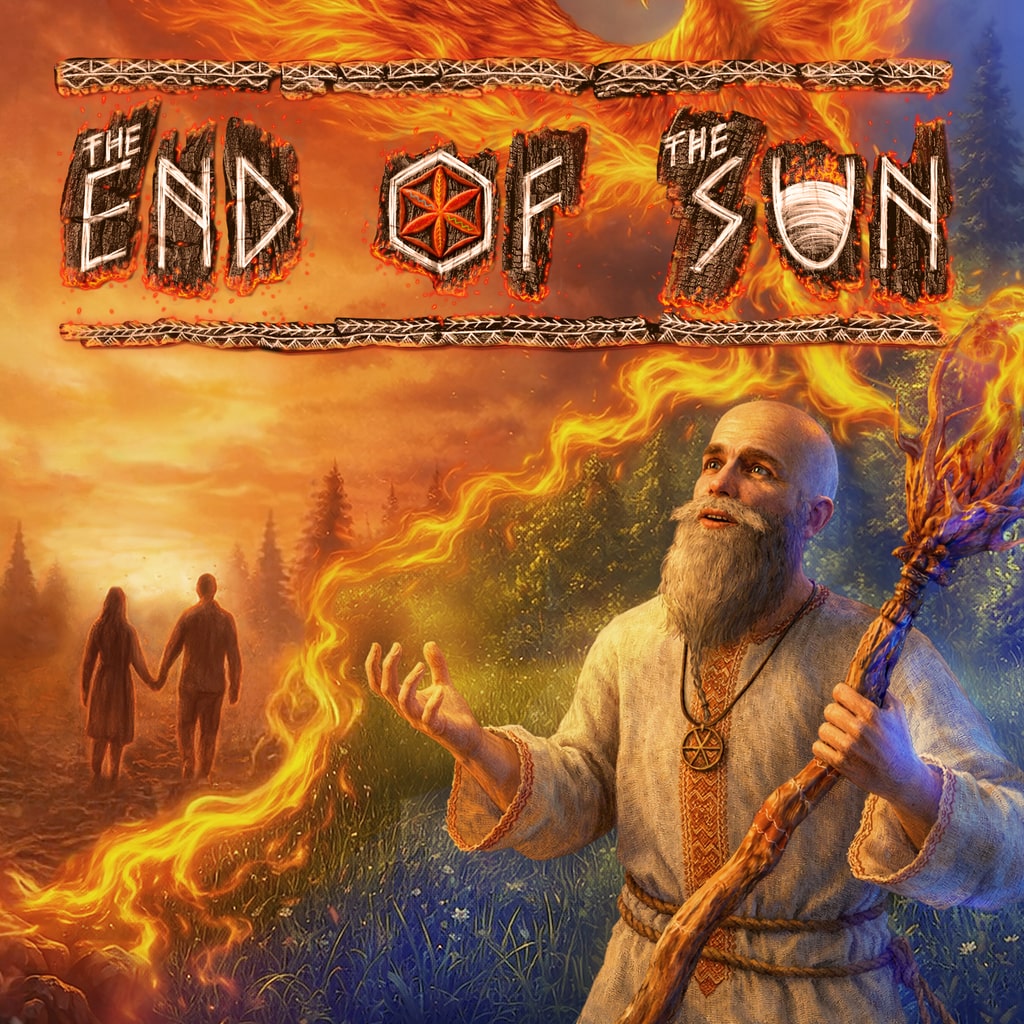
There are games that build worlds, and then there are games that preserve them—carefully, deliberately, almost reverently. The End of the Sun, developed by the two-person team at The End of the Sun Forge and published by IMGN.PRO, belongs firmly in the latter category.
Now arriving on PlayStation 5 in 2026, after its original PC release, this first-person mystery adventure is less concerned with spectacle and more with atmosphere, authenticity, and quiet discovery. Built over eight years with extensive research and photogrammetry from ethnographic museums, it is one of the most visually and culturally grounded explorations of Slavic folklore ever attempted in games.
It is also, at times, slow, opaque, and deliberately restrained. But that restraint is part of its identity.
“The End of the Sun is not a game about saving a world—it is about listening to one that has already been forgotten.”
A World of Ash and Memory
You play as the Ashter, a Slavic fire mage who can perceive time through flame. You arrive in a village where something has gone deeply wrong: hearths still smoulder, yet the people are gone, leaving only echoes of lives once lived. Reality itself feels fractured, caught between seasons and timelines.
The narrative is not delivered in conventional form. There are no long expositions or clear quest markers guiding you from A to B. Instead, the story unfolds through environmental clues, reconstructed events, and the act of investigation. You are not simply told what happened—you are asked to piece it together.
This approach gives the game a distinctive rhythm. Progress is slow, deliberate, and often reflective. It encourages observation over action, patience over urgency.
For some players, this will be deeply immersive. For others, it may feel impenetrable.
Fire as Mechanic, Fire as Metaphor
The central mechanic—bonding with bonfires to reveal hidden traces of events—is among the game’s most compelling ideas. Fire is not merely a tool; it is a lens through which reality becomes legible.
By interacting with hearths, you uncover fragments of past lives: echoes of conversations, spectral reenactments, and environmental shifts that hint at larger mysteries. Fully ignited fires serve as gateways to different points in time, allowing you to witness events across seasons and years.
This system gives the game its structure. Exploration is not about filling a map but about understanding the relationships between places, events, and timelines. Each fire you awaken feels like unlocking a chapter of memory.
The idea of time travel is handled with restraint. You are not flung into chaotic alternate realities or paradox-heavy narratives. Instead, time feels layered—like sediment—waiting to be carefully uncovered.
It’s a design that rewards attention to detail and curiosity rather than speed or efficiency.
Investigation Over Action
As an exploration-driven experience, The End of the Sun leans heavily on environmental storytelling and light puzzle-solving. You track mythical beings not through combat or chases, but through observation and deduction.
Riddles are woven into the world rather than set apart from it. You might examine artefacts, interpret seasonal changes, or follow subtle visual cues left in the environment. The satisfaction comes not from mechanical challenge, but from understanding.
There is almost no traditional combat. Instead, tension is created through atmosphere—fog-drenched forests, abandoned villages, and silent structures that feel suspended in time.
This design choice will divide players. Those expecting action or fast-paced gameplay will find the experience minimalist. Those willing to engage with its slower rhythm will find a deeply contemplative adventure.
A Village Built from Reality
Perhaps the most striking aspect of the game is its visual authenticity. Using photogrammetry, the developers have recreated objects, architecture, and textures sourced from real-world ethnographic museums. The result is a world that feels physically grounded, a quality few fantasy games attempt.
Wood feels like wood. Stone feels weathered and heavy. Buildings are not stylised abstractions but reconstructed echoes of real cultural heritage.
This lends the village an unusual emotional weight. Even when nothing is happening, the environment itself feels meaningful. You are walking through something that feels preserved rather than imagined.
Seasonal transitions further enhance this effect. The same locations shift dramatically over time, reinforcing the game’s core theme: impermanence.
Atmosphere and Sound Design
Sound is crucial to maintaining immersion. Ambient noise is subtle yet effective—wind through trees, the distant crackle of a fire, the faint creak of wooden structures. Music is used sparingly, often yielding to silence.
When it appears, it is understated and melancholic, reinforcing the game’s reflective tone rather than dominating it.
The overall effect is meditative. At times, it feels less like playing a game and more like inhabiting a memory.
Where It Struggles
Despite its artistic ambition, The End of the Sun is not without its challenges.
Its pacing is deliberately slow, though it occasionally lapses into sluggishness. The lack of clear direction can make progress feel uncertain, especially in the early stages. While this ambiguity is intentional, it may frustrate players unfamiliar with this design style.
The puzzle structure, while thematically integrated, can also feel uneven. Some investigations are deeply satisfying to unravel, while others rely heavily on obscure environmental clues that are easy to miss.
Additionally, the absence of more dynamic gameplay systems means engagement relies almost entirely on curiosity and atmosphere. If those elements don’t resonate, the experience may feel sparse.
A Quietly Ambitious Work
What makes The End of the Sun remarkable is not its mechanical complexity but its commitment to preservation—of culture, myth, and forgotten ways of life.
It is a game that prioritises authenticity over accessibility and mood over momentum. In doing so, it carves out a rare space in modern gaming: a contemplative, culturally rooted exploration experience crafted with extraordinary care.
It is not trying to compete with mainstream adventure games. It is trying to remember something they often forget.
Final Verdict
The End of the Sun is a slow, atmospheric, and deeply intentional experience. It demands patience and rewards attention, offering a uniquely grounded interpretation of Slavic mythology through exploration and environmental storytelling.
It will not appeal to everyone, but for those willing to embrace its rhythm, it offers something quietly powerful and unlike most contemporary games.