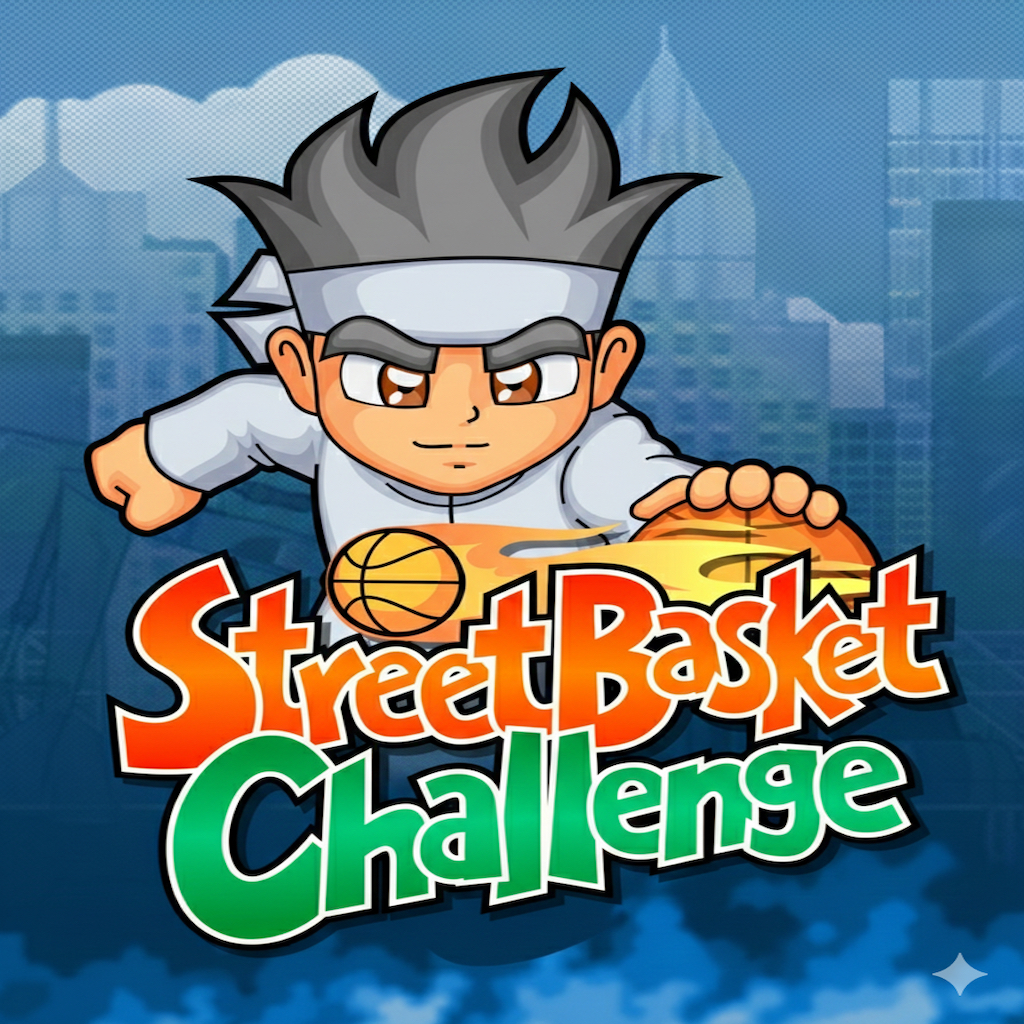
From the moment you step onto its urban courts, Street Basket Challenge presents itself as basketball distilled to its most agile and expressive form: no arenas, no leagues, no national teams—just you, the pavement, and the relentless rhythm of pick-up hoops culture. Developed with an emphasis on speed, style, and one-on-one competitiveness, Street Basket Challenge seeks to capture the essence of street basketball: improvisation, flair, and outplaying your opponent through momentum and cunning rather than systemic simulation. It is a game that prioritises feel over formality, performance over polish, and community energy over structured progression.
Yet this very focus—while offering moments of kinetic brilliance—also defines the game’s limitations. Street Basket Challenge is at its best when it embraces its casual, spontaneous energy; it falters when measured against more structured basketball titles or even within its own stylistic ambitions. This dichotomy shapes the overall experience: explosive and rewarding in bursts, uneven and underdeveloped as a complete package.
The Urban Court and Core Gameplay
At its heart, Street Basket Challenge places players in face-to-face duels on gritty neighbourhood courts, where pick-up basketball takes priority over professional regimentation. Matches are typically short—often two to three minutes per half—and focused on core actions: driving to the hoop, pulling up for jumpers, contesting shots, and executing stylish passes. Controls prioritise accessibility: simple combinations for dribbles and steals, quick inputs for shooting, and directional anticipation rather than complex timing windows.
This design achieves one of the game’s key intentions: immediacy. Enter a match, choose your player, and you are in motion within seconds. The lack of menus cluttering transition, and the fluid movement systems mean there is rarely a sense of interruption or unnecessary friction. Every encounter feels compact and concentrated, mirroring the tight bursts of energy that define real-world street basketball.
Yet this immediacy can also be a double-edged sword. While the game avoids the daunting complexity of simulation titles, it sometimes oversimplifies mechanics to the point where sustained engagement — beyond a few matches — feels repetitive. Dribble moves, while visually expressive, can lack strategic depth; defensive timing, though responsive, rarely demands more than holding a button and jogging backwards. As a result, Street Basket Challenge often feels like a light-to-medium escalation of play rather than a fully realised basketball experience.
Visual Identity and Court Culture
Street Basket Challenge’s visual presentation is one of its most compelling assets. Courts are set against gritty, stylised cityscapes—graffiti-soaked walls, chain-linked fences, and animated crowds that sway to the beat of an energetic soundtrack. Character models have expressive animations that emphasise individuality: wild step-backs, over-the-top celebrations, and exaggerated gestures that reinforce the game’s street-centric personality.
This aesthetic choice serves an important role. Where professional basketball titles often pursue photorealism and statistical accuracy, Street Basket Challenge leans into vibrancy, attitude, and cultural flair. The effect is reminiscent of playground legends and local rivalries—pickup games under streetlamps long after sunset. Visually, the game embraces a caricatured yet affectionate interpretation of street basketball culture, and the soundtrack—driven by pulsing hip-hop rhythms—helps establish tone without overwhelming gameplay.
The energy of the courts and characters helps elevate Street Basket Challenge beyond a bare-bones athletic simulation, yet a closer look reveals that flourish can sometimes mask design gaps. The cityscapes, while atmospheric, are largely decorative: they do not influence play, interact with game systems, or evolve over sessions. Crowd reactions, though lively, are scripted and superficial rather than reactive to gameplay momentum. If the game’s visuals inspire energy, its underlying systems often fail to reciprocate with equivalent depth.
Controls and Mechanics
Mechanics in Street Basket Challenge are designed with accessibility in mind, and it shows. Shooting combines directional input with a simple meter or timing cue; dribbling unlocks special moves through combinations that are easy to remember; defence operates largely through context-sensitive triggers that scale based on positioning rather than intricate timing. The result is a control scheme that most players — even those new to basketball games — can grasp within minutes.
For quick matches and casual play, this simplicity is a strength. The controls rarely get in the way of the action, and responsive inputs help ensure that players feel capable rather than overwhelmed. However, as players strive for mastery, the lack of mechanical depth becomes increasingly apparent. Advanced concepts like weighty passing physics, nuanced shot arcs, pick-and-roll strategy, or stamina-influenced decision trees are either simplified or absent. Defensive AI can be opportunistic but not smart; offensive momentum often hinges on exploiting recurring animation windows rather than reading subtle visual tells.
Nevertheless, there are moments when the mechanics coalesce into something genuinely fun: threading a no-look pass across defenders, pulling up from the elbow as the clock winds down, or locking down an opponent with a well-timed steal. These individual moments reflect the best of Street Basket Challenge: fast, consequential, and visceral. But they are episodic rather than systemic, memorable spikes in an otherwise surface-level framework.
Modes, Progression, and Longevity
Modes in Street Basket Challenge include quick matchmaking, local skirmish play, and a loose progression track that unlocks cosmetic customisation and incremental player boosts. There are also competitive leaderboards that track wins and individual performance across seasons, but the system stops short of a deep ranked ecosystem with meaningful rewards or tiered advancement.
This approach is consistent with the game’s arcade-leaning identity, but it also highlights one of its core limitations: a sense of longevity without meaningful growth loops. Players may enjoy a series of street matches, but without deeper character progression, narrative hooks, or strategic reward pacing, the appeal can plateau. Cosmetic unlocks provide personalisation, but do not fundamentally alter playstyle. Performance boosts feel modest and do little to transform gameplay.
This leaves Street Basket Challenge in an unusual position: it provides plenty of quick thrills, but fewer incentives for extended commitment. Without a larger meta-structure or compelling progression narrative, extended engagement risks mechanical fatigue rather than competitive aspiration.
Audio and Presentation
The audio design in Street Basket Challenge is in many ways a highlight. The soundtrack blends street-style beats, rhythmic hooks, and dynamic tracks that match the tempo of play. Commentary — when present — is sparse but energetic, interjecting with slang-infused shoutouts and crowd reactions that enhance the ambience. Sound effects are crisp: sneakers squeak on asphalt, balls thump against rims with satisfying weight, and character voices capture personality without descending into caricature.
Visually, while the game does not match the graphical fidelity of high-budget sports titles, it compensates with thematic cohesion. Stylised character models, bold colour schemes, and expressive animations reinforce the game’s identity. Courts are detailed and varied, although they lack interactive elements that could deepen immersion. Performance on both PS4 and PS5 remains smooth, with higher frame rates on the newer hardware making the action feel especially fluid.
Final Assessment
Street Basket Challenge occupies a distinctive position in the basketball genre. It is neither a simulation titan nor a purely casual mobile-style spin-off; it sits somewhere between arcade spontaneity and competitive play, offering short, energetic contests grounded in street-ball flair. Its strengths lie in accessibility, character, and kinetic surface engagement. Its limitations stem from a lack of mechanical depth, minimal progression incentives, and systems that seldom reward long-term mastery.
For players seeking fast, stylish one-on-one or two-on-two street basketball matches with immediate payoff, Street Basket Challenge achieves its goal with energy and visual panache. For those hoping for a more nuanced basketball experience—one with strategic layers, evolving meta, and rich player progression—the title may feel light and fleeting.