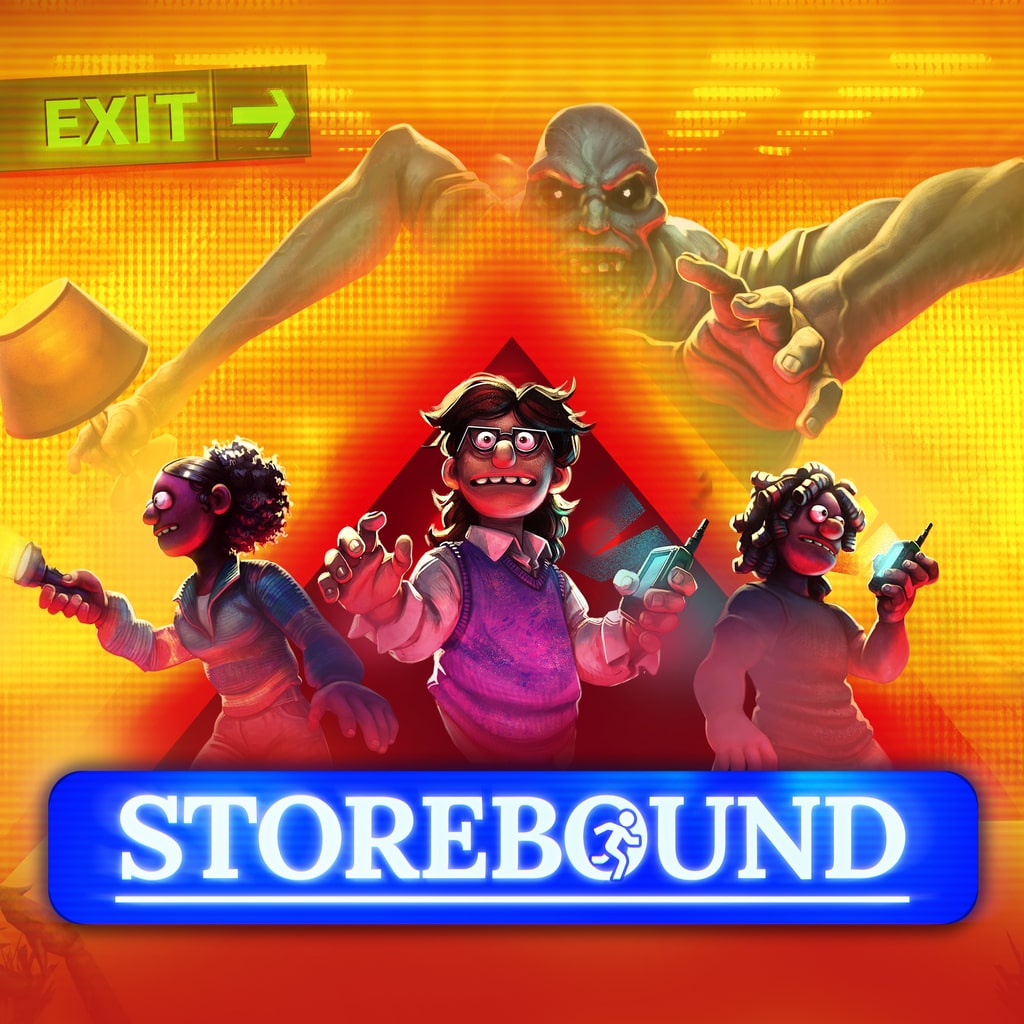
There is something deeply unsettling about an empty shopping centre. During the day, places like this are full of noise, bright lights, music, advertisements and people wandering around without giving much thought to their surroundings. Take all of that away, switch off the lights and leave the doors locked, and suddenly the familiar becomes deeply uncomfortable. Storebound takes that simple idea and stretches it into a six-episode descent into a megastore caught somewhere between reality, dream and nightmare.
Developed and published by solo indie studio Embers, Storebound is a co-op puzzle horror experience designed for one to three players, though it clearly finds its personality when played as part of a group. Across a campaign lasting roughly five to seven hours, players explore different eras and sections of a cursed retail complex, searching for clues, solving puzzles and trying to stay alive when the lights inevitably go out. What makes the concept particularly appealing is how communication becomes part of the horror rather than simply a convenient multiplayer feature. You are not just exploring a haunted shop with your friends. You are relying on them to survive.
Shopping After Dark
The liminal setting is Storebound’s biggest attraction. There is something wonderfully wrong about wandering through departments that should feel familiar, knowing you are very much not supposed to be there. The empty aisles, abandoned retail spaces and sprawling corridors create that classic liminal feeling, where everything looks recognisable yet somehow completely disconnected from the world you know.
The game makes good use of this discomfort by refusing to keep the setting completely static. Every two chapters introduce a different era and area of the store, giving the campaign a sense of progression without simply walking players through increasingly similar corridors. That variety matters because a horror game built around one location can quickly become repetitive, but Storebound has enough changes of scenery to keep curiosity alive.
There is also a pleasing contradiction at the centre of the setting. Shopping centres are designed to encourage people to stay, browse and consume. Storebound takes that idea and turns it into something sinister. Here, the store genuinely does not want you to leave, and the longer you remain inside, the more it becomes apparent that the building is not simply abandoned. Something is still running the place. And it certainly does not have your best interests at heart.
Friends Make the Fear Worse
Co-op horror lives or dies by how well it uses the presence of other players, and Storebound has a particularly clever approach to teamwork. Proximity voice chat means your friends are not always clearly audible, especially when someone wanders into another department or corridor. Suddenly, the person you were joking with moments earlier might be nothing more than a distant voice echoing through the store.
That creates some wonderfully uncomfortable situations. Splitting up can make certain puzzles considerably easier, particularly when players need to search different areas for objects or relay information from separate locations. At the same time, splitting up means you may be leaving someone alone when the lights go out.
The walkie-talkies add another layer to this dynamic. They allow players to communicate over longer distances, but Storebound deliberately makes communication feel like a risk. When the game warns you that something might be listening, every conversation suddenly becomes a potential mistake. The simple act of saying, “Where are you?” can feel much more dangerous when you are not completely certain that the voice coming back belongs to your friend.
That is where the multiplayer experience delivers some of its best horror moments. It is not necessarily what you see that frightens you. Sometimes it is what you hear.
Puzzles With a Purpose
Beneath the horror lies a puzzle adventure that demands genuine teamwork. Players need to search the store for useful objects, examine their surroundings, collect clues and work out how the pieces fit together. The best puzzles encourage communication, as one person might discover a code while another finds the mechanism that requires it.
There is something satisfying about that kind of cooperative problem-solving because it gives everyone a role. One player can search for clues while another studies the environment, with the third keeping an eye out for what might be approaching. Even simple tasks become more interesting when the group is forced to coordinate rather than simply following a single objective marker.
The store itself also contributes to the puzzle design. You are not solving abstract riddles on a menu screen. You are manipulating the environment, looking for objects and attempting to understand the building’s twisted logic. That helps the puzzles feel like part of the world rather than interruptions between horror sequences.
The downside is that the experience can become less compelling when playing alone. The mechanics still function, but much of the magic comes from the uncertainty created when several players are separated. Storebound is at its best when communication is messy, incomplete and slightly frightening.
After Hours
Then the lights go out. This is when Storebound shifts from an atmospheric puzzle game into something considerably more threatening. The store’s after-hours employees begin to emerge, and suddenly the empty aisles that once felt intriguing become places you desperately want to avoid. These entities are not simply there to attack the player at random. They become part of the game’s broader tension, forcing you to recognise warning signs and decide whether it is safer to move, hide, or stay quiet.
The idea of being “assisted” by something that absolutely should not be assisting you is particularly effective. It plays into the unsettling artificial friendliness of retail environments, where everything is supposed to be welcoming and helpful. Here, that concept has been twisted into something predatory.
The threats are also supported by the game’s 3D audio. Distant noises, movement, and environmental sounds can become incredibly important when you cannot see what is happening around you. Hearing something beyond the next aisle is often enough to make you stop dead, especially when your friends are scattered across the building and you are not entirely sure who is making which noise.
When Your Own Mind Turns Against You
The sanity system is another feature that gives Storebound more personality than a straightforward co-op horror game. The megastore does not simply threaten your physical survival. It gradually erodes your ability to trust what you are experiencing.
That opens the door to one of the most interesting forms of multiplayer horror: uncertainty between players. If your character’s sanity deteriorates far enough, you may no longer be fully trustworthy to the people you are playing with. The game can therefore create situations where your friends have to question what you are saying and whether what you are describing is actually happening.
It is a strong idea because trust is already at the heart of cooperative horror. You rely on the people around you to tell you where to go, what they have found and what they have seen. If the game starts making those conversations unreliable, the safest person in the building can suddenly become another potential threat.
Six Chapters Into the Darkness
The six-episode campaign gives Storebound a welcome sense of structure. Rather than relying on a single setting for the entire experience, the campaign moves between different eras and areas, providing fresh puzzles and new horrors along the way. This helps sustain a sense of discovery, particularly in the earlier sections, when you are still trying to understand exactly what kind of place you have wandered into.
Five to seven hours feels like a sensible length for the concept. There is enough room for the atmosphere, puzzles and multiplayer mechanics to breathe without dragging the experience into unnecessary repetition. Horror can lose its impact when the player becomes too familiar with its tricks, so keeping the campaign relatively focused works in its favour.
There is still a slight sense that some of the game’s ideas could have been pushed further. Once players learn the behaviour patterns of certain entities, some of the fear naturally diminishes. The unknown is always scarier than the known, and repeated encounters can eventually turn something terrifying into another problem that needs solving. That is a familiar issue within horror, but it is particularly noticeable in a game built around learning how its world behaves.
The Joy of Getting Lost
What I particularly like about Storebound is that it understands how important it is to make getting lost part of the experience. In many games, losing your way is treated as an inconvenience. Here, it becomes part of the horror.
A giant retail complex should be easy to navigate when everything is operating normally. There are signs, departments and familiar visual cues telling you where to go. Remove the staff, change the environment and introduce things that should not exist, and suddenly those familiar conventions become much less useful.
There is also something inherently social about getting lost with friends. Someone will inevitably insist they know the way, someone else will claim they saw a shortcut, and before long the entire group is arguing over which corridor they came from. In a normal game, that might simply be funny. In Storebound, it can become the moment when something finds you.
Final Verdict
Storebound is an atmospheric and imaginative co-op horror experience that makes excellent use of its cursed megastore setting. The liminal environments are consistently effective, while proximity voice chat and walkie-talkies turn communication into a genuine part of the horror rather than simply another multiplayer convenience. Add in environmental puzzles, a sanity system, 3D audio and a six-episode campaign that shifts setting as it progresses, and there is plenty here for a group of horror fans to sink their teeth into.
It is not without its limitations. The scares can lose some of their bite once players have learned the behaviour patterns of the various entities, while the experience is noticeably less engaging when tackled alone. Some mechanics also feel as though they could have been pushed further, particularly the sanity system, which has the potential to create even more unpredictable situations.
Even so, there is a lot to enjoy here. Storebound understands that the best co-op horror is often about the stories that happen between the scares. It is the friend who confidently leads everyone down the wrong corridor, the sudden silence when somebody stops responding, the distant voice crackling through a walkie-talkie and the moment everyone realises that the footsteps they can hear are not coming from a member of the group.
It is a game about being trapped somewhere that was designed to make you feel welcome, and there is something wonderfully sinister about that contradiction. The store wants you to keep shopping, keep exploring and keep moving deeper inside. Unfortunately, the longer you stay, the more you realise that the price of leaving may already have been paid.