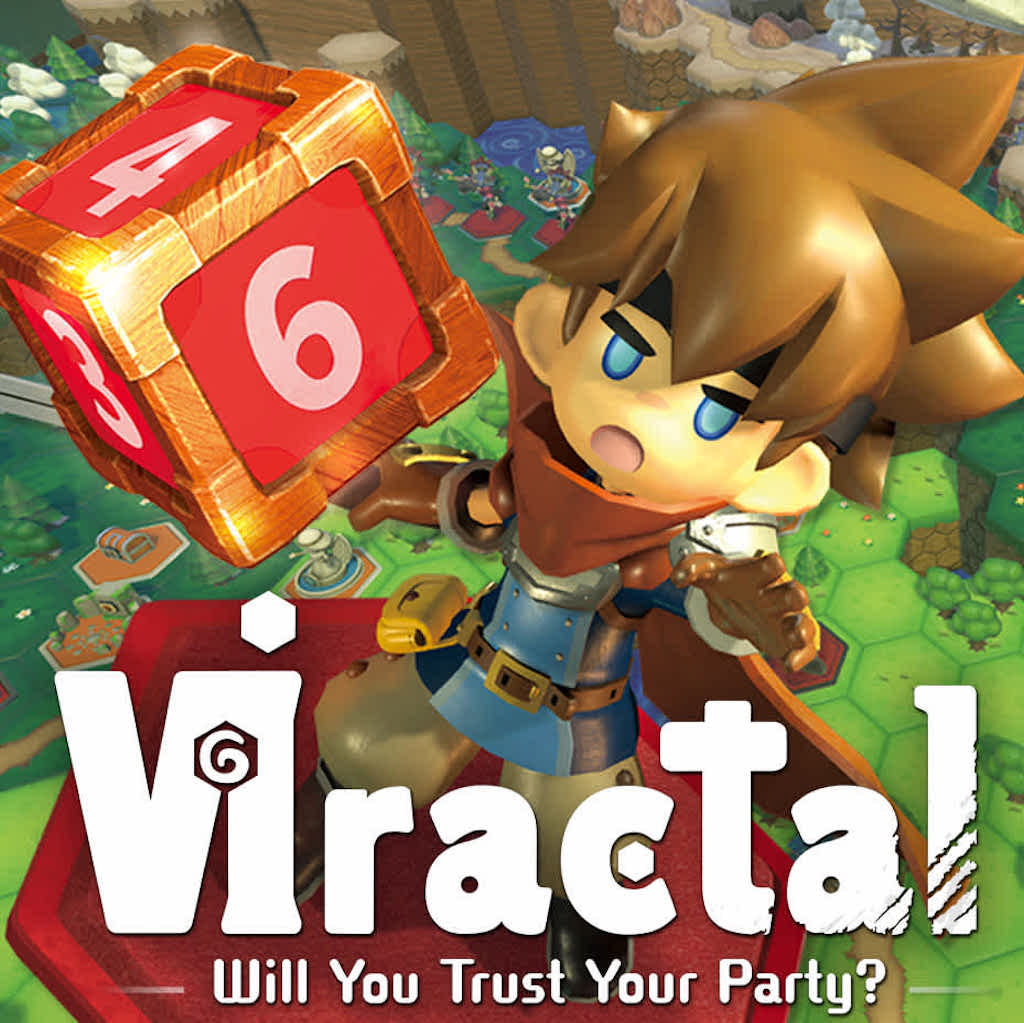
There is something wonderfully dangerous about putting your fate in the hands of a dice roll. You can spend hours building the perfect deck, carefully choosing a party and convincing yourself that you have finally cracked the game’s systems, only for a tiny plastic cube to decide that none of your plans matter. Viractal: Will You Trust Your Party? understands that particular joy and frustration better than most, taking the familiar ingredients of a board game, card battler and RPG and throwing them together into a surprisingly compelling adventure. It is the sort of game where a brilliant strategy can save you from a terrible roll, but sometimes a terrible roll simply laughs in your face.
Developed and published by veteran Japanese studio Sting, Viractal: Will You Trust Your Party? transports players into the miniature fantasy world of Viractalia, where movement is determined by dice and battles are fought with carefully constructed card decks. You can assemble a party of up to three adventurers and guide them through constantly changing stages, encountering enemies, events and opportunities along the way. It is a wonderfully simple premise on paper, yet there is considerably more thought behind the systems than the cheerful board game presentation initially suggests. Beneath the colourful surface lies a game about managing risk, building synergies and making the most of whatever fate happens to throw at you.
Welcome to Viractalia
Viractalia is an unusual place because it manages to feel both familiar and unpredictable at once. The game presents its environments as a miniature tabletop world, with characters, terrain and events arranged almost as though somebody has physically constructed a fantasy board and then brought it to life. Each adventure can change the layout and the opportunities available to you, meaning that even when you think you know what you are doing, the next journey can quickly become something completely different.
That sense of transformation is important because Viractalia is built around replayability. You are not simply following a fixed route from one story beat to another, and the procedural nature of its stages gives each run a different rhythm. One journey might provide a string of useful events and generous battles, while another can leave you desperately trying to make something useful out of a series of unfortunate encounters. There is genuine excitement in seeing what is waiting around the next corner because the game never quite allows you to settle into a predictable routine.
When Luck Meets Strategy
The central appeal of Viractal lies in how it combines dice-based movement with card-driven combat. At first glance, those two systems might seem to belong to completely different types of games. Dice are all about uncertainty, while deckbuilding is about planning and control. The cleverness here is that the game allows the two ideas to coexist, creating situations where preparation can reduce the impact of bad luck without ever eliminating uncertainty entirely.
That balance is not always comfortable, but it is rarely boring. You can build an excellent deck and still find yourself dealing with an awkward sequence of movement rolls, or you can stumble into a brilliant opportunity simply because the dice decided to be generous. The important thing is that Viractal gives you tools to respond to those situations. It never completely takes control away from you, which means that even a bad roll can sometimes become the beginning of a clever recovery.
No Roll Is Truly Wasted
One of the smartest mechanics in the game is the DP system. Normally, rolling a high number when you only need to move a couple of spaces would feel like a frustrating waste. Viractal turns that excess movement into something useful by converting unused movement points into DP, which can then be spent to strengthen events or give you an advantage in battles.
It is a deceptively simple idea, but it changes the way you think about every dice roll. Suddenly, rolling too high is not necessarily a problem, because those extra points can become another resource to manage. It adds a small layer of decision-making to what could otherwise have been a purely luck-based movement system. More importantly, it means the game rarely leaves you staring at a good roll and thinking, “Well, that was completely useless.”
Build Your Party, Build Your Fate
The deckbuilding is where Viractal reveals its strategic depth. Each member of your party has their own skills and cards, allowing you to build individual decks while also considering how those characters work together. It is not enough to simply give everyone a collection of powerful abilities. You need to think about how those abilities interact and whether your party can cover the weaknesses created by your choices.
That makes party composition surprisingly important. A card that looks fairly ordinary in isolation can become much more valuable when paired with another character’s abilities. Likewise, a powerful card is not necessarily useful if it does not fit the rest of your strategy. There is a lovely sense of experimentation in gradually discovering combinations that work, particularly when a seemingly modest change to one character’s deck suddenly makes the entire party more effective.
Cards, Combos and Carnage
Combat takes the board game concept and turns it into something more tactical. Battles are turn-based, with your cards determining what your characters can do, and building the right hand becomes just as important as knowing when to play it. You have to consider your immediate situation while also thinking about how your available cards might contribute to a larger combination. A strong turn can feel genuinely satisfying when several abilities come together exactly as planned.
The downside is that the game can take a little while to explain itself. There are several interconnected systems to understand, and newcomers may initially feel as though they have been handed a pile of cards, dice and instructions and told to figure it out. The learning curve is not insurmountable, but there is a definite period when you are likely to make mistakes simply because you are still learning how everything interacts. Once those systems start to click, however, battles become considerably more enjoyable.
Every Event Could Change Everything
Between battles, Viractalia throws various events your way, and these are among the game’s most enjoyable sources of unpredictability. Some encounters offer useful rewards, others present difficult choices, and some can alter the direction of your adventure altogether. The important thing is that you rarely know exactly what you are going to get until you commit to a decision.
This gives the journey a wonderful tabletop quality. You are effectively wandering across a living game board, turning over the next possibility and hoping the consequences are in your favour. Sometimes you walk away with a useful ability or resource and feel incredibly clever. Other times you make a decision that seems perfectly reasonable and immediately discover that Viractalia has a very different sense of humour.
Will You Trust Your Party?
The title is not just a catchy question. Will You Trust Your Party? is particularly appropriate because the game constantly encourages you to think about the relationship between individual characters and the group as a whole. Building three strong characters is one thing, but creating a party whose abilities complement one another is another challenge entirely.
That becomes even more interesting when playing with other people. Online multiplayer adds a social dimension, allowing friends to share the adventure and react to the game’s increasingly ridiculous twists together. A bad dice roll is considerably easier to laugh off when someone else is suffering alongside you. It also creates opportunities for discussions about deck choices, party composition and whether somebody’s questionable tactical decision has just doomed everyone.
A Charming Tabletop World
Visually, Viractal gets a lot of mileage from its miniature board-game presentation. The world has a handcrafted quality that makes it feel as though you are watching a tabletop adventure come alive before you. Characters and environments have a playful charm, and the overall presentation helps soften some of the more complex systems beneath the surface.
There are limitations, particularly when later areas begin recycling enemy designs with palette variations. It can take some of the excitement out of discovering a new environment when the opposition does not always feel as fresh. There are also occasional awkward moments in the English localisation, with some dialogue lacking the natural flow you would expect from a fully polished translation. Neither issue destroys the experience, but both are reminders that Viractal is not quite as polished as its strongest ideas deserve.
The Joy of Uncertainty
What makes Viractal work so well is that it understands something fundamental about board games. Uncertainty is not necessarily the enemy of strategy. In fact, sometimes it is what makes strategy exciting. If you knew exactly what would happen every time you rolled the dice or turned over an event, there would be very little reason to replay the adventure.
Instead, the game asks you to make the best decision possible with imperfect information. You build your decks, choose your party, manage your DP, and decide which events are worth risking, but ultimately the dice still get a vote. That creates wonderfully memorable moments, particularly when a desperate roll turns a losing situation around or when a seemingly perfect plan collapses because fate has other ideas.
Final Verdict
Viractal: Will You Trust Your Party? is a clever and charming fusion of board game adventure, deckbuilding and RPG strategy that makes luck feel like part of the fun rather than simply an obstacle. Its miniature world is full of personality, its procedural adventures provide plenty of replay value, and the combination of individual character decks with party synergies gives the combat more depth than its colourful presentation might initially suggest.
It is not without rough edges. The RNG-heavy movement can occasionally test your patience, the learning curve takes time to overcome, and the English localisation could use a little more polish. Some later enemy designs also lack variety, but these are relatively minor blemishes on an experience that gets the important things right. Once you understand how the different systems fit together, there is a satisfying rhythm to building a party, rolling the dice, adapting to whatever happens, and trying to turn bad luck into an opportunity.
There is also something wonderfully old-fashioned about the whole experience. Viractal feels like a digital board game designed to be played with friends, argued over, laughed at, and occasionally blamed when everything goes spectacularly wrong. It does not demand that you take every decision seriously, but it rewards you when you do. Sometimes you will outsmart the game, sometimes the game will outsmart you, and occasionally you will have no idea how you survived at all.
And perhaps that is exactly the point. In Viractalia, strategy gives you a fighting chance, your cards give you options, and your party gives you hope. The dice, however, are always waiting to remind you who is really in charge.