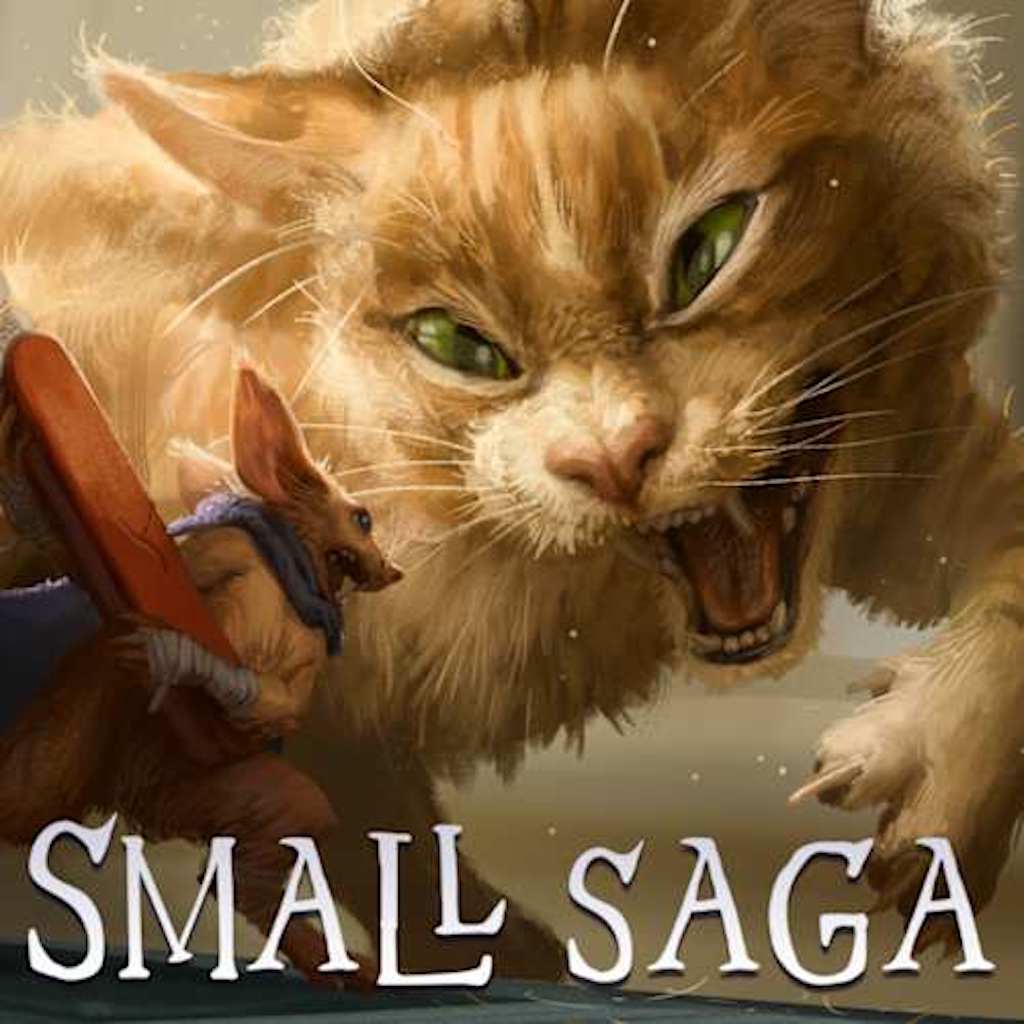
There is something wonderfully British about the idea of a medieval kingdom hidden beneath London’s streets. We are used to thinking of the capital as red buses, busy pavements, ancient buildings and endless streams of people, but Small Saga asks us to imagine what might be happening beneath all that noise. Down below lives Rodentia, a hidden civilisation of mice, rats, moles, squirrels and shrews, complete with its own politics, religions, rivalries and very serious rules about what should never be attacked. Unfortunately for everyone involved, Verm has never been especially good at following rules.
His tail has been stolen by the Yellow God of Death, a human being who is seen by Rodentia’s inhabitants as something far beyond their ability to challenge. Verm, however, has little interest in accepting his fate. Armed with a tiny blade and an enormous grudge, he sets off on a revenge mission that soon becomes something considerably bigger. What begins as one mouse’s personal quest gradually develops into a surprisingly moving tale of friendship, oppression, revolution and the courage to stand up to something much larger than yourself.
Developed and published by solo creator Darya Noghani, Small Saga is an isometric, turn-based RPG that understands the importance of pacing. It does not waste your time with endless random battles, repetitive grinding or huge stretches of filler. Instead, it concentrates on its characters, its world and a series of memorable confrontations that continually push the story forward. The result is a small adventure in physical scale that somehow manages to feel enormous in imagination.
Welcome to Rodentia
The first thing that makes Small Saga so memorable is its setting. Rodentia is not simply a fantasy world populated by talking animals. It is a distorted reflection of the world above, with its own social structures, beliefs and divisions.
Human rubbish becomes valuable equipment. Everyday objects become medieval artefacts. A discarded razor blade can become a sword, while a thimble might serve as protective armour. From the perspective of something only a few inches tall, the world humans take for granted suddenly becomes enormous and often terrifying.
That shift in perspective is where much of the game’s charm lies. A familiar London street can become an intimidating wilderness, while a sewer can feel like the entrance to a vast underground kingdom. Small Saga constantly reminds you that size is relative, and the pixel art does a superb job of conveying that idea.
There is a lovely sense of discovery in exploring Rodentia. The environments feel as though they have been built from the scraps of the human world, yet the rodents have transformed those scraps into something uniquely their own.
A Mouse With a Grudge
Verm is an immediately likeable protagonist, although “likeable” might not be the first word you would use when you meet him. He is angry, stubborn and driven by revenge, and he is not particularly interested in listening when other characters tell him that challenging a god is a terrible idea.
That attitude gives him personality from the start. Verm is not some destined hero waiting for an ancient prophecy to reveal his importance. He is a small creature who has suffered something deeply personal and has decided to do something about it.
As the adventure progresses, however, his motivation develops beyond simple revenge. The people he meets and the situations he encounters gradually force him to question what he is actually fighting for. His journey becomes about more than getting his tail back, and that emotional progression gives the story considerably more weight than the whimsical premise initially suggests.
Small Saga is particularly good at allowing humour and darker themes to coexist. One moment you can be laughing at a ridiculous character or situation, and the next the game reminds you that this world is dealing with grief, inequality and political oppression.
Tiny Weapons, Big Battles
Combat is turn-based, but Small Saga avoids the familiar RPG trap of making you fight the same enemies for hours just to gain enough experience to progress. There are no random encounters cluttering your journey, and the game actively avoids the grinding that has become almost synonymous with traditional RPG design.
Instead, battles are carefully structured around significant encounters. Bosses are the stars, each with its own personality, mechanics and tactical requirements.
This gives combat a much stronger sense of purpose. When you enter a battle, you know you are facing something important rather than simply another collection of enemies standing between you and the next story scene. Every confrontation feels like an event.
The streamlined resource system also encourages you to think about how you use your abilities. Rather than relying entirely on conventional mana management, your characters need to balance their available actions and resources. Powerful attacks can make a huge difference, but using everything at once can leave you vulnerable later in the fight.
That creates a pleasant tactical rhythm. You are constantly considering whether to attack, defend, support another character or prepare for the next opportunity. The system is approachable without becoming shallow.
Meet the Misfits
Verm may be the star, but Small Saga’s supporting cast is arguably one of its greatest strengths. The adventure brings together a cast of rodents, each with distinct personalities, abilities and reasons for joining Verm on his increasingly ridiculous journey.
A mole wizard, a bardic squirrel and a pious laboratory rat are among the characters you will encounter, and their contrast creates plenty of entertaining moments. They do not simply feel like interchangeable party members filling different combat roles. They feel like individuals.
That matters because the adventure moves at a brisk pace. Without random encounters constantly interrupting the story, there is considerably more room for the characters to interact. Conversations feel meaningful because you are not desperately trying to skip through dialogue to get back to fighting another group of identical enemies.
The result is a party that is easy to care about. Their arguments, friendships and differences give the journey an emotional centre, and some of the game’s quieter moments can be just as memorable as its biggest battles.
Titans of the Underground
The scale of the enemies is where Small Saga really embraces its premise. These rodents are tiny, yet the foes they are expected to fight can be enormous by comparison.
You will face everything from intimidating beasts to bizarre, imaginative creatures, including a swashbuckling water vole, a pious laboratory rabbit and a poetry-spouting kraken. It sounds absurd, and it is, but the game consistently treats these encounters with enough seriousness to make them feel important.
That balance is one of Small Saga’s greatest achievements. It can make you laugh at the sheer ridiculousness of a situation while also making you care about what happens next.
The boss encounters benefit enormously from this approach. They are not just larger enemies with bigger health bars. They are characters within the story, and defeating them feels like overcoming a genuine obstacle rather than simply completing another combat encounter.
No Grinding, No Problem
One of the smartest decisions Small Saga makes is to remove the grind. There is a particular kind of RPG fatigue that comes from walking backwards and forwards through the same area simply because you need a few more levels before the next boss.
Small Saga has no interest in that. By focusing on a tightly structured adventure, the game keeps moving. You progress from one story beat to another, meet new characters, encounter new threats, and eventually find yourself facing another memorable boss. This makes the whole experience feel purposeful. There is very little sense that you are wasting time, and that is increasingly valuable in an RPG.
The downside is that players who enjoy spending dozens of hours building an overpowered party may find the experience too brief and perhaps a little too forgiving. Small Saga is not trying to be that kind of RPG. It is a focused adventure, and its relatively short runtime is part of the appeal.
Pixel Art With Real Character
Visually, Small Saga is absolutely gorgeous. The pixel art makes the world feel nostalgic yet surprisingly detailed, with environments that convey scale and atmosphere without relying on modern graphical effects.
The human world becomes especially impressive when viewed from a rodent’s perspective. Objects that would normally be insignificant suddenly appear as enormous pieces of architecture or equipment. A discarded human item can become an important part of a character’s kit, and the game constantly reminds you how small its heroes really are.
The character designs are equally expressive. Each member of the cast has a distinctive appearance, making them easy to recognise even when the screen becomes busy.
There is also a real sense of care in the presentation. Small Saga looks like a game made by someone who genuinely loves this world, rather than simply a collection of pixel art assembled around a set of mechanics.
A Small Story With Big Ideas
Perhaps the most surprising thing about Small Saga is how mature its story becomes. What initially appears to be a cheerful adventure involving anthropomorphic rodents gradually deepens into something much more serious.
The game explores themes of class, power, religion, oppression and revolution without losing sight of its central characters. The inhabitants of Rodentia live within systems established long before Verm begins his journey, and challenging them carries consequences.
This gives the adventure an emotional weight you might not expect from its premise. The world is funny and colourful, but there is genuine darkness beneath the surface.
Grief is another important part of the story, particularly as Verm’s personal quest begins to intersect with others’ struggles. His journey becomes less about taking revenge and more about understanding what that revenge might mean.
It is an impressive amount of thematic material to pack into such a compact RPG, and the writing deserves considerable credit for keeping it engaging.
The Final Verdict
Small Saga is one of those games that manages to sneak up on you. You begin playing because the idea of a mouse fighting its way through an underground kingdom sounds charming and unusual. Before long, you find yourself invested in the characters, intrigued by the world and genuinely interested in where Verm’s journey is going.
Its biggest strength is its discipline. The game does not waste time. It does not force you into hours of grinding simply to make the numbers go up, nor does it pad its adventure with endless encounters that have little meaning.
Instead, almost everything feels purposeful. The combat is built around memorable bosses, the party members have personality, the world is packed with imagination and the story has considerably more depth than its tiny heroes might suggest.
It is not the longest RPG you will play, and experienced turn-based veterans may occasionally wish for a greater level of tactical difficulty. The streamlined systems also mean that players searching for an enormous character development experience will find something much more focused here. But those are hardly criticisms when you consider what Small Saga is trying to achieve.
This is a game about making every moment count. It takes a tiny mouse, gives him a penknife and a reason to fight, then builds an entire world around that deceptively simple idea. The result is funny, warm, occasionally heartbreaking and consistently imaginative.
There is something rather lovely about a game that understands you do not need hundreds of hours to tell a great story. Sometimes you just need a good cast, a memorable world and a protagonist with enough determination to take on something vastly bigger than himself. Small Saga may be small in name, but its ambitions are anything but.
Small Saga is a beautifully crafted RPG that combines wonderful pixel art, sharp writing and focused turn-based combat into one of the most charming adventures in its genre. The lack of grinding keeps the story moving, while its imaginative bosses and memorable cast ensure that the journey rarely loses momentum. It is proof that an RPG does not need to be enormous to tell a story that leaves a big impression.