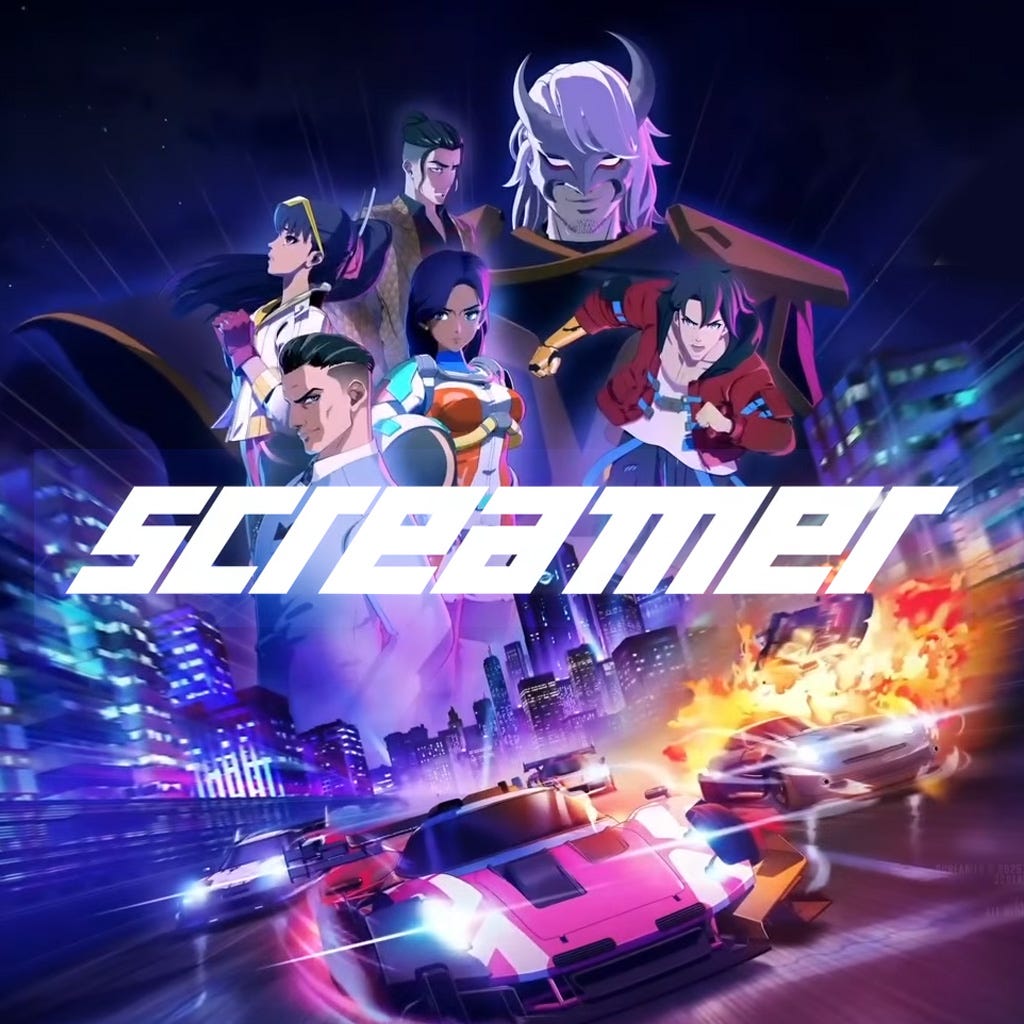
Reboots often strike a delicate balance between paying homage to the original and trying something new. With Screamer (2026), it’s clear which direction it leans towards — more reinvention than revival. The name still echoes the 1995 arcade racing classic, but this new version feels like a fresh take rather than just a simple update. It has been transformed from a straightforward racing game into a vibrant, combat-focused spectacle, glowing with neon lights, storytelling dreams, and innovative mechanics.
What emerges is a game that dares to stand out, brimming with personality and life. It may occasionally feel a bit jarring as it attempts to juggle multiple ideas, but that passion and energy are undeniable.
Racing with Purpose (and Personality)
Unlike many arcade racers that treat story as an afterthought, Screamer puts character motivation right at the forefront. The tournament isn’t just about speed; it’s a gathering of five unique factions—soldiers, scientists, criminals, celebrities, and corporate elites—each driven by their own personal stakes to compete.
This approach gives the game more than just racing action; it infuses it with personality. The drivers aren’t simply interchangeable avatars; they are crafted characters with distinct looks, feelings, and special abilities. This design encourages players to experiment, since switching drivers can significantly change how races play out and introduce new layers of strategy.
However, while the concept is undeniably compelling, its execution sometimes falters. The story snippets can be striking and stylish, but they often lack depth or consistency. The effort to craft a captivating narrative is evident, yet at times, it struggles to maintain momentum throughout the game.
The ECHO System: Speed Meets Combat
At the heart of Screamer is the ECHO system, a revolutionary mechanic that changes how racing feels. It shifts the emphasis from just raw speed and precision to creating a more immersive experience, turning races into lively, tense battles where every move counts. In this world, good positioning and perfect timing are just as important as taking sharp turns, making each race pulse with energy and anticipation.
ECHO provides three main abilities: Boost, Strike, and Shield. Using these in real-time adds depth and strategy, making each race more exciting. Boost gives you quick bursts of speed for sudden overtakes or escaping danger. Strike lets you attack opponents directly, while Shield acts as a temporary barrier to keep you safe from attacks. Finding the right balance between these skills becomes especially important in chaotic races where everything happens so fast.
Then there’s Overdrive—a mode that takes the action to another level. It’s a gamble but one that can pay off big. When activated, your speed skyrockets, attacks become more aggressive, and controlling your car gets even trickier. But the thrill of pulling it off is unmatched, creating moments filled with raw intensity and unforgettable excitement.
This system is fresh and innovative, giving racing a new dimension. Still, it has its challenges. The variety of effects and interactions can make races feel complex and overwhelming, especially for newcomers. There’s a steep learning curve, and the game doesn’t always guide you smoothly through it, which might leave some players feeling a bit lost at first.
Tracks and World Design
Visually, Screamer captures your attention immediately. Built with Unreal Engine 5, it transports players into a neon-lit, futuristic world that clearly draws inspiration from 90s anime. Tracks wind through glowing cityscapes, industrial zones, and surreal environments that blend the familiar with the otherworldly to create a vivid, immersive experience.
The game’s style truly defines its spirit. Its art direction, featuring dynamic lighting, particle effects, and richly detailed environments, makes the world feel alive and pulsating with energy, even amid chaotic moments during gameplay.
However, when it comes to track design, the experience varies. Some circuits are cleverly crafted, offering multiple routes and strategic choices that invite creativity. Others tend to feel more linear and predictable, which can limit how much players can experiment. While this inconsistency doesn’t ruin the fun, it does prevent the game from reaching its full potential.
Modes and Multiplayer
Screamer offers an array of game modes that go far beyond your typical racing experience. For example, the team-based events encourage players to collaborate deeply, focusing on strategy and coordination. Success in these modes depends not just on individual skill but on how well the team functions together, creating a sense of camaraderie and shared achievement.
There are also specialized modes that challenge players to master specific mechanics, such as keeping Overdrive active for as long as possible. These variations keep the game feeling fresh and exciting, pushing players to explore different aspects of the ECHO system and discover new ways to test their limits.
Multiplayer is at the heart of the experience, with options for both online competitions and split-screen battles. Racing against other players highlights the game’s true strength. Facing human opponents adds an element of unpredictability that is difficult for AI to replicate, making each race feel unique and deeply engaging.
Of course, balancing the game is an ongoing challenge. Some abilities and strategies can seem overpowered, which might lead to matches that are more about exploiting the system than genuine skill. This is an aspect that benefits from continuous attention and fine-tuning, ensuring gameplay remains fair, challenging, and fun for everyone.
Controls and Performance
On a technical level, Screamer proves to be quite reliable across different platforms. On the PS5 and Xbox Series X|S, it runs smoothly, delivering impressive visuals and very few performance issues. PC players benefit from greater flexibility, and seeing that it is Steam Deck certified is a nice bonus, opening up more ways to enjoy the game.
The controls respond effectively, although it takes some time to truly get used to them. With fast-paced racing and combat mechanics, precision is crucial. At first, races might feel a bit chaotic until you become more familiar with how everything functions.
The game walks a fine line between being accessible and maintaining depth. The core driving experience is quite straightforward, but the added layers of ECHO management can make it seem more complex than it initially appears. This challenges you to look deeper and master its subtleties.
Where It Falters
Despite its ambitious scope, Screamer occasionally struggles to come together in a truly coherent way. Each of its core elements—whether it’s the gripping narrative, adrenaline-pumping combat, or high-octane racing—has its own unique appeal. Yet, they don’t always blend seamlessly, which can leave the experience feeling disjointed. The visual spectacle is undeniably stunning, a true feast for the eyes; however, it can sometimes become so overwhelming that important information during races gets lost in the chaos. On top of that, the game’s balance of abilities feels like it’s still a work in progress, needing some fine-tuning to foster a more consistent and engaging competitive environment.
There’s an underlying sense that Screamer is still searching for its true identity. Is it primarily a racing game with some combat thrown in, or is it more focused on delivering a combat-heavy experience with racing elements? It seems to lean toward the latter, yet the distinction isn’t clear enough to pin down definitively. You can sense the potential simmering beneath the surface, waiting to be fully realized as the game continues to evolve. This uncertainty, this yearning for clarity, gives Screamer a sense of unfinished beauty—a promise of greatness yet to come.
Final Verdict
Screamer (2026) emerges as a bold and stylish reboot that reimagines its source material with a fresh, creative energy. The addition of the ECHO system breathes new life into arcade racing, blending speed and combat in a way that feels both thrilling and innovative. Yet, this daring approach isn’t without its hurdles. The game’s mechanics, while inventive, can sometimes feel a bit overwhelming, and not every element aligns perfectly. It’s an experience that flickers with moments of chaos and brilliance—bright flashes that captivate but don’t always come together into a seamless whole.
There’s an undeniable energy here, a spirit that sparks curiosity and excitement. While Screamer isn’t perfect, its willingness to take risks brings a refreshing breath of innovation to a genre often defined by the comfort of familiarity. With a bit more refinement, this game could grow into something truly special—something that deeply resonates with players who crave boldness and creativity in their racing experiences.