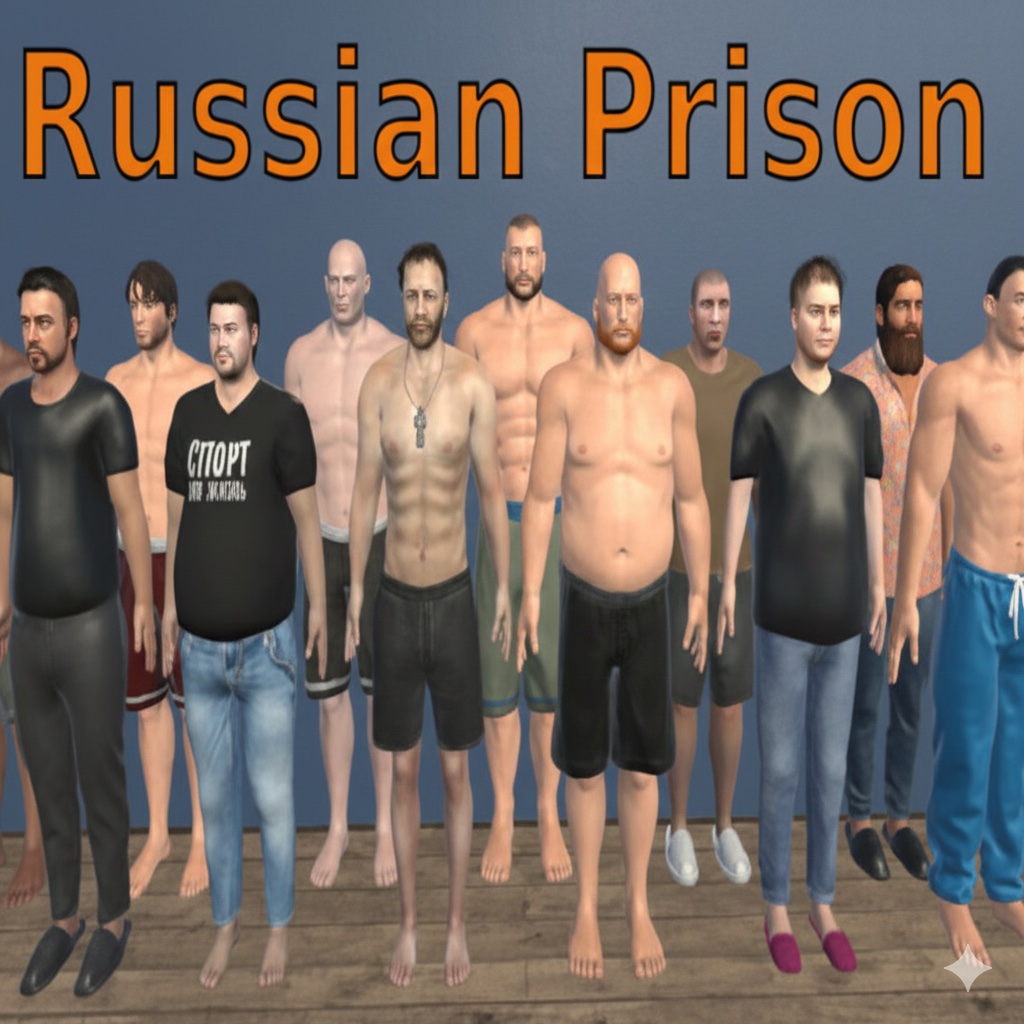
Prison simulations are not uncommon, but Russian Prison distinguishes itself by eschewing fantasy mechanics and arcade stylings in favour of a stark, unvarnished look at incarceration within one of the most notorious penal contexts in history. Developed with an explicit intent to confront players with the grim realities, power hierarchies, and subtle psychological warfare of life behind bars in a Russian correctional facility, Russian Prison is less a game of progression and more an exercise in endurance, observation, and ethical reflection.
That deliberate seriousness is both the core strength and principal challenge of Russian Prison. It is not designed for casual play, rapid advancement, or thrill-seeking escapades. Instead, it asks players to inhabit a world of ritualised hardship and systemic brutality — an experience that is immersive, often uncomfortable, and uncompromising in its portrayal of survival within constrained structures. For players interested in narrative depth, socio-political nuance, and demanding choice systems, this simulation delivers memorably. For others, its slow pacing and emotional weight can feel relentless.
Narrative and Ambience
Russian Prison begins not with fanfare but with confinement. There is no introductory flourish; players awaken in a cell, already incarcerated, with scant information about their crime or sentence — a narrative choice that reinforces the disorientation and lack of agency at the heart of the experience. From this starting point, the game unfolds as a series of daily choices, social interactions, and systemic pressures that make escape seem improbable and survival uncertain.
The narrative is structural rather than linear. It is driven by interaction and consequence rather than plot beats. Conversations with guards, dialogues with other inmates, and responses to institutional demands shape the player’s experience. There is no overarching cinematic storyline; the tension comes from the texture of prison life itself: negotiating favours, maintaining physical health, navigating clandestine power networks, and deciding when compliance or resistance is necessary.
Dialogue options range from polite submission to calculated defiance. Each choice carries immediate social consequences and potential long-term repercussions. A seemingly innocuous comment can escalate tensions with another inmate, while cautious deference to a guard may preserve safety but erode self-respect. This narrative framework aligns with the game’s thematic focus on survival as a moral and tactical balancing act.
Gameplay Systems and Mechanics
On a mechanical level, Russian Prison emphasises simulation over spectacle. Players manage a suite of basic needs — hunger, sleep, hygiene, mental resilience — but these systems are not abstracted into simple meters with convenient refill options. Instead, they are tied to daily routines and institutional schedules. Food distribution is regimented and unremarkable. Showers occur at set times and offer minimal relief. Sleep comes in short, interrupted bouts that underscore psychological strain.
Movement and interaction mirror this restraint. There are no flashy traversal mechanics or combat combos; navigating spaces is slow and deliberate, passing through institutional corridors and shared cells in a manner that feels oppressive by design. Interactions with objects — inspecting personal effects, opening cupboards, or attempting to access contraband — require intent rather than reflexive input.
One of the game’s most compelling systems is its social hierarchy mechanic. Inmates and guards alike occupy positions of influence, and understanding these hierarchies becomes essential to survival. Aligning too overtly with one faction may protect a player in the short term but make them vulnerable in others. Trust is a currency that depletes quickly and is costly to build. Players must constantly gauge the atmosphere: who holds authority, who resents it, and who can be manipulated or befriended.
The guard interaction system deserves particular attention. Rather than presenting guards as faceless adversaries, Russian Prison assigns them personalities, schedules, and individual triggers. A brash comment may provoke one guard into punitive action but amuse another. Players must learn not only the rules but the temperament of their overseers, turning interpersonal acuity into a form of soft survival strategy.
Pacing and Player Engagement
If there is a single word that captures Russian Prison, it is “slow.” The experience unfolds gradually, and the passage of time is integral to its emotional impact. Days are long, and progress is measured in small, incremental adjustments rather than sweeping transformations. This pacing is thematically coherent — prison life is inherently repetitive — but it demands patience and emotional investment from the player.
Notably, the game rarely provides explicit goals outside of the vague imperative to survive and maintain personal integrity. There are no progress bars or objective markers urging players forward; instead, meaning is derived through emergent events and personal narratives that arise from sustained engagement with systems and characters. This design choice produces a world that feels lived-in rather than gamified, but it also means players seeking clear targets or conquest goals may feel disoriented.
The engagement loop is decidedly contemplative. There are days when nothing seems to happen, and that is precisely the point: monotony is part of the lived experience the game seeks to convey. When meaningful events do occur — an inmate challenge, a guard confrontation, a rare opportunity to request favours or resources — they carry emotional weight precisely because they break from repetition.
Visuals, Audio, and Worldbuilding
Aesthetically, Russian Prison opts for a utilitarian visual language that reinforces discomfort rather than escape. Cells are muted and cramped; common areas are industrial and cold. Lighting is harsh and uncompromising; shadows feel oppressive rather than mysterious. This visual consistency builds a sense of place that is unforgiving and bare, much like the institutional environments it depicts.
Audio design reinforces this tone. Ambient sound is dominated by distant clangs, intercom announcements, muffled conversations, and the low hum of fluorescent lighting. There is no sweeping score or dramatic theme; instead, sound emphasizes the mechanical and the mundane. Voices — guards barking orders, inmates grumbling or laughing — are mixed at a human scale, neither polished nor cinematic. This rawness contributes to both immersion and emotional tension.
Strengths and Weaknesses
Strengths:
- Cohesive thematic focus — the game consistently reinforces its central concept of survival under systemic constraint
- Robust social interaction systems — guard and inmate hierarchies are richly simulated and consequential
- Atmospheric worldbuilding — visuals and audio create an oppressive, memorable setting
- Narrative through interaction, not exposition — stories emerge from choices and consequences rather than cutscenes
Weaknesses:
- Deliberately slow pacing may deter players seeking dynamic action or fast progression
- Sparse narrative direction can feel aimless to players who prefer explicit goals
- Emotional weight may fatigue those who prefer lighter or more fantastical simulations
- Limited mechanical variety outside of social and survival systems
Final Verdict
Russian Prison is not a game for everyone — and by design, it should not be. Its interests lie far from spectacle and fantasy, instead embedding players in a simulation that is at once sobering and intellectually demanding. It challenges players not to win but to endure, to read social cues, and to make ethically fraught choices in a world of limited agency.
Where many simulators offer mastery through expanding systems and escalating power, Russian Prison subverts that paradigm by underscoring constraint, hierarchy, and consequence. As an experiential narrative about life under rigid institutional control, it succeeds with restraint and texture. It is not sensationalised; it is methodical, introspective, and — for those willing to absorb it — genuinely affecting.
For players who value socio-psychological simulation, systems-driven storytelling, and emotional engagement rooted in consequence rather than conquest, Russian Prison is a standout. It may not entertain in the conventional sense, but it compels, provokes, and lingers.