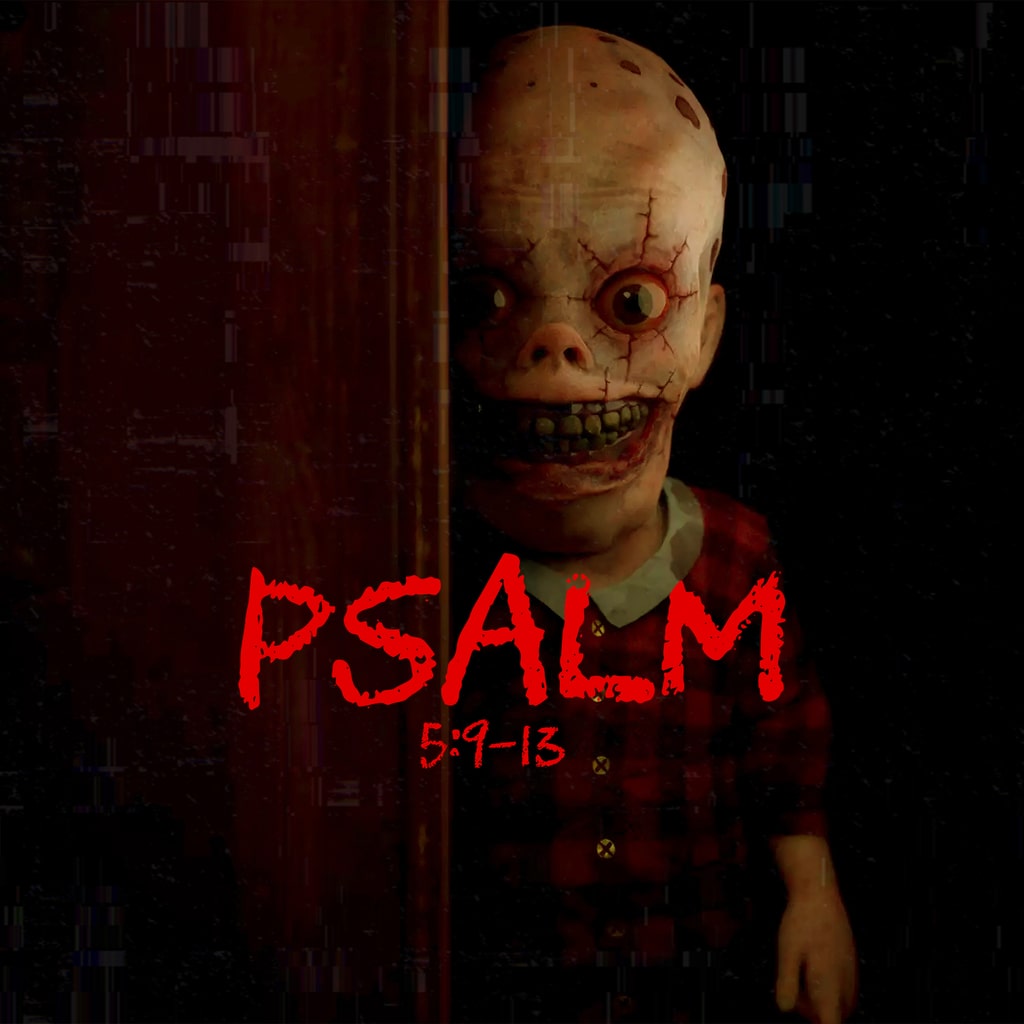
There is something particularly unsettling about horror that refuses to announce itself. Give me a blood-soaked castle or a monster charging down a corridor, and I know where I stand. Put me inside an ordinary-looking home, let everything appear perfectly normal, then quietly start moving things that shouldn’t move, and suddenly my imagination becomes the most frightening thing in the room. Psalm 5:9-13 understands that distinction beautifully, delivering a short psychological horror experience that relies far more on atmosphere and uncertainty than on brute force.
Developed by EMIKA GAMES and published by Axyos Games, Psalm 5:9-13 is another compact first-person nightmare from a studio that has clearly developed an affection for making everyday environments feel deeply wrong. The premise is deliberately vague, with players stepping into an apparently ordinary location and gradually discovering that reality isn’t quite behaving as it should. There are no elaborate combat systems, sprawling inventories, or endless corridors filled with monsters. Instead, the game asks a much simpler question: how long can you remain comfortable when everything around you starts becoming just a little bit strange?
Nothing Is Quite What It Seems
The opening moments of Psalm 5:9-13 are deliberately restrained. You are given the freedom to explore your surroundings, inspect objects and take in the environment without being immediately told what to fear. That decision works because it gives the setting time to breathe. You begin by treating the space as somewhere you simply need to navigate, rather than somewhere you desperately need to escape.
Then something changes. It might be a detail you initially dismiss. Perhaps an object is no longer where you remember seeing it, a doorway behaves differently, or a familiar part of the environment suddenly feels unfamiliar. The clever part is that the game doesn’t always draw attention to these changes. You are expected to observe, which makes the player an active participant in the horror rather than simply a passenger being dragged from one scripted scare to another.
That approach creates a wonderful sense of paranoia. You start questioning your own memory because you can no longer be entirely certain whether something actually changed or whether you simply missed it the first time. Before long, you are checking rooms twice, looking behind you and studying seemingly insignificant details. That’s when Psalm 5:9-13 really gets under your skin.
The Horror of the Ordinary
The game’s greatest strength is its grasp of the uncanny. There is nothing inherently frightening about a corridor, a bedroom or a domestic living space. We’ve all spent countless hours in such environments, so their corruption is far more effective when the game begins to twist them.
A flickering light in an abandoned asylum is expected. A flickering light in an ordinary home is somehow much worse. EMIKA GAMES makes excellent use of this familiarity. Walls, furniture and everyday objects become part of the horror because they provide a baseline for normality. Once that baseline starts to fracture, even the most innocuous-looking room can feel threatening. You begin searching for anomalies because you know something is wrong, but finding one doesn’t necessarily make you feel safer.
In fact, it often makes things worse. The game also understands the importance of restraint. Not every strange occurrence needs a loud musical sting or something screaming directly into the camera. Sometimes a shadow appearing where it shouldn’t is enough. Sometimes a doorway being open when you know you closed it is considerably more disturbing than a monster jumping into your face.
A VHS Nightmare
Visually, Psalm 5:9-13 embraces the increasingly popular VHS horror aesthetic, but it uses the effect as more than mere decoration. The grain, distortion and imperfect image quality lend the world an unsettling sense of authenticity. It feels as though you’re watching something that perhaps wasn’t meant to be seen, and that feeling works particularly well alongside the game’s psychological themes.
The visual presentation also benefits from its relatively realistic environments. There is a grounded quality to the locations that makes the supernatural elements stand out more strongly. When something impossible happens within a convincingly rendered domestic space, the contrast becomes unsettling.
There are moments when the VHS effect can obscure some of the environmental detail, particularly when the screen becomes heavily distorted, but that is arguably part of the intended experience. You aren’t supposed to have a perfectly clean view of everything around you. Uncertainty is one of the game’s most important weapons.
Sound Is Where the Game Gets Mean
If the visuals make Psalm 5:9-13 uncomfortable, the sound design makes it genuinely unnerving. Horror lives and dies by audio, particularly in a game where the player spends much of their time simply walking and observing. EMIKA GAMES uses silence extremely well, letting footsteps, distant noises and subtle environmental sounds become events in themselves.
A quiet room can be more frightening than a room full of screaming. You begin to listen for things that aren’t there, wondering whether that faint sound came from nearby or whether your imagination supplied it. The occasional use of interference and unsettling noises gives the player just enough information to become nervous without completely revealing what is happening.
The result is a soundtrack of sorts in which the environment itself becomes the instrument. Every creak has meaning. Every unexpected noise becomes a potential warning. It creates the kind of tension where you can find yourself walking more slowly simply because you don’t want to discover what is waiting around the next corner.
A Short Journey With Little Wasted
One of the inevitable talking points about Psalm 5:9-13 is its length. This is not a game designed to occupy your weekend. The core experience can be completed in roughly half an hour, firmly placing it within the short-form horror tradition.
That brevity will undoubtedly disappoint some players. Horror fans expecting a substantial campaign may feel the experience ends just as it has settled into its rhythm. However, I think the compact structure works in its favour more often than not.
The game doesn’t have to stretch its central idea beyond breaking point. There are no unnecessary combat sections or repetitive fetch quests simply to pad the runtime. Instead, it establishes its atmosphere, gradually increases the pressure, and gets out before the concept becomes exhausted. There is something to be said for horror that knows when to leave the room.
Psychological Horror Without The Padding
What makes Psalm 5:9-13 memorable isn’t any single scare. It’s the cumulative effect of those little disturbances. You walk through a familiar environment and slowly realise you’re no longer entirely certain of the rules that govern it.
That is where the psychological side of the game earns its keep. Rather than constantly throwing monsters at you, the experience encourages you to doubt what you’re seeing. It makes the player feel vulnerable without taking away their ability to explore.
There are certainly moments when the experience leans towards familiar horror conventions. Some scares are more predictable than others, and anyone who has played many indie walking simulators will recognise certain tricks. Yet the execution is strong enough that these familiar ingredients still work.
The game doesn’t reinvent psychological horror, but it doesn’t need to. Sometimes good horror comes from understanding the fundamentals and executing them with confidence.
Verdict
Psalm 5:9-13 is a short game, but its brevity shouldn’t be mistaken for a lack of ambition. EMIKA GAMES has crafted an atmospheric little nightmare that understands the power of suggestion, silence and environmental unease. The VHS presentation gives the experience a suitably grimy personality, while the sound design does an excellent job of making empty rooms feel occupied by something you really don’t want to meet.
The biggest criticism is inevitably its length. There simply isn’t enough here for players seeking a substantial horror adventure, and some of the narrative mysteries could have benefited from more time to breathe. Yet stretching the game unnecessarily could just as easily have diluted what works so well. Psalm 5:9-13 is at its best when it leaves you alone with your thoughts and allows your imagination to fill in the gaps.
And perhaps that’s the most important thing a psychological horror game can achieve. It doesn’t need to chase you. It just needs to make you wonder whether something is standing behind you. Psalm 5:9-13 does exactly that. It is an eerie, atmospheric and wonderfully uncomfortable slice of psychological horror that makes good use of its compact format. Fans of short first-person horror experiences should absolutely give it a look, particularly if they prefer creeping dread and environmental oddities over constant jump scares.