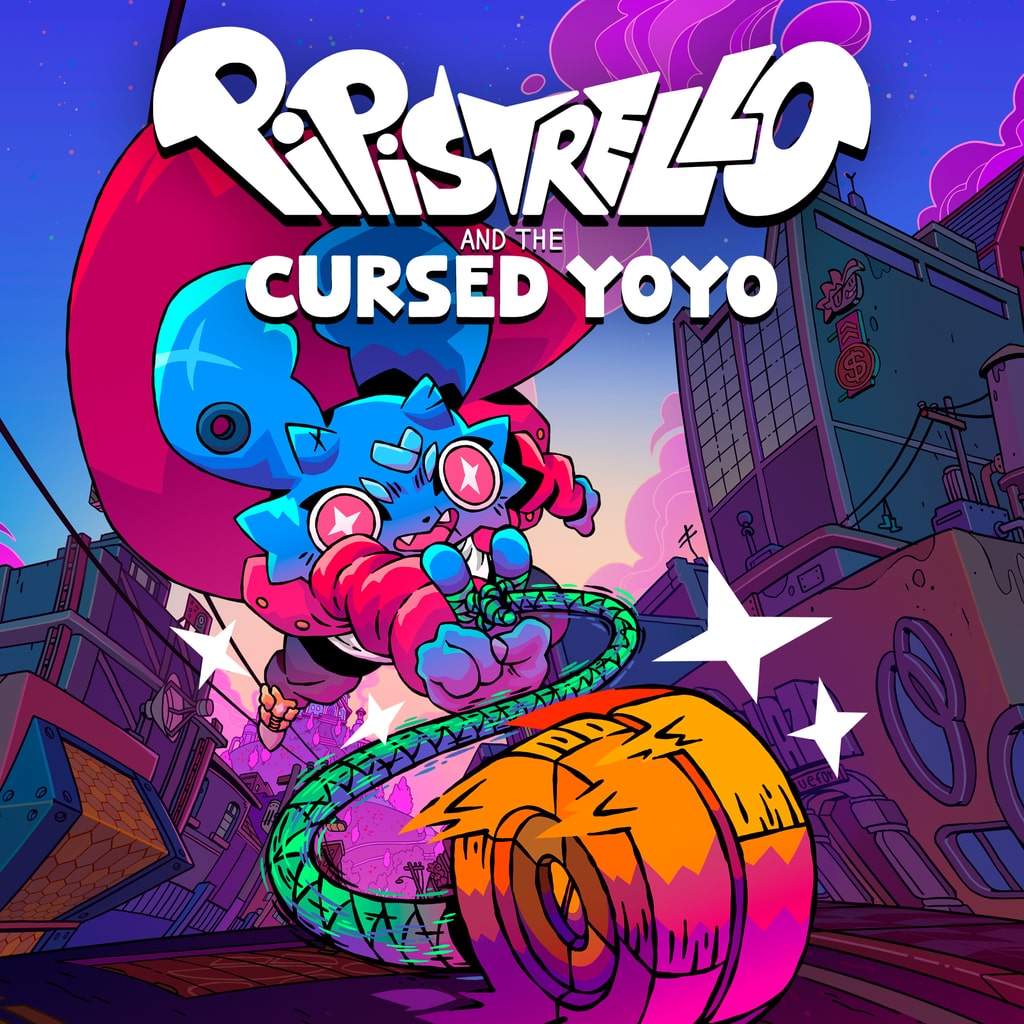
There are some games that look at an ordinary object and somehow manage to turn it into the foundation for an entire adventure. Pipistrello and the Cursed Yoyo takes one of the most recognisable toys imaginable and asks a very important question: what if this thing could also be a weapon, a grappling tool, a platforming device and the key to exploring an entire city? The answer is a surprisingly inventive 2D adventure that manages to make the humble yo yo feel fresh, useful and, at times, downright dangerous.
Developed by Pocket Trap and published by PM Studios, Pipistrello and the Cursed Yoyo combines top down exploration, action combat, environmental puzzles and precision platforming into something that feels wonderfully old school while still having plenty of its own personality. The Nintendo Switch 2 Edition builds on that foundation with higher resolution visuals and an enhanced frame rate, giving the colourful city of Obal a welcome technical boost. More importantly, underneath all that visual polish is a game with a genuinely clever central idea and a protagonist who is difficult not to root for.
Welcome to Obal
The story begins with Pippit, a budding yo yo master who finds herself caught up in a rather unpleasant family situation. Her auntie’s business empire has become tangled in a conspiracy involving a soul stealing mega laser, while four particularly unpleasant crime bosses are making life considerably more difficult than it needs to be. Naturally, Pippit is going to have to sort it out herself, and fortunately she has a cursed yo yo capable of doing considerably more than entertaining people at the end of a piece of string.
That setup immediately gives Pipistrello and the Cursed Yoyo a wonderfully playful tone. The game never feels as though it is trying to imitate darker, more serious action adventures, even when the story wanders into surprisingly sinister territory. There is a colourful comic book quality to everything, with eccentric characters, larger than life villains and a city that feels like it has been designed specifically to encourage you to poke your nose into places you probably shouldn’t.
The four districts of Obal provide the backbone of the adventure, with each one offering its own challenges, enemies and secrets. There are more than 1,000 screens to explore, which sounds intimidating on paper, but the interconnected structure makes exploration feel much more natural. You will constantly spot somewhere you cannot reach yet, remember a suspicious looking doorway from earlier or realise that one of your newly acquired yo yo techniques can completely change the way you approach a previously impossible obstacle.
The Yo Yo Is the Star
The biggest achievement here is that the yo yo never feels like a gimmick. It would have been very easy for the developers to create a standard action adventure and simply replace a sword with a yo yo, but that is not what has happened. Instead, the weapon has been designed around movement, momentum and environmental interaction, giving it a remarkable amount of versatility.
You can throw it at enemies, use it to hit switches, interact with objects and manipulate your surroundings. Better still, learning new tricks gradually expands what you can do with it. A technique that initially seems useful only for combat can suddenly become the missing ingredient in a platforming puzzle, while another can open up a shortcut that you had previously assumed was decoration.
That sense of discovery is where Pipistrello and the Cursed Yoyo really shines. Rather than simply handing you a new ability and saying, “Here is where you use it”, the game encourages experimentation. You start to think about the city differently because you are no longer just looking for doors and ladders. You are looking for walls to bounce from, gaps to swing across and objects that might react to a well placed yo yo.
Learning the Art of the Trick
Combat is similarly built around the yo yo’s flexibility. Enemies can be attacked from a distance, projectiles can be dealt with creatively and clever positioning can turn an awkward encounter into something surprisingly elegant. Once you start chaining attacks and tricks together, the combat develops a pleasing rhythm that rewards players who are willing to experiment rather than simply hammering the attack button.
The trick system gives encounters another layer of personality. Successfully chaining moves can build your trick meter, allowing you to unleash more powerful techniques and make short work of groups of enemies. There is a lovely feeling when everything clicks into place and your yo yo starts bouncing around the screen as though Pippit has been doing this for years.
Naturally, the platforming eventually becomes considerably more demanding. Precision matters, and the momentum based movement can initially take a little getting used to. There is a definite difference between knowing what the game wants you to do and actually having the skill to execute it, but that is precisely what makes mastering the harder challenges so satisfying.
A City Full of Secrets
Obal is more than a backdrop for the action. It is effectively one enormous puzzle box, and the more abilities you unlock, the more of it begins to make sense. Hidden routes, secluded rooms and collectible treasures encourage you to revisit areas rather than simply racing towards the next story objective.
There are more than 40 badges to discover, each capable of altering aspects of your abilities or changing the way you approach the game. These provide another welcome layer of customisation, particularly for players who enjoy tweaking their character to suit their preferred style. You can also unlock more than 20 passive upgrades, while more than 80 additional collectibles give completionists plenty of reasons to search every corner.
What I particularly like is that exploration rarely feels completely compulsory. If you want to concentrate on the main adventure, you can do so, but the game constantly dangles little mysteries in front of you. You might notice something on a distant rooftop or glimpse an item behind an obstacle, and suddenly that quiet voice in your head starts saying, “I wonder if I can get there yet?”
Of course, you will probably go and find out.
Four Crime Bosses, Four Challenges
The four major crime bosses provide the game’s larger dramatic encounters, with their businesses acting as sprawling environments packed with enemies, puzzles and platforming challenges. These areas help give the adventure a sense of progression without making Obal feel like a collection of disconnected levels.
There is a pleasing variety to the challenges, too. Some sections ask you to think about your surroundings, while others test your combat skills or movement precision. The best moments are those where the game combines all three, forcing you to think quickly while using the yo yo in ways that you might not have expected.
It is here that Pipistrello and the Cursed Yoyo feels most like a modern interpretation of the classic adventure games that inspired it. There is a genuine joy in finding a new ability, remembering an inaccessible area and then returning to discover what was waiting there. It is a simple formula, but when the underlying mechanics are this enjoyable, it remains remarkably effective.
A Perfect Fit for Switch 2
The Nintendo Switch 2 Edition is an excellent home for the game. The higher resolution presentation brings additional clarity to the colourful pixel art, while the enhanced frame rate makes the fast movement and precision platforming feel considerably smoother.
That matters more than it might sound. When a game relies so heavily on momentum, timing and accurate movement, consistency is important. A smooth experience makes those tricky yo yo manoeuvres feel more responsive, particularly during the later challenges when a tiny mistake can send you tumbling into trouble.
The art style itself is a delight. Pipistrello and the Cursed Yoyo has a wonderfully colourful aesthetic that manages to feel nostalgic without becoming trapped by nostalgia. Obal is packed with personality, and the visual design complements the game’s playful humour beautifully.
The Joy of Mastery
Perhaps the biggest compliment I can give Pipistrello and the Cursed Yoyo is that it gets better the more comfortable you become with it. Early on, the yo yo can feel slightly awkward because you are learning its peculiarities. Eventually, those same mechanics become second nature, and you begin throwing it around corners, bouncing off surfaces and navigating the city with an almost effortless rhythm.
That transition from uncertainty to mastery is something great games understand. The developers have created mechanics that are distinctive enough to require learning but intuitive enough that you eventually stop thinking about the controls and simply start playing.
There are certainly moments when the platforming can be demanding, and some players may find the momentum based movement frustrating until it clicks. The sheer number of collectibles can also feel a little overwhelming if completion is your goal. However, these are relatively minor complaints in an adventure that consistently rewards curiosity and experimentation.
Verdict
Pipistrello and the Cursed Yoyo is a wonderfully inventive adventure that takes a deceptively simple idea and builds an entire game around it. The yo yo is not merely a novelty weapon. It is the heart of the experience, shaping combat, exploration, puzzle solving and platforming in ways that feel surprisingly natural once everything clicks.
The colourful city of Obal is packed with secrets, the four crime bosses provide memorable targets and the huge collection of badges, upgrades and collectibles gives explorers plenty to chase. Most importantly, there is a real sense of joy running through the whole thing. It feels like a game made by people who genuinely understand why experimenting with a strange new mechanic can be so much fun.
The Nintendo Switch 2 Edition is arguably the best way to experience it, with the higher resolution visuals and enhanced frame rate making an already responsive adventure feel even sharper. It is bright, inventive, occasionally challenging and full of character, which is a pretty fantastic combination.
If you have ever looked at a yo yo and thought it could probably make a surprisingly good weapon, Pipistrello and the Cursed Yoyo is the game you’ve been waiting for.