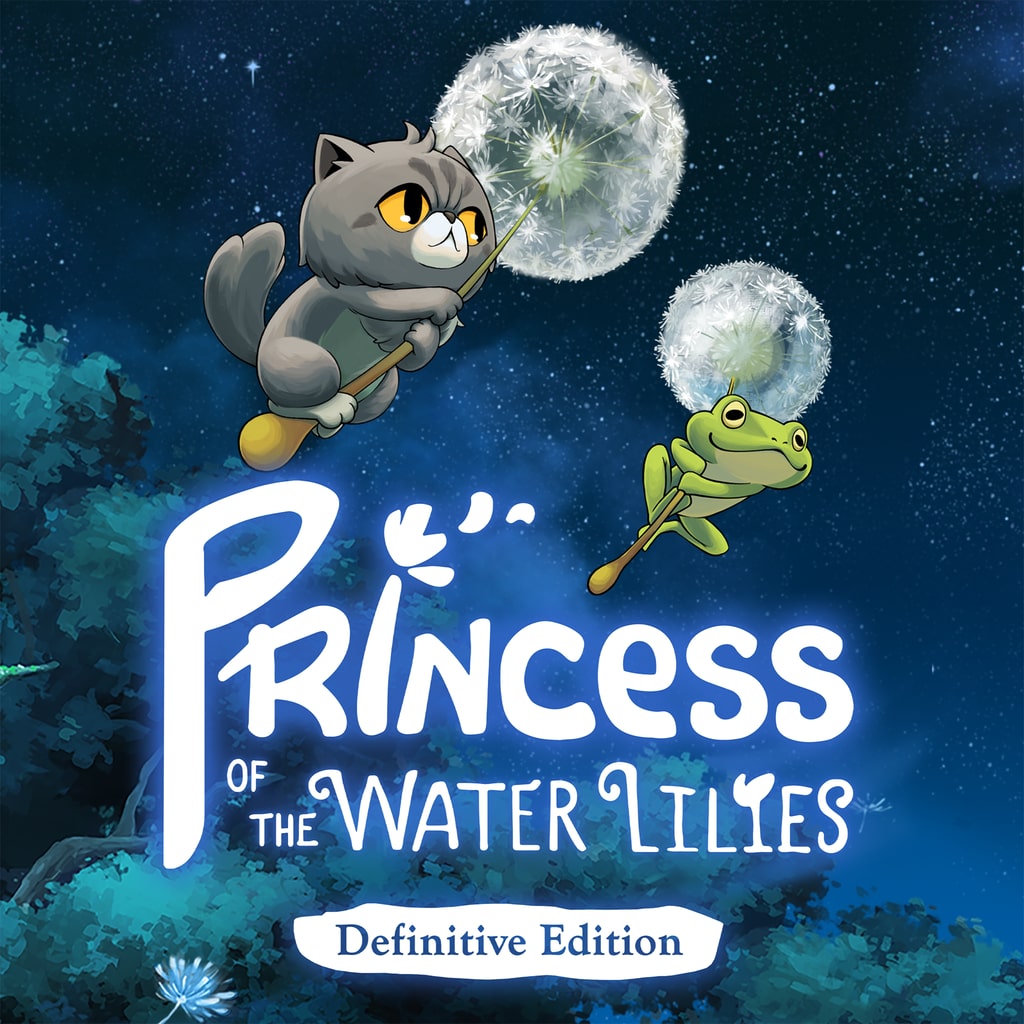
Some games seem determined to give you a good kicking, despite looking like they were designed to be played while curled up under a blanket with a cup of tea. Princess of the Water Lilies is one of those games. At first glance, its hand-drawn artwork, soft watercolour backgrounds and adorable flat-faced cat protagonist suggest a gentle fairy tale where the biggest danger might be getting your paws wet. Then a giant mechanical camel starts firing bullets at you, and suddenly that cosy bedtime story has turned into something considerably more stressful.
Developed by Whyknot Studio and published by Red Dunes Games, Princess of the Water Lilies is a 2D puzzle platformer with a wonderfully unusual premise. You play as an abandoned kitten who is taken in by a family of frogs and eventually grows into the guardian of a magical lily kingdom. Your weapon is not a sword, a gun or a collection of increasingly ridiculous explosives, but a magical purr that can heal the natural world and interact with the environment.
It is an immediately likeable idea, and thankfully the game does not rely solely on its cute appearance to carry the experience. Beneath those charming visuals lies a platformer with clever environmental puzzles, exploration, collectibles and some surprisingly demanding boss encounters. The contrast between the gentle storybook presentation and the occasional bursts of absolute chaos is what makes Princess of the Water Lilies so memorable.
Once Upon A Lily Pad
The story begins with a kitten being abandoned and then adopted by frogs, which is about as wonderfully strange as video game storytelling gets. As Princess grows up, she becomes connected to the lily kingdom and eventually takes on the responsibility of protecting the natural world from a growing corruption.
There is no traditional dialogue constantly explaining what is happening. Instead, the game relies heavily on its visuals, animation and environmental storytelling to tell its tale. That works surprisingly well because the hand-crafted presentation gives everything the feel of a beautifully illustrated children’s storybook.
There is a certain innocence to the opening hours that makes the darker elements stand out more effectively later on. You are wandering through beautiful forests, meeting charming creatures and bringing life back to areas that have been damaged. Then the game reminds you that something has gone very wrong in this world, and suddenly your little feline hero has rather more responsibility on her paws than you might have expected.
The Power Of A Purr
The central gameplay mechanic is Princess’s magical purr, an idea that sounds ridiculous when described but works beautifully in practice. By releasing a magical soundwave, Princess can interact with the world around her, awaken dormant plants and activate environmental mechanisms.
It is a lovely alternative to the usual platforming abilities. Rather than simply giving you another projectile to fire at enemies, the purr becomes a tool for understanding and manipulating the environment. You start looking at plants, switches and strange objects differently, knowing that your voice might be the key to bringing them to life.
There is also something fitting about using a purr as a force for healing. Princess is not travelling through this world simply to destroy everything in sight. Her purpose is to restore what has been damaged, and the mechanics reinforce that idea rather than merely mentioning it in the story. It gives the adventure a surprisingly gentle heart.
A World That Wants To Be Explored
The game’s environments are spread across five distinct biomes, each with its own visual identity and challenges. There are plenty of familiar platforming ideas here, including wall climbing, vine swinging and underwater exploration, but the game uses them alongside environmental puzzles rather than treating movement as an end in itself.
Exploration is often about working out where you need to go rather than simply following a straight path. Locked doors, hidden switches and environmental mechanisms encourage you to look around rather than sprint through each area. Sometimes the solution is right in front of you, while other moments require you to backtrack and reconsider something you saw earlier.
That makes the world feel more like a collection of little puzzles than a simple series of platforming challenges. The semi-open structure gives you enough freedom to poke around, and finding a hidden route or discovering that an apparently decorative object actually has a purpose is always satisfying.
Keys, Cages And Golden Orbs
There is plenty to discover if you are the sort of player who cannot resist checking every suspicious corner. Hidden walls and secret paths conceal collectables, while trapped forest animals can be rescued along the way.
These extras fit well with the game’s overall theme. You are not simply collecting random objects because the developers needed something to put in the level. There is a sense that you are helping to restore the world, which makes exploration feel a little more meaningful.
The golden orbs provide another reason to revisit areas and pay closer attention to your surroundings. You can easily rush through a section without finding everything, but the game rewards curiosity. If you see a suspicious-looking gap or an area that seems slightly too empty, there is usually a good reason to investigate.
Storybook Beauty
Visually, Princess of the Water Lilies is one of its strongest elements. The hand-drawn animation and watercolour-inspired environments give the game an almost traditional animated-film quality, with lush greenery, expressive characters and beautifully illustrated backgrounds.
There is a softness to the artwork that immediately sets the mood. Everything looks warm and inviting, and even the stranger creatures have a certain charm. Princess herself is wonderfully simple, with that flat feline face becoming surprisingly expressive despite its minimal design.
The animation deserves particular praise for bringing the world to life. Plants react to your abilities, environmental elements move around you, and the various creatures have enough personality to keep the world from feeling static. It is the sort of presentation where you occasionally want to stop playing simply to take in the scenery.
Then Everything Gets Horrible
And this is where Princess of the Water Lilies catches you completely off guard. The game looks gentle. The soundtrack can be soothing. Princess is an adorable little cat raised by frogs. Surely the boss encounters will be equally pleasant, right? Absolutely not.
The boss battles can be surprisingly intense, transforming the relaxed platforming into frantic tests of movement and timing. One moment you are happily exploring a colourful environment, and the next you are dodging waves of projectiles while working out how to stay alive.
The contrast is brilliant because it makes the bosses feel like genuine events. They are not simply larger enemies placed at the end of a level. They completely change the pace of the game, demanding far more concentration and precision than the quieter sections.
Boss Battles With Bite
Some of these encounters lean heavily into bullet-hell territory, with attacks filling the screen and forcing you to keep moving. A mechanical camel that fires projectiles at you is not something I expected to write about when I started this review, but here we are.
The difficulty spikes can be quite dramatic. Players who arrive expecting a purely cosy platformer may find themselves completely unprepared when one of these battles begins. There is a definite learning curve, with success often coming from recognising patterns, understanding where you can safely stand, and knowing when to make your move.
Thankfully, the challenge rarely feels completely out of place. The bosses are designed to test the movement skills you have developed throughout the preceding stages, and beating one can provide a genuine sense of achievement. There is something particularly satisfying about finally overcoming an encounter that looked utterly impossible a few attempts earlier.
A Silent Little Hero
One of the more interesting aspects of Princess of the Water Lilies is that its protagonist does not rely on traditional dialogue to reveal who she is. Princess is effectively a silent hero, yet the game still makes her feel like the emotional centre of the adventure.
Her actions tell the story. She explores a damaged world, restores nature, rescues animals, and faces increasingly dangerous creatures because she believes the kingdom is worth saving. There are no lengthy speeches explaining her motivation, and in a strange way that makes the journey feel more universal.
It also gives the game’s visual storytelling more room to breathe. Characters communicate through expressions and animation, while changes in the environment show the consequences of what is happening. Sometimes a world returning to life says far more than a paragraph of dialogue ever could.
The Sound Of Nature
The orchestral soundtrack is another major part of the game’s charm. During exploration, the music reinforces the peaceful storybook atmosphere, creating a gentle backdrop for your journey through the various biomes.
Then the bosses arrive, and the soundtrack shifts with them. The orchestration becomes more dramatic and energetic, matching the sudden increase in danger and giving those encounters a real sense of occasion.
The purring itself is also an important part of the soundscape. It is an amusingly wholesome sound to build a magical power around, but it also reinforces the game’s identity. You are not playing another generic hero with another generic weapon. You are a cat whose greatest power is an exceptionally powerful purr, and I absolutely love that.
Cute Does Not Mean Easy
If there is one thing I would make clear to potential players, it is that Princess of the Water Lilies should not be mistaken for a completely relaxing experience. The presentation may suggest something suitable for players seeking an easygoing platformer, but the boss battles can be considerably more demanding.
That contrast may catch some players off guard, particularly if they have been drawn in by the cosy artwork. Personally, I think it works. If the entire game remained gentle from beginning to end, the tougher encounters would not have nearly the same impact.
The important thing is that the difficulty gives the adventure some teeth without destroying its personality. Princess is still a charming little cat in a beautiful storybook world. She just happens to spend part of her journey dodging enough projectiles to make you question whether cats really do have nine lives.
A Little Rough Around The Edges
Princess of the Water Lilies is not flawless. The sudden difficulty spikes can occasionally feel harsher than the surrounding platforming prepares you for, and some players may find the transition from peaceful exploration to frantic boss combat a little abrupt.
There are also moments when the puzzle elements could perhaps do more to challenge the player. The environmental mechanics are enjoyable, but they generally serve as gentle interruptions to the platforming rather than becoming truly demanding brain teasers.
Neither issue undermines the overall experience, though. The game’s personality carries it a long way, and there is a genuine sense of care in the artwork, animation and world design. It feels like a small team has poured a lot of affection into creating something that looks and feels different from the crowd.
Final Verdict
Princess of the Water Lilies is a charming little adventure with considerably more bite than its beautiful storybook appearance suggests. The combination of hand-drawn animation, watercolour environments, gentle environmental puzzles and an adorable cat protagonist creates an immediately appealing experience.
The magical purr is an inspired central mechanic, giving Princess a distinctive way to interact with the world while reinforcing the game’s themes of healing and restoration. Exploring the five biomes, rescuing trapped animals, discovering hidden paths and collecting golden orbs give the adventure plenty of reasons to look beyond the obvious route.
Then there are the bosses, which provide the game’s biggest surprise. These encounters can be frantic, challenging and occasionally brutal, but they also give the otherwise gentle adventure a welcome sense of tension. The contrast between cosy exploration and bullet-hell-style battles will not appeal to everyone, particularly those expecting a completely relaxing platformer, but it certainly gives the game an identity.
What ultimately sticks with me is how much personality Princess of the Water Lilies manages to create without relying on walls of dialogue or endless exposition. It is a game about a little cat raised by frogs who wanders through a beautiful but damaged world, using the power of her purr to bring nature back to life. That sentence alone sounds like something from a children’s book, yet Whyknot Studio has turned it into a surprisingly engaging platforming adventure.
It is sweet, strange, beautiful and occasionally rather vicious. Most importantly, it has a heart, and in a world filled with games constantly vying for your attention, there is something rather lovely about a little cat simply purring her way through it.