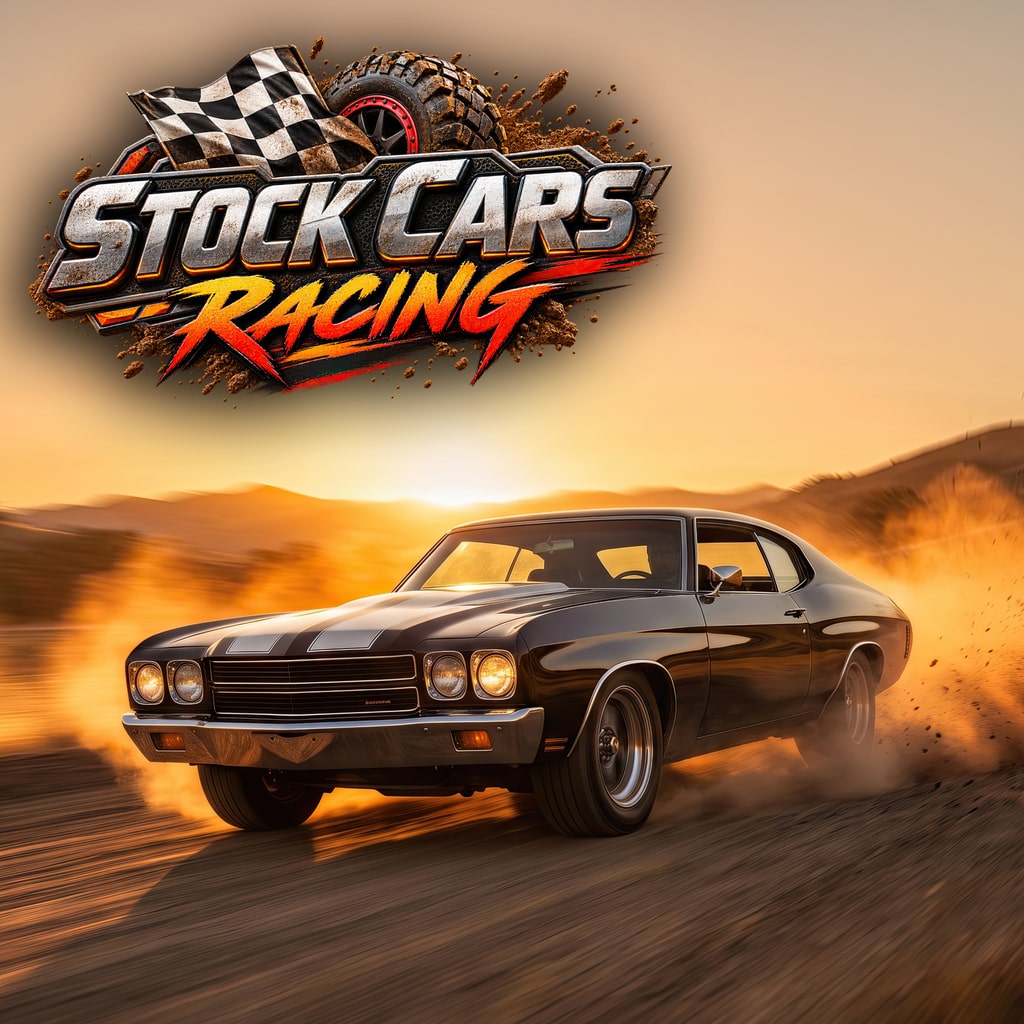
There is something wonderfully uncomplicated about getting behind the wheel, pointing a car at the horizon and putting your foot down. You do not need a detailed career mode, a garage full of tuning options or a degree in motorsport engineering to enjoy a good arcade racer. Sometimes you just want a few laps, a handful of opponents and the chance to barge your way through the pack before somebody does exactly the same to you. Stock Cars Racing understands that basic appeal, although its ambitions are about as modest as its budget.
Developed and published by Pix Arts, Stock Cars Racing is a straightforward arcade racer built around short races, varied surfaces and a small selection of vehicles. There is no attempt to compete with the technical complexity of the big racing simulations, and frankly, that is probably for the best. Instead, this is a game that wants you racing almost immediately, throwing you onto dirt, through forests and across snowy circuits while aggressive AI opponents do everything they can to stop you reaching the chequered flag first.
It is simple, occasionally rough around the edges and certainly not going to keep the more serious racing fan busy for hundreds of hours. Yet there is a certain charm to that simplicity. Stock Cars Racing knows what it wants to be, and while it does not always deliver it with the polish you might hope for, there are moments when the uncomplicated arcade racing formula clicks surprisingly well.
Put Your Foot Down
The first thing you notice is how quickly Stock Cars Racing gets to the point. There are no lengthy introductions or complicated systems to learn before you can start racing. Pick a vehicle, choose a track and get ready to fight your way through the pack.
That immediate accessibility is arguably the game’s greatest strength. Anyone who has ever played an arcade racer can pick this up and understand the basics within seconds. Accelerate, steer, brake when necessary, and try not to turn your car into an expensive collection of spare parts.
The races are also short enough to make the game particularly easy to dip into. You can have a few races in a spare ten minutes without feeling as though you have committed yourself to a major gaming session. It is the sort of design that works well when you want something uncomplicated after a long day.
Dirt, Forest And Snow
Where the game tries to add variety is through its environments. Tracks take you across dusty dirt roads, forest trails and snow-covered circuits, with each surface aiming to provide a slightly different driving challenge.
The dirt tracks are perhaps the most natural fit for the game’s rough-and-ready approach. Cars slide around corners, grip can feel unpredictable, and getting the perfect line is less important than simply keeping your momentum. There is a satisfying sense of chaos when several cars enter a corner together and emerge pointing in completely different directions.
The forest tracks bring a little more technicality into the mix. Trees and tighter corners make positioning more important, while the narrower routes mean that getting stuck behind another driver can cost valuable seconds. Snow is naturally the trickiest surface, with reduced grip making mistakes considerably easier to commit and considerably harder to recover from.
The environmental variety is welcome, even if the differences between surfaces are not as dramatic as they could be. You certainly notice that a snowy circuit requires a little more care, but the underlying driving model remains fairly consistent regardless of where you are racing.
Choose Your Weapon
There is a small selection of vehicles to choose from, including classic cars, lightweight buggies and heavier vans. It is not the largest garage you will ever see in a racing game, but the variety of vehicle types at least gives you something to experiment with.
The classic cars provide a fairly familiar driving experience, while the buggies feel lighter and more agile. They are particularly enjoyable when you need to change direction quickly or recover from a mistake. The vans, meanwhile, add a little more weight to proceedings and can feel considerably less nimble when thrown into a tight corner.
That difference matters because it stops vehicle selection from feeling purely cosmetic. You can choose something that suits the way you like to race rather than simply selecting whichever car happens to have the biggest number attached to it. If you prefer aggressive driving and enjoy squeezing through gaps, a more agile vehicle makes sense. If you would rather bully your way through the pack, something heavier can feel like the obvious choice.
The Need For Speed
The boost system is the game’s main way to inject tactical thinking into the racing. Boost is not something you should simply activate the moment it becomes available. Using it at the right time can make the difference between sitting behind another driver and flying past them on a straight.
That creates some enjoyable little decisions during a race. Do you use your boost now to gain a position, or save it for the final straight? Do you risk activating it while approaching a corner, knowing you might carry too much speed into the turn? These are not exactly revolutionary questions, but they give the races a little more personality.
The boost is at its best when several cars are fighting for position. A well-timed burst of speed can turn a disappointing race into a last-second charge towards the front. Equally, wasting it at the wrong moment can leave you watching the opposition disappear into the distance.
These Drivers Do Not Like Losing
The AI opponents are surprisingly aggressive. They are not simply there to drive around the circuit and give you something to look at while you collect an easy victory. They will fight for position, block racing lines, and happily turn a tight corner into a battle of paint and bumpers.
That aggression can be both entertaining and frustrating. There are moments when the chaos works brilliantly, particularly when several cars are battling for the same piece of track. You can feel the pressure building as everyone tries to squeeze through the same corner, and coming out the other side in front feels genuinely satisfying.
There are also occasions when the AI seems more interested in ramming you than actually racing. Being pushed wide after carefully setting up for a corner can be infuriating, especially when you are already fighting the limitations of the handling model. Still, the aggression does at least ensure that races rarely feel completely lifeless.
Arcade Racing At Its Most Basic
It is important to approach Stock Cars Racing with realistic expectations. This is not a simulation, and there is no point pretending otherwise. You will not find complex vehicle setups, tyre strategies, detailed telemetry, or an enormous career system waiting for you.
For some players, that will be precisely the attraction. There is something refreshing about a racing game that does not ask you to spend twenty minutes adjusting suspension settings before letting you onto the track. Stock Cars Racing wants you driving, and it wants you driving now.
The downside is that the simplicity can eventually become repetitive. Once you have experienced the different environments and tried the available vehicle types, there is not much left to discover. The lack of online multiplayer is particularly noticeable, as this type of chaotic arcade racing could have been great fun with real people.
A Little Rough Around The Edges
The budget origins of Stock Cars Racing are hard to hide. The visuals are functional rather than spectacular, with relatively basic vehicle models, environmental assets and trackside detail. Weather effects are also fairly restrained, so do not expect snowstorms, dynamic weather or dramatic lighting changes to transform the circuits.
The audio follows the same philosophy. Engine sounds, tyre noise and collisions do their job without exactly setting your speakers on fire. There is nothing particularly offensive about the soundtrack either, but it is unlikely to have you searching for it on a music streaming service after putting the controller down.
None of this makes the game unplayable, but it does limit the overall sense of polish. The racing itself does most of the heavy lifting, and when that works, you can overlook the rougher presentation. When the racing becomes repetitive, however, the lack of additional bells and whistles becomes considerably more obvious.
Just One More Race
Despite its limitations, there is one quality that Stock Cars Racing gets absolutely right: it can be hard to put down after a disappointing race. There is always the temptation to have another go because you know you could have taken that corner better or saved your boost for a little longer.
That is the magic of arcade racing in its simplest form. You lose, you grumble, you restart, and then you convince yourself that the next attempt will be different. Suddenly you have completed several races without really noticing how much time has passed.
It is not a deep experience, but it does not necessarily need to be. There is a place for games that simply let you race without demanding too much of your time or attention. Stock Cars Racing occupies that space quite comfortably.
Final Verdict
Stock Cars Racing is a modest arcade racer that delivers exactly what its title promises. There are cars, tracks, aggressive opponents and a boost button that lets you make a desperate charge for the finish line. It is straightforward racing entertainment without the complicated systems and long-term commitments that come with more ambitious titles.
The variety of dirt, forest and snow environments helps keep things moving, while the different vehicle types give you some choice over how you want to tackle the tracks. The boost mechanic adds a small amount of strategy, and the aggressive AI ensures that even a short race can become surprisingly chaotic.
The problem is that the game’s simplicity eventually catches up with it. The visuals and audio are basic, the number of vehicles is limited, and there is no online multiplayer to provide the kind of unpredictable competition that could have given the game a much longer lifespan. Once the novelty of the different environments has worn off, there is not an enormous amount here to keep dedicated racing fans coming back.
Still, there is something to be said for a game that knows exactly what it is. Stock Cars Racing is not trying to be Forza Motorsport or Gran Turismo. It is a quick, accessible arcade racer designed for short bursts of wheel-to-wheel action, and when you approach it on those terms, there is some uncomplicated fun to be had.