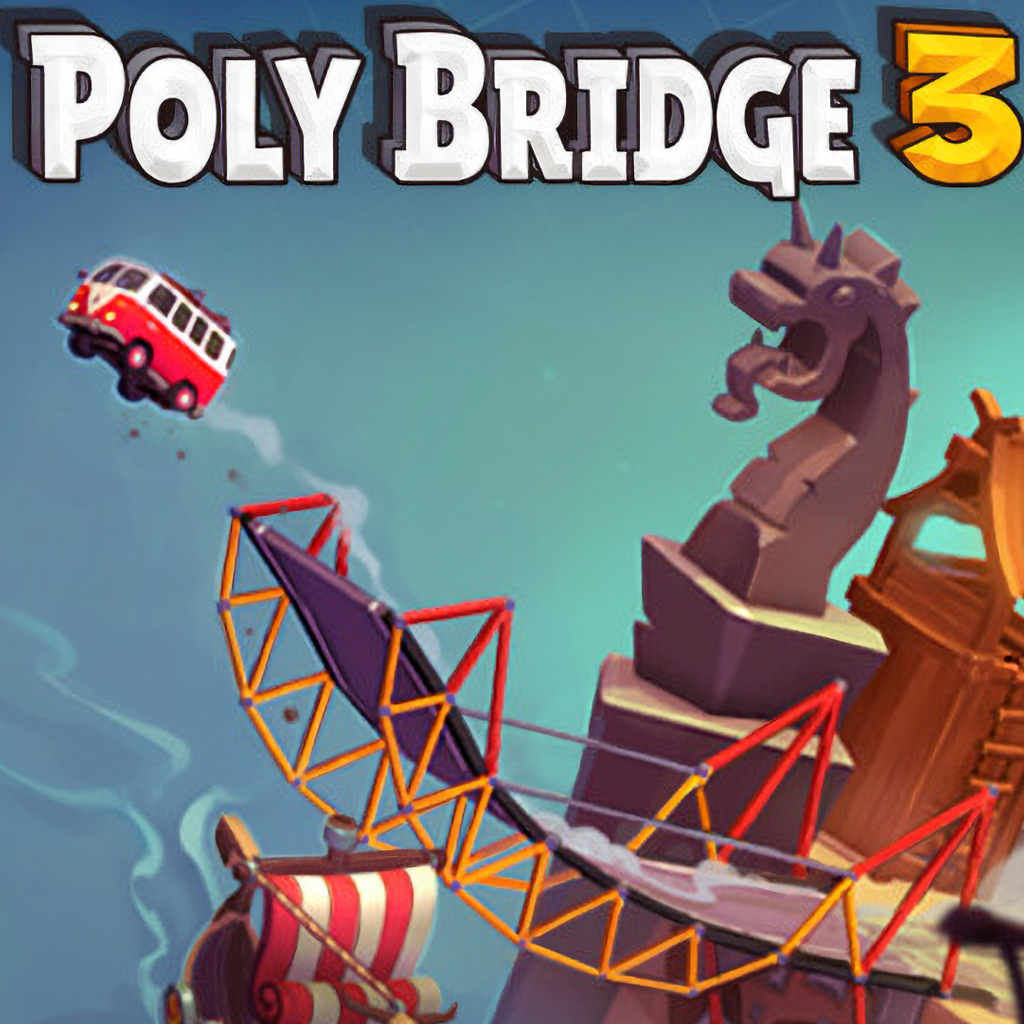
There are games that make you feel like a hero, games that make you feel like a master detective, and games that make you feel like the fate of the world rests entirely on your shoulders. Poly Bridge 3 does something rather different. It makes you feel like an engineer who has just been handed a pile of materials, a very suspicious-looking ravine, and a collection of vehicles whose drivers apparently have complete faith in your abilities. That faith is not always justified.
Poly Bridge 3 is a wonderfully addictive physics-based puzzle game about getting vehicles from one side of a gap to the other without turning your carefully constructed masterpiece into an expensive pile of splinters. It sounds simple because, on the surface, it is. Build a bridge, send a vehicle across it, and hope the whole thing stays together. What makes the experience so enjoyable is everything that happens between placing that first piece of road and watching your creation either stand proudly or collapse spectacularly.
This is a game where failure is rarely something to get angry about. More often, it is the moment when you suddenly realise exactly what went wrong. Perhaps that support was in the wrong place, perhaps the bridge needed more tension, perhaps you have somehow created a structure that appears to have been designed by a particularly confused architect. Whatever the reason, you simply go back, make another adjustment, and try again.
Building Dreams From Sticks
The basic concept behind Poly Bridge 3 has not changed dramatically from its predecessors, and that is absolutely fine. There is something inherently satisfying about constructing a bridge from relatively simple components and then watching physics decide whether you deserve your engineering degree. Roads, joints, supports, hydraulics and suspension systems all become part of your toolbox as the challenges gradually become more demanding.
The beauty is that there is rarely one perfect solution. You can create something elegant and efficient, something wildly overengineered, or something that looks as though it was assembled during a particularly stressful lunch break. If it works, it works. That freedom is crucial because it means your solutions feel like your own rather than simply being answers the game expects you to discover.
There is also a lovely rhythm to the building process. You construct, test, watch, wince, adjust and test again. Sometimes everything works perfectly on the first attempt and you feel like an absolute genius. More often, your bridge explodes into a heap of expensive regret, and you learn something useful from the wreckage.
A Campaign That Keeps On Growing
Poly Bridge 3 gives you a substantial open-world campaign with a dozen worlds and more than 100 levels, offering an impressive amount of engineering puzzles to get yourself into. Each world introduces different ideas and environmental challenges, ensuring you cannot simply rely on one favourite bridge design for the entire campaign. One moment you are building a relatively sensible crossing, while the next you are being asked to construct something that appears to have been designed specifically to test your sanity.
Vaulty Towers and Bifrost Bend are particularly good examples of how the game likes to mix things up. Jumps, hydraulics and more conventional bridge construction all become part of the challenge, and the campaign steadily encourages you to think beyond the obvious solution. It is not simply about making something that reaches the other side. It is about understanding the forces acting upon your creation and figuring out how to make all those individual components work together.
The open-world structure also gives the campaign a welcome sense of discovery. Rather than feeling like you are simply ticking levels off a linear list, there is a sense that you are gradually exploring a collection of engineering playgrounds. That makes the sheer number of challenges feel less intimidating, because there is always another interesting problem waiting around the corner.
When Physics Becomes The Enemy
The custom physics engine is the heart of Poly Bridge 3, and thankfully it is one of the game’s strongest features. Bridges behave consistently, so when something goes wrong, you generally have a good idea that your design is to blame rather than some random act of digital chaos. That consistency is crucial in a physics puzzle game because it lets you learn from mistakes.
It also creates some fantastic moments of tension. Watching a vehicle slowly crawl across a bridge as the structure bends beneath it is far more nerve-racking than it has any right to be. You start staring at every joint, every support and every tiny movement, desperately hoping the whole thing will hold together for another few seconds. Then it doesn’t.
There is a particular kind of satisfaction in watching a bridge that previously collapsed suddenly perform flawlessly after a small adjustment. You haven’t simply solved a puzzle. You have understood the problem, changed your design and proved that your solution works. Poly Bridge 3 makes those little victories feel surprisingly rewarding.
Hydraulics, Jumps And Other Bad Ideas
Eventually, the game starts asking you to do things that would probably make a real civil engineer quietly leave the room. Hydraulic systems add another layer of complexity, allowing sections of your bridge to move and transform when vehicles need to pass through. Suddenly, you are not simply worrying about whether your bridge can support a vehicle. You are asking whether it can support itself while parts of it are moving. Then there are jumps. Because apparently ordinary bridges were not stressful enough.
These challenges add variety and force you to rethink your approach to construction. The game continually introduces situations that make you question your assumptions, and that is exactly what a good puzzle game should do. Just when you think you have mastered one particular technique, Poly Bridge 3 introduces something that makes you realise there is considerably more to learn.
Think Inside The Box
Build Zones are another clever addition. Instead of giving you complete freedom to construct wherever you want, certain levels restrict building to defined areas. It sounds like a small change, but it can completely alter how you approach a puzzle.
Suddenly, the obvious support cannot be placed where you want it. Perhaps the road needs to take an awkward route, or maybe you have to make use of existing structures in ways you had not considered. These restrictions encourage creative problem-solving without feeling arbitrary, and they are particularly effective at preventing you from simply throwing enormous amounts of material at every problem.
That is an important part of Poly Bridge 3’s appeal. The game constantly asks you to work smarter rather than simply build bigger. When a solution finally works within the restrictions, it feels considerably more satisfying than simply creating the world’s most ridiculously overbuilt bridge.
A Helping Hand Or A Nightmare
Pre-built materials add another interesting wrinkle. Some levels give you sections of the bridge already constructed, so you need to decide whether to work around them, incorporate them into your design, or work out how to stop them from becoming a problem.
This is a deceptively simple idea that adds plenty of depth. A pre-built section can be a gift, saving you time and resources, or it can be a complete nightmare that limits your options. Either way, it encourages you to look at the level as a whole rather than immediately placing your own materials everywhere.
That attention to existing structures is another reason the puzzles feel more like engineering problems than conventional video game challenges. You are not simply solving an abstract puzzle. You are responding to the conditions you have been given.
Foundation For Success
The new Foundation material is perhaps the sort of addition that sounds boring until you actually need it. Foundations are expensive, but they can dramatically reduce stress in key positions, making them particularly useful when dealing with long spans or ambitious designs.
The interesting part is deciding when to spend the extra resources. You could try to save money by relying on cheaper supports, but if your bridge is already under significant stress, that saving might turn into a catastrophic failure. On the other hand, throwing foundations everywhere defeats the purpose because efficiency matters.
This creates another balancing act between strength, cost and creativity. Poly Bridge 3 constantly encourages you to think about what you really need rather than simply giving you unlimited access to the strongest possible materials.
When The Bridge Becomes Your Canvas
Sandbox mode is where Poly Bridge 3 really comes into its own. Once the campaign’s restrictions no longer dictate every decision, you can build whatever ridiculous structure your imagination can conjure. It is an excellent place to experiment, test ideas and discover just how far the physics engine can be pushed.
The decorative options are also a lovely touch. Traffic cones, rocks, hot air balloons and biomes-specific objects allow you to add personality to your creations. It might sound superficial in a game about engineering, but after spending hours obsessing over structural integrity, being able to make your bridge look good is surprisingly satisfying.
There is a creative streak running through Poly Bridge 3 that deserves more attention. This is not purely about efficiency or solving puzzles as quickly as possible. It is also about creating something you are proud of, even if nobody else would look at it and describe it as structurally sensible.
A Game That Makes Failure Fun
Perhaps the biggest compliment I can pay Poly Bridge 3 is that failure rarely feels like failure. Watching a beautifully constructed bridge collapse can be genuinely hilarious, especially after you have spent ages convincing yourself it is absolutely going to work.
Some of the disasters have a slapstick quality that makes experimentation feel safe. You try something ridiculous, watch it fall apart, and then immediately start wondering whether you can make it work with a few tweaks. That encourages the kind of trial and error that can make puzzle games so addictive.
The difficulty curve can be a little intimidating for newcomers, particularly when new mechanics are introduced without always providing extensive guidance. Poly Bridge 3 expects you to learn by doing, and while experienced players will probably love that approach, beginners may occasionally wish for a little more explanation before being thrown into the deep end.
Final Verdict
Poly Bridge 3 is a brilliant reminder that puzzle games do not need explosions, villains or world-ending stakes to get your heart racing. Sometimes all you need is a bridge, a handful of materials and a little digital car waiting patiently on the other side. The combination of clever level design, reliable physics and enormous freedom makes building each structure feel like a genuine creative process rather than simply following a solution.
The open-world campaign provides an impressive amount of content, while hydraulics, Build Zones, pre-built materials and foundations keep the puzzles evolving. Sandbox mode then gives you the freedom to throw the rulebook out of the window and build whatever your engineering imagination can produce. There is enough here to keep newcomers busy for a very long time, while experienced bridge builders can spend countless hours refining designs and chasing increasingly ambitious solutions.
The difficulty can occasionally feel steep, particularly when the game introduces mechanics faster than some players might be comfortable with. A little more tutorial guidance would have made the early experience more welcoming, but I would not want the game to lose its willingness to let players experiment and learn through failure. Some of the best moments come from figuring things out for yourself.
Poly Bridge 3 is clever, funny, frustrating and ridiculously addictive. It is the sort of game where you can sit down intending to solve one puzzle and suddenly realise that several hours have disappeared while you were trying to convince a suspension bridge to carry three vehicles across a ravine without exploding. And honestly, there are worse ways to spend an afternoon.