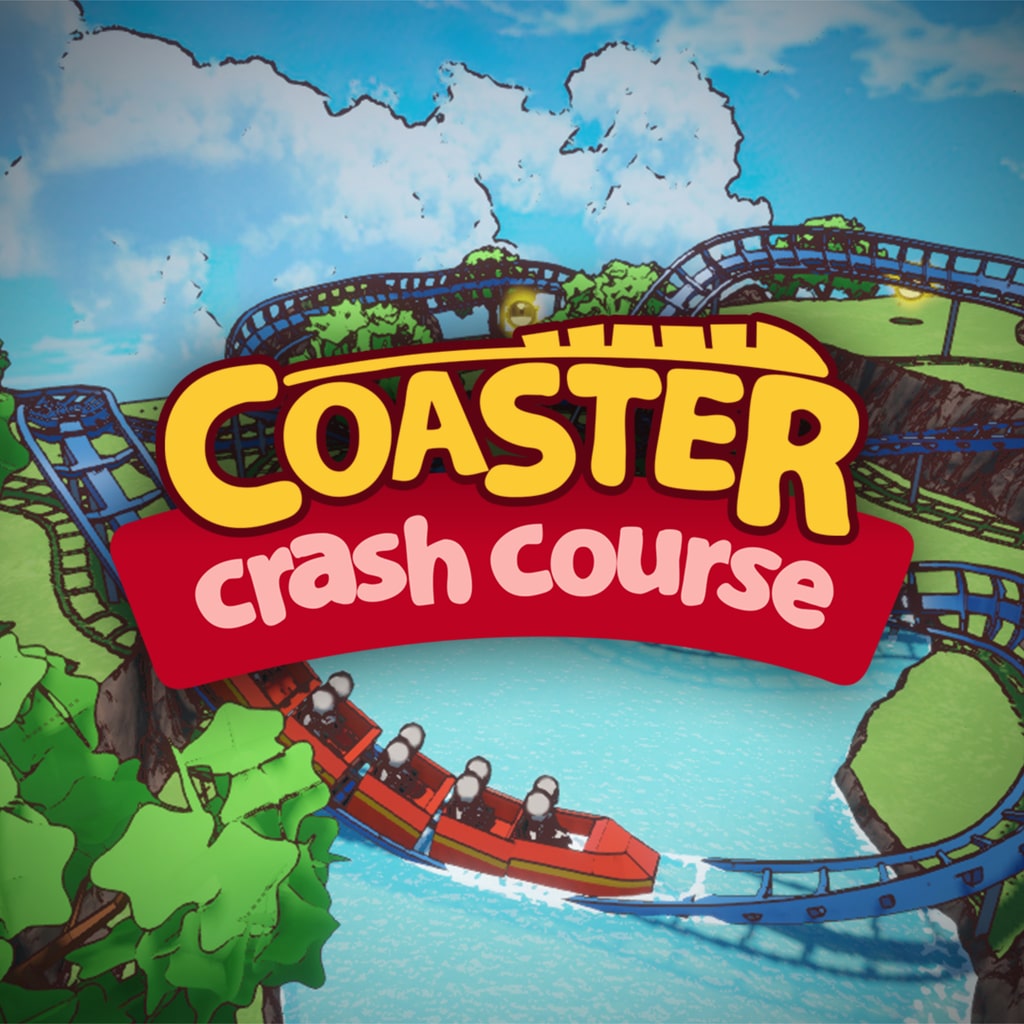
There are few things more satisfying in gaming than building something that should not work, watching it wobble on the brink of disaster, and then discovering that, somehow, against all reasonable expectations, it actually does. Coaster Crash Course understands that feeling perfectly. It takes the simple pleasure of building a roller coaster and turns it into a series of increasingly ridiculous physics puzzles, where your biggest enemy is often your own enthusiasm.
At first glance, the concept sounds wonderfully straightforward. Build a roller coaster, collect the required items, and get your passengers safely to the end of the track. Simple enough, right? Well, that depends on how much faith you have in physics, because a coaster travelling too quickly into a tight corner has a nasty habit of treating the rails as a mere suggestion.
Coaster Crash Course is not a traditional roller coaster management simulator, and that is one of the reasons it works. There are no endless spreadsheets to study, no complicated menus to navigate, and no feeling that you have accidentally taken on a second job at an amusement park. Instead, the game strips the idea down to its most entertaining ingredients: build, test, adjust, and try not to launch your passengers into the scenery.
Building A Better Coaster
The building system is arguably the game’s biggest strength. It is deliberately simple, letting you start constructing a track almost immediately rather than spending the first half-hour learning which button does what. There is something refreshing about that approach, particularly in a genre where management interfaces can sometimes become more complicated than the attractions you are supposed to be building.
Here, the emphasis is on creativity rather than bureaucracy. You can shape your track, experiment with slopes and curves, and quickly see whether your idea works. The controls stay out of the way, so the focus remains on the puzzle itself.
That simplicity does not mean there is no depth. Quite the opposite. Once the levels introduce more complex terrain and objectives, you realise that building a successful coaster requires considerably more thought than simply drawing the most exciting-looking route possible. Your track needs to balance speed, momentum, height and direction, and suddenly that innocent-looking curve you placed five seconds ago becomes the most important piece of engineering in the entire park.
Physics Has The Final Say
Physics is where Coaster Crash Course gets its personality. You can design the most beautiful coaster imaginable, but if you get the forces wrong, the game is more than happy to punish your arrogance.
There is a wonderfully predictable logic to the disasters. Build a track with too much speed and throw the coaster into a tight corner, and things are likely to go badly. Push a slope too far, and you can turn what was supposed to be a thrilling ride into a very brief attempt at human flight.
The important thing is that failure generally teaches you something. If a coaster goes wrong, you can look at what happened and make an informed adjustment. Perhaps you need to reduce the speed before the corner, change the angle of the descent, or rethink the entire approach. That makes experimentation enjoyable because every spectacular crash contains a little lesson.
More Than Just Getting From A To B
The game’s levels add another important layer by asking you to take collectibles into account. Suddenly, simply reaching the finish is not necessarily enough. You need to think about where your track goes and how to incorporate the required items without turning the whole thing into an uncontrollable mess.
This changes how you approach construction. The shortest route may not be the best, while a seemingly unnecessary loop or diversion might be exactly what you need to collect something positioned away from the obvious path. It gives the levels a puzzle structure without taking away the creativity that makes building itself so enjoyable.
There is also something satisfying about finding an elegant solution. You might initially create a huge, complicated track that technically works, only to realise that a much simpler design can achieve the same result. That constant search for improvement gives the game more longevity than you might expect from such a straightforward premise.
A World Of Colour And Chaos
Coaster Crash Course does not take place in a single repetitive amusement park. Its challenges are spread across a collection of colourful environments, each with its own visual character and gameplay considerations.
The bright presentation suits the game’s personality. This is not supposed to be a serious engineering simulator where you spend hours calculating structural tolerances. It is a playful world where ridiculous coaster designs are encouraged and spectacular failures are part of the entertainment.
That visual variety also helps the campaign feel like it is progressing. As new environments and mechanics are introduced, you get the impression that the game is gradually expanding its vocabulary. What begins as a simple bridge between two points can eventually become a much more elaborate exercise in planning and problem-solving.
When The Game Starts Getting Clever
The introduction of new mechanics and obstacles is important because a coaster builder can become surprisingly repetitive if every level asks you to solve exactly the same problem. Coaster Crash Course avoids that trap by gradually increasing the complexity of its challenges.
Rather than simply making the gaps bigger, the game encourages you to approach construction differently. Terrain becomes part of the puzzle, collectibles influence your route, and physics continually reminds you that gravity is not interested in your artistic vision.
This creates lovely moments when you stare at a level for a while before suddenly seeing the solution. It is that little flash of understanding that makes puzzle games so satisfying. You go from thinking, “There is no way I can do this” to grabbing the building tool and immediately trying your idea. Of course, there is a fair chance your brilliant idea will collapse. But that is part of the fun.
The Joy Of Watching It Go Wrong
Coaster Crash Course understands something that many puzzle games forget. Failure can be entertaining. Watching a coaster accelerate down a slope, enter a corner far too quickly and fly majestically into the unknown is the kind of failure that makes you laugh rather than reach for the restart button in frustration. There is a certain slapstick quality to it all, particularly when you were absolutely convinced that your design was flawless.
The best physics based games create stories out of their failures, and Coaster Crash Course has plenty of those little stories. You remember the ridiculous coaster that somehow survived, the track that collapsed at the final moment and the design that looked completely wrong but somehow collected everything and crossed the finish line.
Those moments give the game character. They are also the reason I found myself wanting to have another go rather than simply moving on after a failed attempt.
Easy To Learn, Harder To Master
The simple building system is excellent for getting players started, but the puzzles’ increasing complexity ensures there is still a learning curve. You do not need an engineering degree to understand the controls, but you will gradually develop a sense of how your creations behave.
That progression feels natural. Early levels teach you through experimentation, while later challenges expect you to recall what you have learned and apply it in new ways. There is a satisfying sense of improving at the game without ever feeling like you are studying for an exam.
That balance is particularly important because the game is clearly designed to be accessible. It wants you to play around, build strange things and have fun, rather than scare you away with a wall of instructions. The result is a puzzle experience that feels welcoming while still providing enough depth for players who want to chase better solutions.
A Refreshing Change Of Pace
The roller coaster genre is typically associated with larger simulation games in which you build entire parks, manage finances, satisfy visitors, and spend an alarming amount of time worrying about toilet placement. Coaster Crash Course takes a completely different approach.
There is something genuinely refreshing about focusing almost entirely on designing the ride itself. You do not worry about whether the park has enough benches or whether your visitors are willing to walk another twenty metres for an overpriced burger. Your job is much simpler: build the coaster and make it work.
That focused design gives the game an appealing pick-up-and-play quality. You can tackle a level, experiment with a design, and walk away, or become completely absorbed in trying to perfect one particularly stubborn challenge.
Final Verdict
Coaster Crash Course is a charming little physics puzzle game that knows exactly what it wants to be. It does not try to overwhelm you with complicated systems or bury the simple pleasure of coaster construction beneath layers of management mechanics. Instead, it gives you a track, a challenge and enough freedom to make the solution your own.
The simple building system works beautifully, making it easy to get an idea onto the screen within seconds. From there, the physics takes over, forcing you to think about speed, curves, slopes and momentum, while collectibles and changing environments add further layers to the puzzles. Most importantly, failure is genuinely fun, and there is something wonderfully satisfying about watching a completely ridiculous creation somehow succeed.
It is not going to replace the enormous theme park simulations for players who want to manage every detail of an amusement empire, but that is not what it is trying to do. Coaster Crash Course is smaller, more focused and considerably less interested in making you fill in paperwork before you can build a loop.
Instead, it captures the simple childhood joy of drawing a ridiculous roller coaster and asking the most important question imaginable: “Will it work?” Sometimes it does. Sometimes it absolutely does not. And sometimes it launches itself into the sky in spectacular fashion, which is arguably even better.