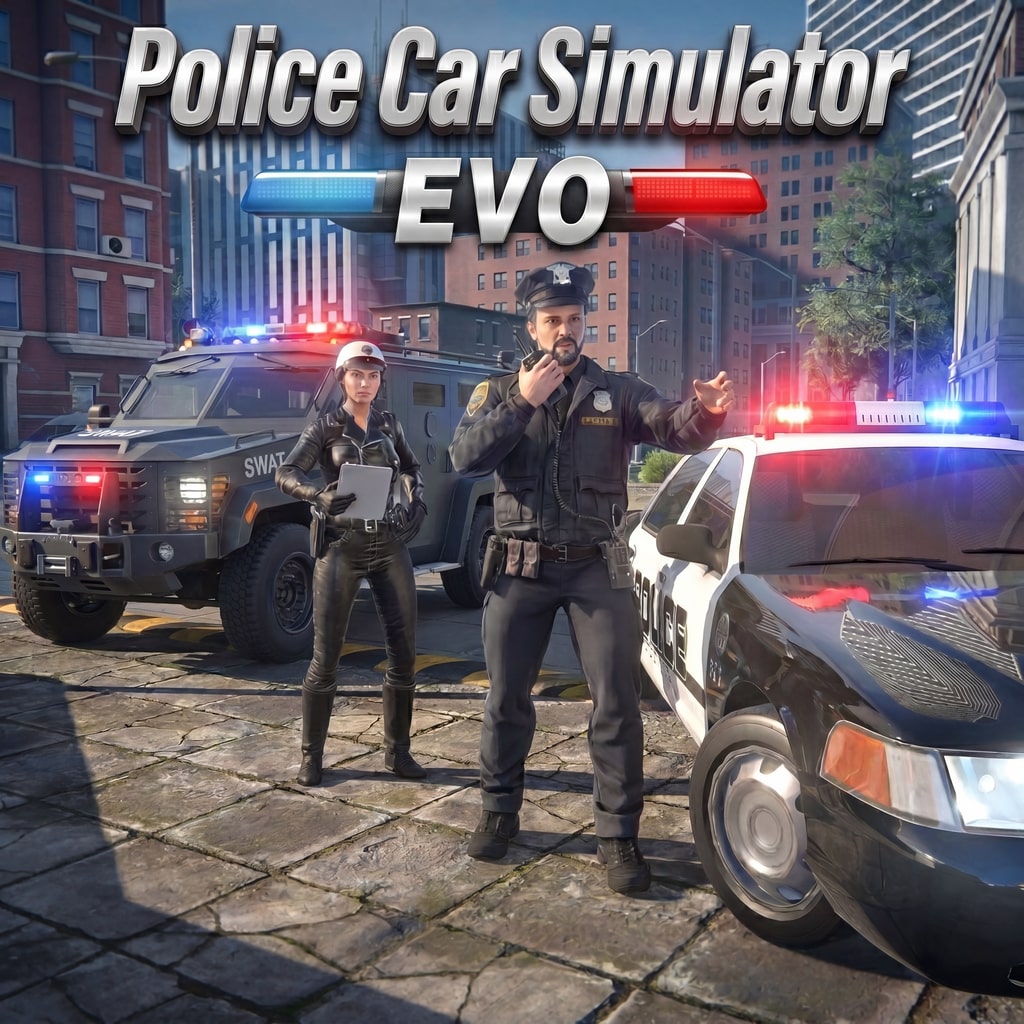
Developed and published by Ovilex Soft SRL, Police Car Simulator: EVO expands the studio’s long-running simulation catalogue into law enforcement territory, with a greater emphasis on realism and open-world freedom than many players might expect.
Set across two sprawling cities inspired by Shanghai and Rome, the game places players behind the wheel of dozens of police vehicles as they balance patrol duties, high-speed pursuits, undercover operations, and vehicle management systems. Fuel consumption, dirt build-up, vehicle damage, and mechanical upgrades all shape the experience.
At first glance, it resembles many other open-world driving simulators crowding digital storefronts. Spend a few hours with it, though, and something more interesting starts to emerge. This is less a power fantasy about being a cop and more a surprisingly meditative driving game, occasionally interrupted by chaos.
The Road Matters More Than the Destination
The strongest aspect of Police Car Simulator: EVO is its driving feel. Ovilex has clearly invested substantial effort in refining vehicle handling compared with previous entries in the EVO series. Cars now carry real weight. Steering feels heavier, acceleration less arcade-like, and collisions carry a satisfying sense of consequence. You are not gliding across roads like a superhero. You are wrestling large, powerful machines through crowded streets. That grounded approach gives even ordinary patrol routes a sense of tension.
Cruising through rain-soaked streets at night while monitoring suspicious traffic creates moments that feel unexpectedly immersive. The game understands that police work is often defined by anticipation rather than constant action. You spend long stretches observing the city before suddenly being thrown into a frantic pursuit. When those pursuits happen, they feel earned.
Sirens blare, traffic scatters, and the handling system demands full attention. Chasing suspects through narrow urban roads becomes genuinely thrilling because the cars feel unpredictable at high speeds. Mistakes matter. Oversteer into a corner too aggressively and you might slam into a barrier hard enough to cripple your vehicle. It creates stakes that many driving games lack.
Two Cities, Two Different Rhythms
The open-world maps deserve credit for their variety. The Shanghai-inspired environment feels dense, modern, and constantly active. Neon signs reflect off wet asphalt, while packed intersections create natural obstacles during chases. It captures the feeling of navigating an overcrowded urban sprawl surprisingly well.
Rome, by contrast, feels older and more open. Narrow side streets twist unpredictably, while historical architecture gives the city a completely different personality. Patrols there feel slower, more observational, almost contemplative at times.
Neither map is perfect. Pedestrian behaviour can feel robotic, and traffic AI occasionally struggles in more chaotic encounters. Still, both locations succeed by establishing distinct moods rather than simply offering visual variety. Driving through them becomes enjoyable even when you are not actively completing objectives.
Missions and Officer Roles
The mission structure is straightforward yet effective. As a Patrol Officer, you respond to traffic violations, suspicious vehicles, and emergency calls. Pulling over reckless drivers, checking behaviour, and deciding when to escalate situations create a loop that remains engaging longer than expected.
The Undercover Agent missions add a different flavour, shifting the focus towards surveillance and more aggressive intervention. These sections inject welcome intensity into the slower patrol pacing.
What impressed me most is that the game rarely forces constant action. There are quiet stretches where you simply drive, observe, and wait for something unusual to happen. That slower rhythm sells the illusion of real police work far better than non-stop explosions ever could.
The game also wisely avoids drowning players in excessive bureaucracy. Unlike some hardcore simulators, you are not endlessly filling in paperwork or navigating complicated legal systems. EVO strikes a middle ground between authenticity and accessibility. That balance is probably its smartest design choice.
Customisation and Progression
The progression systems are surprisingly deep for a game of this scale. With 60 unlockable vehicles and extensive upgrade options, there is always another goal to pursue. Performance modifications meaningfully affect handling, acceleration, and durability, while cosmetic customisation lets players personalise vehicles without turning them into absurd caricatures.
Upgrading sirens, armour, and engine components gives a satisfying sense of ownership over your patrol fleet. Vehicles begin to feel less disposable and more like trusted tools you gradually refine over time.
The officer unlock system is less mechanically impactful but still adds some variety to the presentation. Different characters bring small aesthetic changes that help break up repetition during long play sessions.
Rough Edges and Limitations
For all its strengths, Police Car Simulator: EVO still has the occasional awkwardness common in mid-budget simulation games.
Animations outside vehicles can feel stiff, particularly when controlling officers on foot. The shooting and movement mechanics are serviceable at best, and the game is clearly far more comfortable when players are behind the wheel.
Technical issues also crop up from time to time. Pop-in occurs during fast-driving sections, AI occasionally behaves irrationally, and physics interactions can become unintentionally hilarious during high-speed crashes. Yet oddly enough, some of that jank contributes to the game’s charm.
There is an earnestness here that makes imperfections easier to forgive. EVO never pretends to be a blockbuster masterpiece. It knows exactly what kind of experience it wants to provide and largely succeeds within those boundaries.
Presentation and Atmosphere
Visually, the game punches above its weight at times. Rain reflecting off city streets, flashing police lights bouncing across nearby buildings, and the dense night-time atmosphere all create genuinely striking scenes. Interior vehicle detail is particularly impressive, especially from the cockpit camera perspective.
Sound design also deserves praise. Engines growl convincingly, sirens cut sharply through traffic noise, and ambient city audio helps make locations feel lived in.
The soundtrack wisely stays understated. Long patrol stretches are allowed to breathe naturally rather than being overwhelmed by constant music. That restraint helps the game settle into a comfortable rhythm few driving simulators achieve.
Final Verdict
Police Car Simulator: EVO succeeds because it recognises that driving itself can be satisfying when given enough weight and atmosphere. It is neither the deepest police simulator on the market nor the most polished open-world driving game. But somewhere between quiet patrols, tense pursuits, and late-night drives through glowing city streets, it finds an identity entirely its own. There is a surprising amount of soul beneath its rough edges.
The game respects downtime. It lets players simply exist within its world rather than constantly chasing spectacle. That slower pace may frustrate players expecting non-stop action, but for those willing to settle into its rhythm, EVO becomes oddly relaxing.
Not every shift ends with dramatic heroics. Sometimes the best moments come from cruising through empty streets at 2AM, with lights reflecting across the windscreen, waiting for the next call to come through. And honestly, that feels strangely authentic.