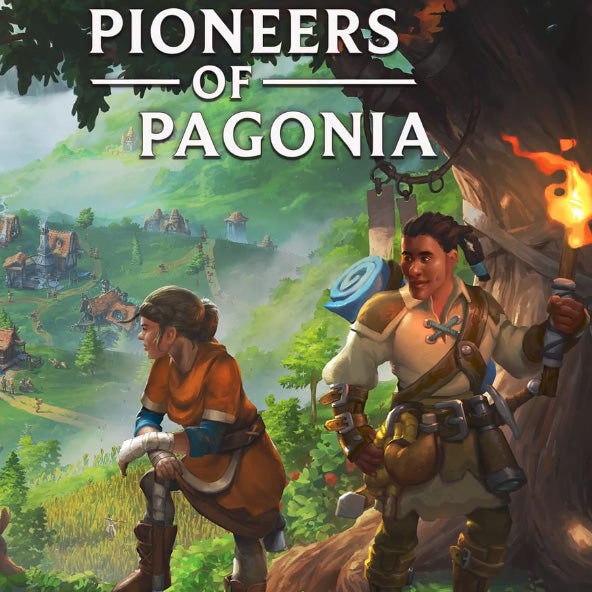
Pioneers of Pagonia is a game built on lineage. Developed by Envision Entertainment and helmed by Volker Wertich, the original creator of The Settlers, it carries the weight of both nostalgia and expectation. Rather than chasing modern trends in real-time strategy, Pioneers of Pagonia deliberately looks back, aiming to revive the slow-burn, logistics-focused settlement gameplay that defined classic PC strategy titles. The result is a measured, systems-driven experience that prioritises production chains, expansion planning, and organic world-building over direct conflict or spectacle.
A Clear Design Philosophy
From the moment Pioneers of Pagonia begins, its intent is evident. This is not a traditional RTS built around armies and base destruction, nor is it a high-pressure survival builder. Instead, it is a settlement simulation focused on growth, efficiency, and balance. Players are tasked with establishing colonies across procedurally generated islands, expanding infrastructure, and ensuring that complex supply chains remain functional as populations grow.
There is no central narrative driving progression. The motivation comes from optimisation and exploration rather than scripted events. Each map presents its own logistical puzzle, shaped by terrain, resource placement, and distance. This design philosophy will feel instantly familiar to fans of classic Settlers titles, and it is clear that Pioneers of Pagonia is designed with that audience in mind.
Core Gameplay and Economy
At the heart of Pioneers of Pagonia is its economy, which is built on layered production chains. Resources must be extracted, processed, transported, and ultimately consumed to support expansion. Roads must be carefully planned, buildings placed strategically, and population needs constantly monitored. Every decision ripples through the system, reinforcing the game’s emphasis on interdependence.
What sets Pioneers of Pagonia apart from more modern city builders is its insistence on visibility. Goods are physically transported across the map by workers, making inefficiencies immediately apparent. A bottleneck is not an abstract number but a visible slowdown in traffic or idle buildings. This tangibility adds clarity and satisfaction to problem-solving, as improvements can be directly observed.
The pace is deliberately slow. Expansion takes time, and rapid growth without proper planning often leads to shortages. This measured tempo encourages foresight rather than reaction, making the game feel more contemplative than competitive. For some players, this will be deeply rewarding; for others, it may feel overly restrained.
Exploration and World Design
Maps in Pioneers of Pagonia are procedurally generated, offering varied island layouts that encourage exploration. Fog of war hides resources and terrain features, incentivising players to gradually push outward. Exploration is not simply about uncovering space, but about assessing logistical viability. A distant resource deposit may be valuable, but connecting it efficiently to the core settlement presents its own challenge.
The visual design supports this exploration-focused gameplay. Environments are colourful and readable, with clear terrain distinctions and charming animation. While not visually extravagant, the art style conveys warmth and clarity, reinforcing the game’s approachable tone. Units are small but expressive, and the world feels busy as settlements grow.
Combat and Conflict
Combat in Pioneers of Pagonia exists, but it is not the focus. Military units can be trained to defend settlements or clear hostile threats, but warfare is restrained and largely secondary to economic development. Battles are functional rather than dramatic, serving as obstacles to expansion rather than core gameplay pillars.
This de-emphasis on combat is a deliberate design choice, and one that will resonate with players seeking a more peaceful strategy experience. However, it also limits variety. Conflict rarely evolves in complexity, and players who enjoy tactical depth or dynamic enemy behaviour may find this aspect underwhelming.
Interface and Usability
The user interface in Pioneers of Pagonia is clean and informative, prioritising clarity over minimalism. Key information about production, transport, and population is easily accessible, and visual cues help players identify inefficiencies. Tooltips are comprehensive, making the game relatively approachable despite its systemic depth.
That said, the learning curve remains significant. While the interface communicates information effectively, understanding how systems interact requires patience and experimentation. The game assumes a willingness to learn through iteration rather than step-by-step tutorials. For its intended audience, this will feel appropriate; for newcomers, it may be daunting.
Pacing, Progression, and Replayability
Progression in Pioneers of Pagonia is open-ended. There are goals and milestones, but no rigid campaign structure. Success is defined by stability and efficiency rather than victory conditions. This sandbox approach enhances replayability, as each map presents different challenges and opportunities.
However, long-term engagement depends heavily on player interest in optimisation. Without narrative arcs, scenario variety, or evolving mechanics, the experience can feel repetitive over extended play. While procedural generation provides variation in layout, the underlying systems remain consistent.
Technical Performance and Polish
Technically, Pioneers of Pagonia is stable and well-optimised. Performance remains solid even as settlements expand, and bugs are minimal. Animations and pathfinding are reliable, which is crucial for a game so heavily reliant on logistics.
That said, the game currently lacks some of the depth and variety expected from a fully realised strategy title. Certain systems feel intentionally restrained, suggesting a foundation designed for future expansion rather than a complete experience in isolation.
Final Verdict
Pioneers of Pagonia is a confident and deliberate return to classic settlement strategy. It succeeds by focusing on logistics, planning, and visible cause-and-effect rather than spectacle or conflict. Its slow pace and systemic depth will appeal strongly to fans of traditional strategy and city-building games, particularly those nostalgic for The Settlers.
However, its narrow focus and limited variety may restrict its broader appeal. It is a game that rewards patience and careful planning, but offers few surprises beyond that core loop.
A thoughtful and well-crafted settlement builder that honours its roots, delivering satisfying logistical gameplay while leaving room for greater depth and variety in the future.