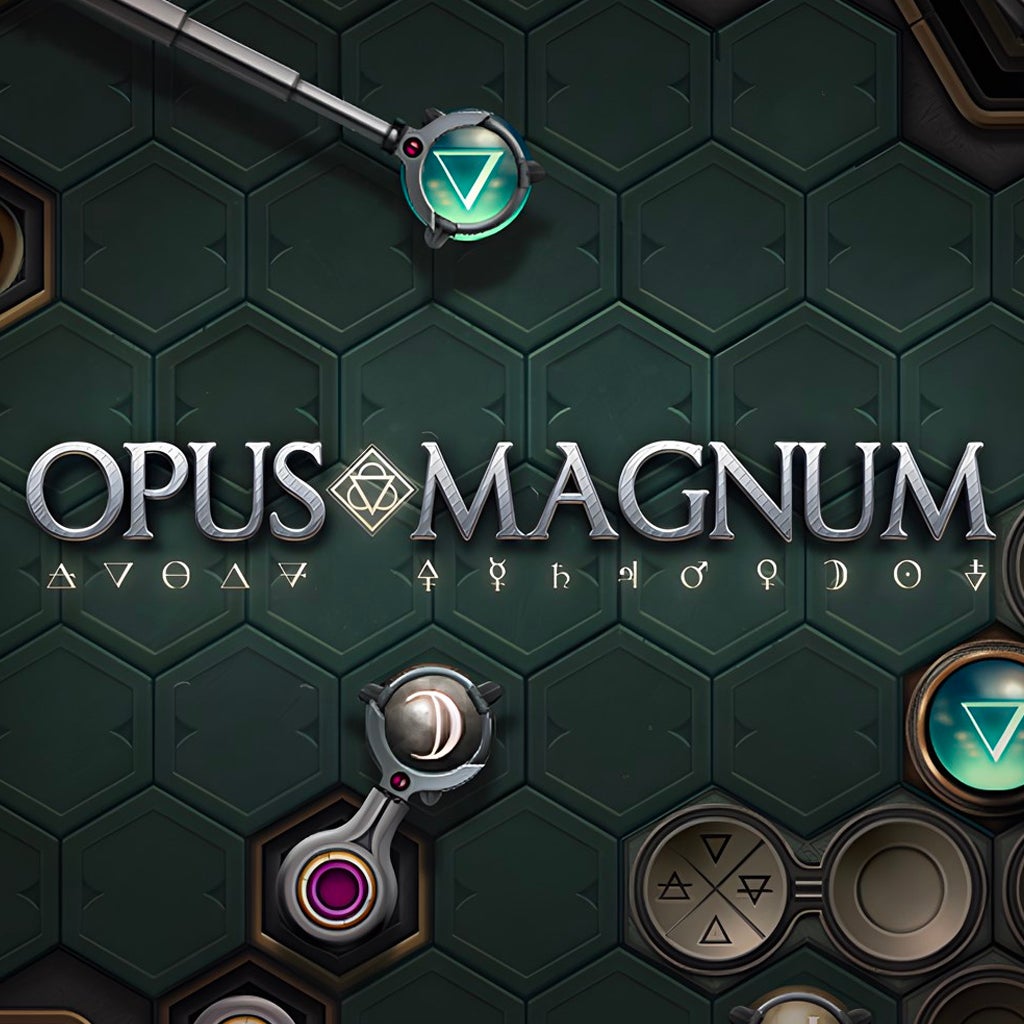
There are puzzle games… and then there are Zachtronics games.
For over a decade, Zachtronics has carved out a niche that few developers even attempt to enter—games that feel less like traditional puzzles and more like engineering disciplines. Titles like SpaceChem and SHENZHEN I/O didn’t just ask players to solve problems—they asked them to understand systems.
Now, with Opus Magnum: Complete Edition, the studio returns—after years of silence—to deliver what feels like both a celebration and a farewell. Originally released in 2017, Opus Magnum was already regarded as one of the studio’s most accessible and elegant works.
This “Complete Edition,” featuring the new De Re Metallica expansion, doesn’t just repackage that experience.
It perfects it.
Engineering Without Code
At its core, Opus Magnum: Complete Edition is a programming game—but one without traditional programming.
Instead of writing lines of code, you build mechanical contraptions that manipulate alchemical elements.
You’ll use:
- Robotic arms
- Rotating joints
- Tracks and pivots
- Specialized glyphs that transmute materials
Your goal? Transform raw elements into precise outputs—whether that’s medicine, gemstones, or something far more dangerous.
It sounds abstract.
In practice, it’s mesmerizing.
The Joy of Building Something That Works
What makes Opus Magnum: Complete Edition so compelling is the process.
There’s no single correct solution to any puzzle.
Instead, the game challenges you to:
- Build something functional
- Then refine it
- Then optimize it
You might create a clunky, inefficient machine that barely works—and feel proud.
Then you’ll watch someone else’s elegant, minimal solution and think:
“I can do better.”
This loop—build, refine, improve—is endlessly satisfying.
Metrics That Turn Solutions Into Competition
Each solution is graded across three metrics:
- Cycles (speed)
- Area (size)
- Cost (resources used)
This transforms every puzzle into a kind of engineering competition.
You’re not just solving problems—you’re solving them better.
The game’s built-in leaderboards and shareable solution animations (the famously “GIF-able” outputs) make it easy to compare your creations with others.
It’s a puzzle game that naturally encourages creativity and mastery.
Aesthetic: Where Science Meets Art
Unlike some of the more intimidating Zachtronics titles, Opus Magnum: Complete Edition is visually inviting.
The alchemical interface is:
- Clean and readable
- Mechanically intricate
- Surprisingly beautiful in motion
Watching your machine operate—arms swinging, components rotating, elements transforming—is deeply satisfying.
It’s not just functional.
It’s artistic.
A Story That Adds Flavor
While gameplay is the focus, the game also includes a narrative centered around alchemist Anataeus Vaya and the political intrigue of House Van Tassen.
The story unfolds gradually through:
- Dialogue sequences
- Character interactions
- Subtle world-building
It’s not essential to the experience, but it adds context and personality.
The new De Re Metallica expansion introduces a prequel storyline following Saverio Daas, expanding the game’s lore without overwhelming it.
The De Re Metallica Expansion
The biggest addition in Opus Magnum: Complete Edition is the De Re Metallica expansion.
It includes:
- 17 new puzzles
- 3 new glyphs that expand the game’s mechanics
- A new story campaign
- Additional music and visual content
These new glyphs are particularly impactful, introducing mechanics that allow for more complex and creative solutions.
For veteran players, this is where the game truly shines again—offering fresh challenges that push the system further than before.
Sigmar’s Garden (and House Colvan)
Beyond the main puzzles, the game features a surprisingly addictive solitaire-style minigame: Sigmar’s Garden.
In the Complete Edition, this is expanded with the House Colvan variant.
It’s a small addition, but an effective one—offering a relaxing break from the intensity of puzzle-solving.
Switch Debut: A Perfect Fit?
The Nintendo Switch release marks the first time Opus Magnum: Complete Edition has appeared on console.
Surprisingly, it works.
Controls have been adapted well:
- Cursor movement is smooth
- Placement feels intuitive
- The interface remains readable
That said, there’s no denying that a mouse still offers more precision.
For complex builds, PC remains the ideal platform—but the Switch version is more than playable.
Accessibility Without Compromise
One of the reasons Opus Magnum is often considered the best entry point into Zachtronics’ catalog is its accessibility.
Compared to titles like TIS-100, it:
- Explains its systems clearly
- Introduces mechanics gradually
- Avoids overwhelming the player early on
Yet it never sacrifices depth.
This balance is rare—and it’s a big part of what makes the game so enduring.
Where It Falls Short
Despite its brilliance, Opus Magnum: Complete Edition isn’t for everyone.
The biggest barrier is its mental demand.
- It requires patience
- It rewards iteration
- It can be frustrating when solutions don’t work
There’s also a lack of traditional “action” or variety.
If you’re not drawn to problem-solving for its own sake, the game may feel repetitive.
Pros
- Deep, rewarding puzzle design
- Endless creative solutions
- Beautiful, satisfying visual feedback
- Strong new content in the Complete Edition
Cons
- Not accessible to players who dislike complex puzzles
- Can be time-consuming and mentally demanding
- Console controls, while solid, aren’t ideal
Final Verdict
Opus Magnum: Complete Edition is more than just a re-release.
It’s a definitive version of one of the greatest puzzle games ever created.
By blending the elegance of the original with meaningful new content, Zachtronics has crafted something that feels both timeless and complete.
It’s not flashy.
It’s not fast-paced.
But it is deeply, profoundly satisfying.
And for players willing to engage with its systems, it offers an experience that few games can rival.