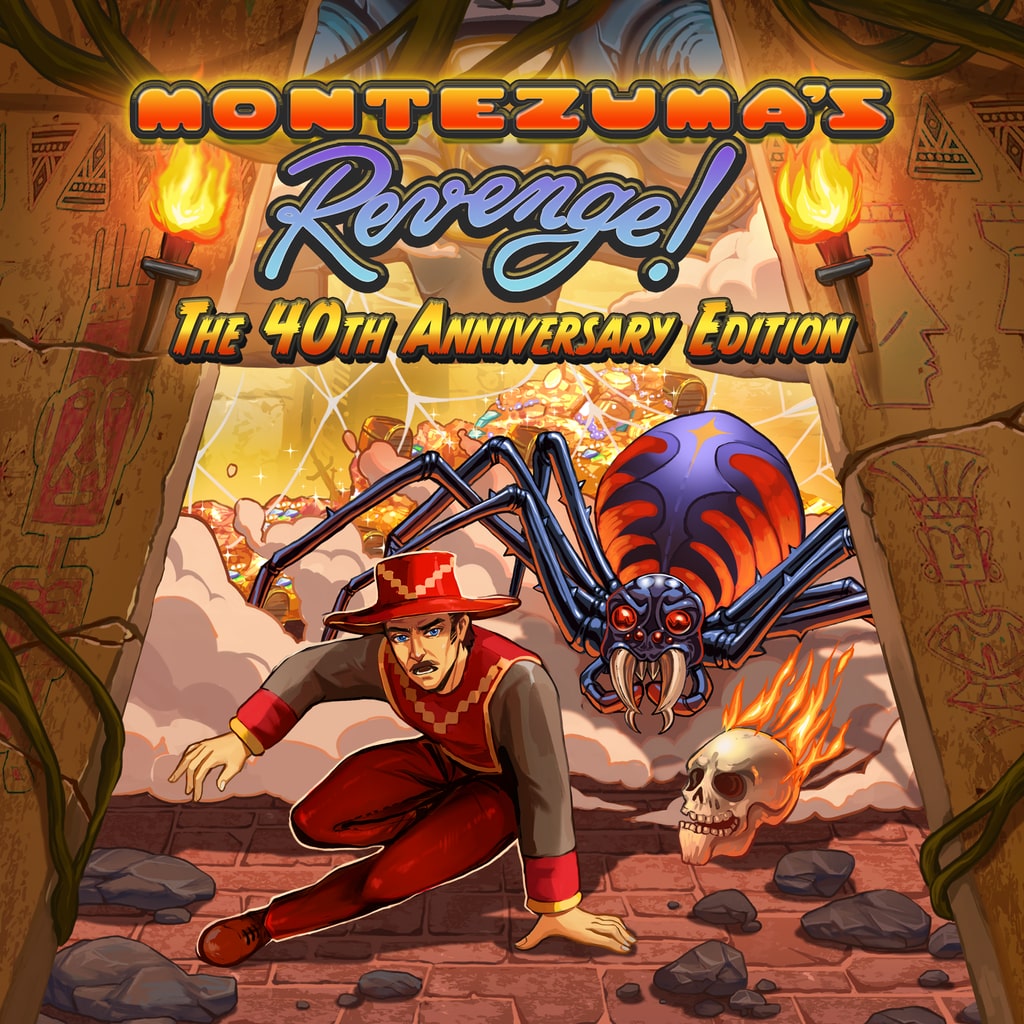
Few games from the early 1980s carry the legacy and influence of Montezuma’s Revenge, a title that helped define trap-laden, exploration-driven platforming long before “Metroidvania” became part of the gaming vocabulary. Now, four decades later, the 40th Anniversary Edition seeks to honour that legacy by modernising the classic while preserving its unmistakable identity: deadly temples, tight jumps, punishing traps, and a sense of danger that remains intact even after 40 years.
This new edition isn’t a simple remaster. It’s a thoughtful celebration of what made the game iconic, adding layers of polish, presentation, and accessibility without undermining its old-school challenge. It’s still unmistakably Montezuma’s Revenge—but now it’s sharper, smoother, more colourful, and far more playable for modern audiences.
A Classic Adventure Reborn
In Montezuma’s Revenge, players once again step into the boots of Panama Joe—the charismatic treasure hunter whose swagger and agility helped cement the game’s cult status. His mission remains the same: infiltrate the sprawling, trap-filled temples of Montezuma, navigating a labyrinth of rooms filled with hazards, enemies, and puzzles to claim the treasure at its core.
The 40th Anniversary Edition preserves this core structure completely. The game’s multi-room temple layout remains a triumph of early game design—each chamber a small challenge that feeds into a broader network of interconnected paths. It feels surprisingly modern. Rooms cleverly loop back into one another, secrets reward exploration, and progression relies as much on planning as platforming skill.
This edition adds large-scale improvements to movement, input responsiveness, and room-to-room transitions, ensuring the game plays as smoothly as nostalgia paints it. Animations are more fluid, controls feel tighter, and jumps—always the heart of the original—land with more consistency and tactile clarity.
Visuals: A Modern Makeover That Still Feels Retro
The biggest change comes through the visuals. The 40th Anniversary Edition introduces a gorgeous HD sprite overhaul that respects the original Atari and Apple II art direction while injecting new detail and vibrancy. Characters now have expressive animations, and the temple architecture has been reimagined with sharper tiles, richer colour palettes, and subtle environmental effects like dust trails, glowing torches, and ambient light flicker.
Of particular note is the dynamic lighting system that emphasises danger and depth. Pit traps glow with ominous colours, rope ladders cast soft shadows, and jewels sparkle enticingly from afar. It enhances immersion without ever overshadowing the game’s classic visual style.
There’s also a toggle for retro mode, letting players switch to the classic art style instantly. This feature is more than nostalgia: it highlights how faithfully the new edition recreates the original layouts and flow.
Sound and Music: Retro Roots, Modern Fidelity
The soundtrack has received a full remaster and expansion. Familiar jingles have been re-orchestrated, adding percussion, richer instrumentation, and ambient reverb to fit the temple theme. New tracks accompany late-game sections, creating a more consistent and atmospheric audio experience without losing the charm of 8-bit sound cues.
Sound effects also add depth:
- Trap triggers echo convincingly
- Snakes and enemies emit crisp, distinct cues
- Footsteps and jumps have tonal variation depending on the surface
It’s faithful, but it feels alive in a way the original never could.
Gameplay Enhancements That Respect the Classic Formula
The 40th Anniversary Edition introduces several quality-of-life improvements, but they’re subtle enough that purists won’t balk.
Improved Controls and Physics
Panama Joe’s jumps are smoother, ladders are easier to mount, and collision detection has been modernised. The precision required remains high, but the handling is now consistent and fair rather than occasionally rigid.
Optional Checkpoints
The original game was famously unforgiving—death often meant losing significant progress. The new checkpoint system eases frustration while preserving challenge. It’s optional, too, so players who want the old-school punishment can disable it.
Enhanced Difficulty Settings
Modes include:
- Classic (pure 1984 design)
- Anniversary (modernised physics and checkpoints)
- Hardcore (fewer lives, faster traps)
- Explorer (reduced combat, lighter penalties)
These modes make Montezuma’s Revenge more approachable than ever without compromising its unforgiving DNA.
New Content Worth Celebrating
Rather than simply polishing the original, the 40th Anniversary Edition adds:
New Challenge Rooms
Additional chambers expand the mid-game and late-game sections with clever trap layouts and more elaborate chain puzzles. These rooms fit seamlessly into the existing map but provide fresh surprises for long-time fans.
Time Trials
Speedrunners will appreciate the precision-focused time attack mode that tracks segment splits and encourages mastery of movement.
Developer Commentary
Unlockable notes and interviews offer insight into the original game’s creation and its legacy, giving fans a chance to reflect on how foundational Montezuma’s Revenge was to platforming history.
Museum Mode
Art galleries, prototypes, and early design sketches showcase the game’s evolution across four decades.
These additions elevate the entire package beyond a simple re-release.
Where the Game Still Shows Its Age
Even with its improvements, Montezuma’s Revenge remains a product of its era in key ways:
- Platforming is still punishing, especially for players not accustomed to 1980s difficulty standards.
- Enemy patterns can feel stiff or predictable compared to modern AI.
- Early-game repetition remains if you play without checkpoints.
- Some new visual flourishes occasionally obscure hazards, though this is rare.
These quirks are part of its identity, but newcomers should expect a learning curve.
Verdict: A Faithful, Fantastic Celebration of a Classic
Montezuma’s Revenge – The 40th Anniversary Edition is everything a retro revival should be. It’s respectful of the original’s design, generous with enhancements, rich with new content, and polished with modern quality-of-life features that maintain the game’s soul. It offers both a faithful recreation for purists and a smoother, more accessible experience for newcomers.
It’s still tough. It’s still quirky. It’s still uniquely Montezuma’s Revenge.
But now it’s also one of the best retro remasters of the decade.