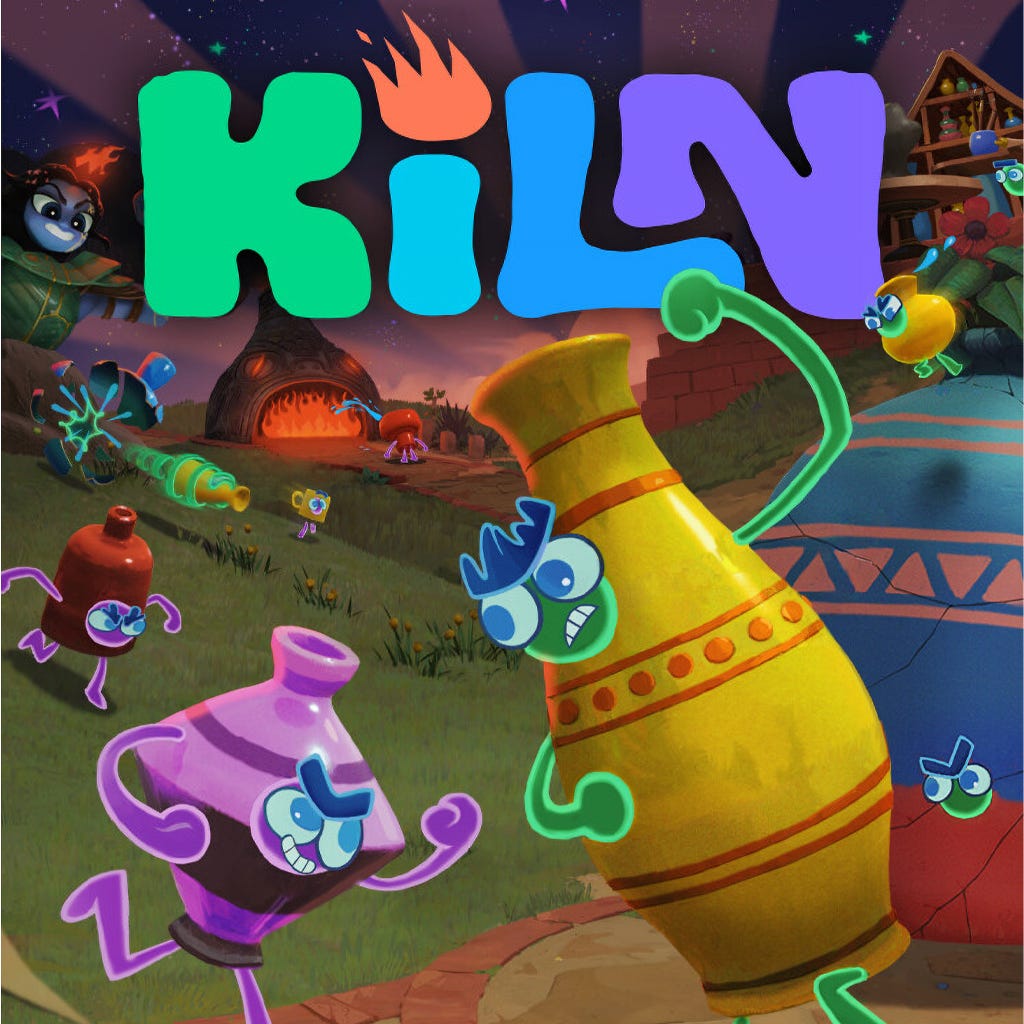
At first glance, it might seem like just a quirky novelty—a multiplayer brawler set in a world of pottery where your ceramic creations come to life and become your fighters. But spend a little time with it, and you’ll discover there’s a deeper, more thoughtful spirit hidden beneath the clay and vibrant colours, revealing a game that’s as imaginative as it is playful. Kiln invites you to shape the world with your hands, to watch as your creations unfold and breathe. Then, with a playful defiance, you deliberately throw them into chaos just to see how everything reacts. It’s a game of creation and destruction, of watching life emerge and then daring to break it apart again.
This isn’t merely about winning matches. It’s about expressing yourself, trying new ideas, and finding a strange joy in creating something delicate within a space meant to break it. There’s a certain magic in that fragility, a feeling that makes what we do truly human.
Clay, Shape, Identity
At the heart of Kiln is its most unusual mechanic. Before you even step into battle, you shape your vessel. Not a character in the traditional sense, but a pot. A body made of ceramic. And that shape matters.
A wide, low bowl might give you stability and defensive strength but leave you slow and predictable. A tall, narrow vase could make you fast and evasive, but fragile under pressure. A jug might balance offence and mobility, while something more abstract pushes you into experimental territory that feels closer to improvisation than optimisation.
It sounds simple, but the moment you realise your entire playstyle is literally shaped on a pottery wheel, something clicks. You are not just selecting a loadout. You are designing a physical identity. And then you smash it into someone else’s design.
The Chaos of Quench
The main mode, “Quench”, is where Kiln reveals its competitive side. Two teams of four compete to collect water and use it to extinguish the opposing team’s kiln. It is structured chaos, part arena brawler, part objective control, part physics experiment gone slightly wrong.
Matches are fast, noisy, and often unpredictable in the best way. Because every player’s vessel behaves differently based on its shape, no two encounters feel identical. A bulky ceramic tank will barrel through space with brute force, while a delicate but agile form darts around collecting water or disrupting opponents.
Combat itself is less about complex inputs and more about spatial awareness and momentum. Positioning matters. Timing matters. But so does understanding what your shape can actually do.
There is a constant tension between creation and destruction. You spend time carefully crafting something, only to watch it shatter under pressure in a chaotic clash of clay and strategy. And strangely, that is where the fun lives.
The Wedge: Where It Breathes
Between matches, Kiln slows down completely in a way that feels deliberate and necessary. The Wedge, its social hub, is where players return to something more reflective.
Here, you can refine your pottery skills, experiment with new shapes, and decorate your creations with patterns and details that carry into future matches. It is part workshop, part gallery, part hangout space.
There is something grounding about this shift in pace. After the intensity of Quench, The Wedge feels almost meditative. You are no longer reacting. You are creating again, but without pressure.
It also serves an important emotional function. Because Kiln works best when you care, even a little, about what you have made. Watching your carefully shaped vessel get destroyed in battle hits differently when you remember the time you spent perfecting it.
A Different Kind of Teamwork
At its core, Kiln is still a team game, and that is where some of its most interesting dynamics emerge. Victory rarely comes from individual performance alone. Teams that succeed are those that understand composition, how different vessel shapes interact, how to combine mobility with durability, how to control space while supporting each other’s strengths.
There is a surprising depth to this layer once you move past the initial novelty. Communication becomes important, not in a rigid competitive sense, but in a more fluid, experimental way. Players discuss shapes, roles, and approaches almost like designers rather than soldiers. It feels less like a traditional brawler and more like a collaborative art experiment that occasionally erupts into violence.
The Joy of Imperfection
One of the most refreshing things about Kiln is how it embraces imperfection. Your vessel will never be perfectly balanced. There will always be trade-offs. That is the point. A beautifully crafted shape might fail in combat. A chaotic, poorly designed one might unexpectedly dominate a match. The game constantly resists the idea that there is a single optimal solution.
This keeps experimentation alive. It encourages players to try strange combinations, to prioritise creativity over efficiency, at least some of the time. And when something works, when a weird shape you sculpted actually holds up in battle, it feels earned in a way that more standardised systems rarely achieve.
Where the Clay Cracks
For all its charm, Kiln is not without its rough edges. The learning curve can feel uneven. New players may struggle to understand how deeply shape influences performance, and early matches can occasionally feel chaotic without much clarity.
There is also a slight imbalance in how certain vessel types perform in competitive settings. While the game encourages experimentation, some shapes inevitably prove more consistent in high-level play, which can subtly discourage creativity over time.
And while The Wedge is a lovely space, its long-term engagement depends heavily on community activity. Without a steady flow of players sharing and experimenting, it risks feeling quieter than intended.
A Game About Making and Breaking
What Kiln understands, perhaps better than most multiplayer games, is that creation and destruction are not opposites. They are part of the same cycle. You build something fragile. You test it. It breaks. You build again.
That loop is everywhere here, not just in combat but in philosophy. The act of sculpting your vessel is never separate from the act of using it in battle. One informs the other constantly. It gives the game a strange emotional rhythm. Not dramatic, not intense in a traditional sense, but steady and reflective in its own way.
Verdict
Kiln is one of the more unusual multiplayer games in recent years, not because it tries to be chaotic, but because it tries to be creative first and competitive second. Its clay-based combat system turns identity into something physical, something fragile, something you can reshape at will.
It is not always perfectly balanced, and its ideas occasionally outgrow its execution. But when everything comes together, when teams are experimenting, adapting, and laughing through the chaos of collapsing ceramic bodies, it feels genuinely special. A game about shaping things, breaking them, and shaping them again.