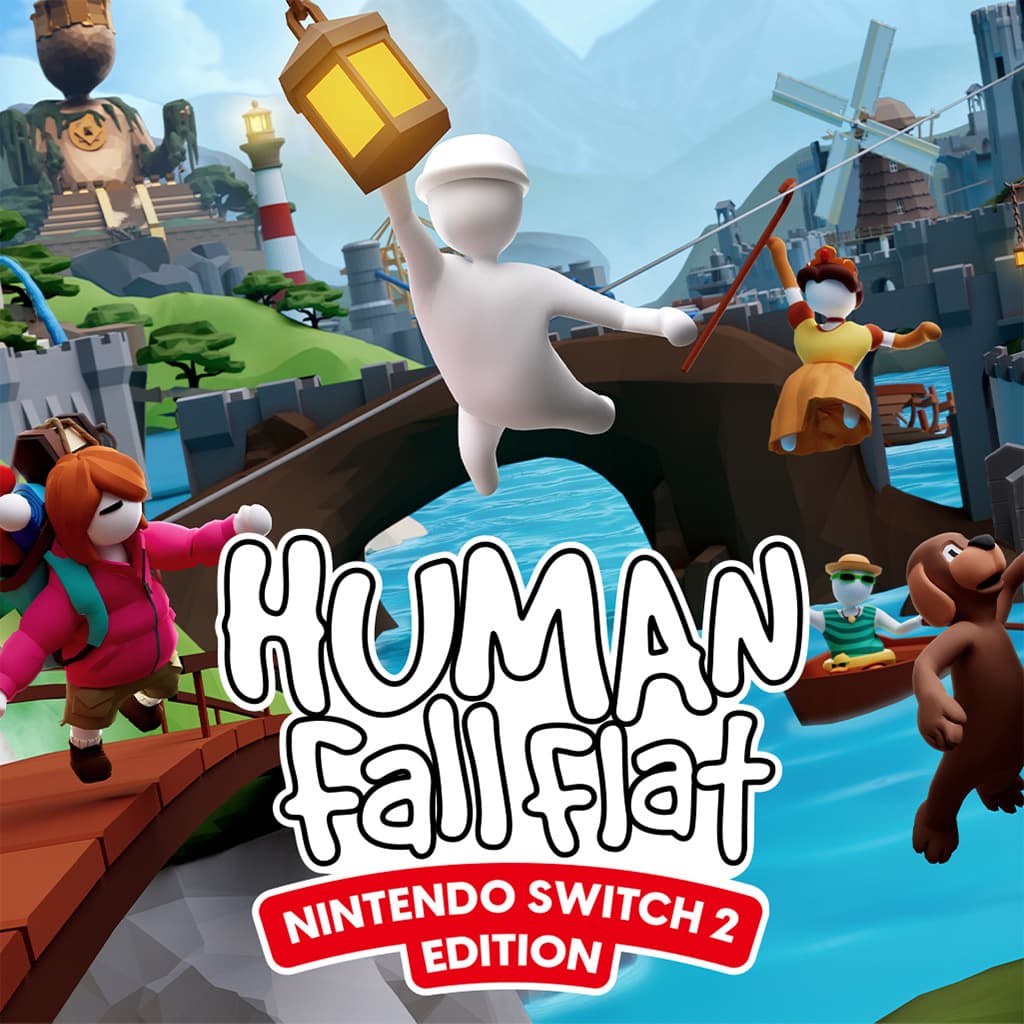
Few games have managed to keep their charm for nearly a decade as well as Human: Fall Flat. Released in 2016, it has steadily grown through updates, new levels, and ports to different platforms. Now, with Human Fall Flat – Nintendo Switch 2 Edition, the game is once again in the spotlight—this time as a launch-window showcase for Nintendo’s new hardware.
The question isn’t whether Human: Fall Flat still works. It’s whether this new edition genuinely enhances an already loved experience—or merely reworks it with a shinier finish.
Still Delightfully Uncoordinated
At its core, Human: Fall Flat remains exactly what it has always been: a physics-based platformer where you control a wobbly, boneless human passing through surreal dreamscapes.
Movement is deliberately awkward. You grab, climb, swing, and stumble through environments that resemble oversized playgrounds. Every action feels unpredictable, and that’s where the magic truly happens.
Simple tasks—like pulling a lever or climbing a ledge—can quickly turn into chaotic comedy. Whether accidentally flinging yourself off a platform or dragging a friend into the abyss, the game thrives on spontaneous, unscripted moments.
This unchanged in the Switch 2 Edition. And frankly, it didn’t need to be.
New Hardware, Smoother Chaos
What has changed is how the game performs.
On Nintendo Switch 2, Human Fall Flat benefits from a noticeable boost in frame rate and resolution. Environments feel smoother, animations are clearer, and the overall experience is more responsive.
It’s not a transformative leap, but it is a meaningful one—especially for a game where precision (or at least controlled chaos) matters. The improved performance reduces frustration, making the already accessible gameplay feel even more approachable.
The addition of mouse controls is also a welcome feature. While not essential, it provides a different way to interact with the game, particularly in handheld or docked modes with compatible setups.
GameShare: A Quiet Revolution
Perhaps the most notable update in this edition is the GameShare feature.
This allows you to play with friends even if they don’t own the game—a feature that fits perfectly with Human: Fall Flat’s social aspect. It reduces the barrier to entry and makes organising spontaneous multiplayer sessions much easier.
In a game that thrives on shared chaos, this is a truly impactful addition. It changes the experience from something you plan into something you can simply do.
GameChat and the Joy of Shared Failure
Multiplayer has always been the core of Human: Fall Flat, and the Switch 2 Edition emphasises this with GameChat support.
Using the built-in microphone, players can communicate directly during gameplay. It’s a small feature on paper, but in practice, it greatly enhances the experience.
Coordination becomes simpler—yet, more importantly, the laughter is immediate. There’s something distinctly entertaining about hearing a friend’s reaction as everything goes wrong in real time.
With support for up to eight players online, the game continues to be one of the most accessible and enjoyable co-op experiences available.
More Worlds, More Mayhem
This edition also includes five additional levels that were previously unavailable on the original Switch: Dockyard, Museum, Hike, Candyland, and Test Chamber.
Each level introduces new themes, mechanics, and puzzles, enlarging the already extensive list of over 30 dreamscapes.
- Dockyard leans into industrial puzzles and large-scale machinery.
- Museum offers a more structured, puzzle-focused experience.
- Hike introduces verticality and environmental traversal.
- Candyland embraces whimsy with colourful, surreal designs.
- Test Chamber adds a more experimental, almost sandbox-like feel.
These levels don’t reinvent the formula, but they do create new areas for the game’s core mechanics to stand out. More importantly, they boost the game’s longevity—particularly for returning players.
Puzzle Design: Open-Ended by Nature
One of Human: Fall Flat’s key features is its approach to puzzles.
There’s rarely a single “correct” solution. Instead, the game encourages experimentation. If you can think of a way to solve a problem—and physically carry it out—the game will often allow it.
This openness is both a strength and a weakness.
On one hand, it promotes creativity and replayability. On the other, it can lead to moments where progress feels uncertain or overly reliant on trial and error.
Nonetheless, the freedom it provides is a fundamental part of the game’s identity. It’s less about solving puzzles efficiently and more about discovering how you want to approach them.
A Timeless Aesthetic
Visually, Human: Fall Flat has always embraced simplicity.
Its minimalist art style—featuring soft colours and abstract environments—has aged remarkably well. On Switch 2, the improved resolution enhances clarity without changing the game’s core aesthetic.
Character customisation remains a highlight. From astronauts to chefs to entirely nonsensical outfits, the ability to personalise your “Human” adds a touch of charm and individuality.
It’s not a technically demanding game, but it doesn’t need to be. Its appeal lies in its clarity and character.
Where It Shows Its Age
For all its strengths, Human: Fall Flat isn’t without its limitations—many of which become more noticeable in 2026.
The physics, while charming, can sometimes feel inconsistent. Controls can be imprecise, causing moments of frustration—especially in solo play.
Camera angles can also be problematic, particularly in tight spaces or complex environments. These issues aren’t new, but they still haven’t been fully addressed.
Additionally, while the new content is welcome, the core gameplay loop remains unchanged. For players who have already spent plenty of time with the game, this edition might not offer enough fresh ideas to feel essential.
The Upgrade Question
For existing Switch owners, the discounted upgrade (£3.99) is a key consideration.
At that price, the improvements—both technical and content-related—are simple to justify. The enhanced performance, extra levels, and new features make it a valuable upgrade.
For newcomers, this is arguably the best version of Human: Fall Flat so far.
Final Verdict
Human Fall Flat – Nintendo Switch 2 Edition is more of a refinement than a complete reinvention. It builds on a proven formula, offering improved performance, thoughtful new features, and extra content.
The core experience remains as charming and chaotic as ever, enhanced with improvements that make it more accessible and fun—especially in multiplayer.
However, its age is apparent in some areas, and those seeking a truly new experience might find it too familiar.
Nevertheless, as a launch-window title and a social gaming staple, it delivers exactly what it promises.