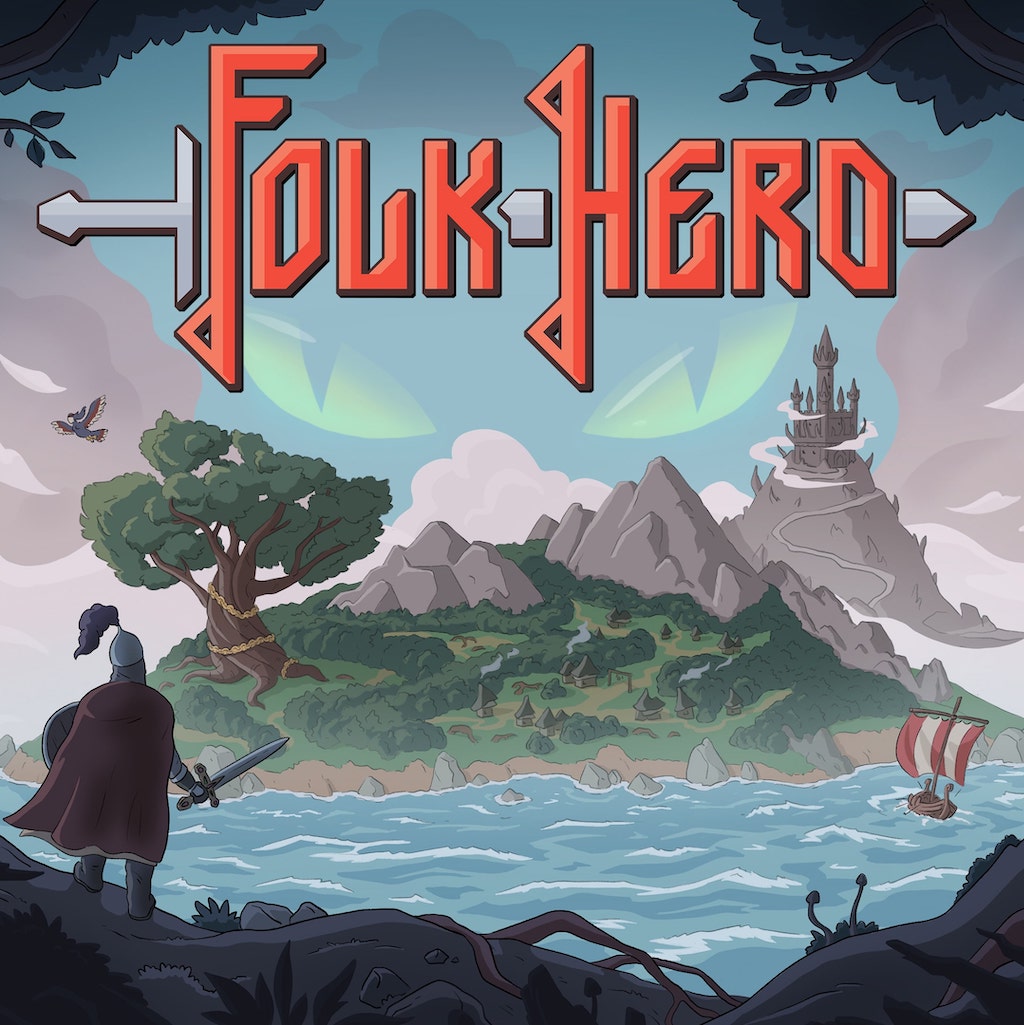
Folklore has always had a knack for making the woods feel a little less welcoming. A rustle in the bushes, a strange noise in the darkness, and suddenly every old story your grandparents ever told you sounds a little more believable. Folk Hero takes that feeling and builds a challenging action roguelite on it, throwing players into the mysterious world of Slavic mythology, where legendary creatures aren’t stories any more. They are very real, very angry, and more than happy to make your journey across Buyan Island a short one.
Developed by Chudo-Yudo Games, Folk Hero wears its inspirations proudly while carving out a personality of its own. There is a clear Souls-like influence in the combat, with careful dodging, blocking, parrying, and stamina management forming the backbone of every encounter. Combine that with procedural exploration, permanent death, character builds, and a wonderfully distinctive folklore setting, and you have an adventure that can be punishing without feeling completely hopeless. It understands that failure is part of the journey, and when everything finally clicks, few things are more satisfying than watching a creature that previously destroyed you suddenly fall at your feet.
Welcome to Buyan Island
The premise is wonderfully simple. Strange things are happening across the land. Animals are disappearing from the forests, villagers are reporting sightings of creatures that should exist only in folklore, and a mysterious island has appeared on the horizon. Naturally, someone needs to investigate, and that someone is you. Buyan Island becomes your destination, though calling it a destination implies that getting there is the difficult part, when in reality it is only the beginning of your problems.
What makes the setting particularly appealing is how Folk Hero embraces Slavic mythology rather than using it as a thin coat of paint. Creatures such as the Leshy, Domovoy and Rusalka feel like natural inhabitants of this world, while the wider mythology gives the adventure a personality that separates it from the countless fantasy games filled with the same familiar European monsters. The mysterious island also provides a wonderful excuse for the developers to throw increasingly strange environments and encounters at you.
There is a genuine sense of discovery during the early runs. You don’t necessarily know what awaits beyond the next stretch of forest, and because the island changes from one attempt to another, learning its dangers becomes part of the experience. That unpredictability helps keep repeated attempts interesting, particularly as you start recognising enemy behaviours and environmental patterns.
Every Swing Counts
Combat is undoubtedly the star of the show. Folk Hero takes the basic ingredients of an action slasher and forces you to think before you swing, where the Souls-like influence becomes immediately apparent. You can attack quickly, unleash heavier strikes, dash out of danger, block incoming blows and attempt perfectly timed parries, but none of these options can be used recklessly. Stamina is precious, and emptying the bar at the wrong moment can turn an easy encounter into a trip back to the beginning.
That deliberate approach gives combat considerably more weight than the colourful pixel art might initially suggest. Enemies aren’t simply walking health bars waiting to be smashed apart. Their attack patterns need to be studied, their movements understood and their openings exploited. Once you’ve spent enough time fighting a particular creature, you begin to recognise the tell before an attack lands, and that knowledge can make the difference between walking away with a handful of health points and watching your hero collapse.
The bosses take this philosophy even further. They are designed to test everything you’ve learned, and some encounters can initially feel brutally unfair. The important thing is that most defeats teach you something, whether that’s the timing of an attack, the range of a particular weapon or the importance of conserving stamina. When you finally overcome a boss that has been causing you grief for several attempts, the sense of achievement is considerable.
There is also a clever little wrinkle in the form of friendly fire. Enemies can hurt one another, meaning that sometimes the smartest thing you can do is simply get out of the way and let your opponents settle their differences. Watching a dangerous creature accidentally obliterate one of its own allies is immensely satisfying, particularly when you’re desperately trying to preserve your health for what comes next.
Building Your Folk Hero
The game’s build system adds another layer of depth to its otherwise straightforward combat. Different character classes, weapons, artefacts and elemental runes can be combined to create very different approaches to each run. One attempt might focus on raw melee damage, while another could emphasise mobility, ranged attacks or elemental effects.
The rune system is particularly enjoyable because it encourages experimentation. Rather than simply increasing a number on a character sheet, different combinations can alter how your weapons behave and offer interesting tactical possibilities. Fire, freezing and other elemental effects can become powerful tools when combined effectively, turning a familiar weapon into something considerably more dangerous.
That experimentation is important because permanent death could otherwise make the whole experience feel excessively punishing. Knowing that your current hero might eventually fall for good gives every decision more weight, but the progression system means your efforts aren’t entirely wasted. Points gathered during runs can be used to improve future heroes and abilities, gradually increasing your chances of surviving deeper into the island.
It creates that familiar roguelite feeling of thinking, just one more run. You might have lost everything, but you’ve also learned something and perhaps unlocked an upgrade that could make the next attempt different. That loop is one of the game’s greatest strengths.
An Island That Keeps Changing
Procedural generation ensures that Buyan Island rarely feels exactly the same twice. Forests, swamps, wastelands and the imposing Castle of Koschei provide distinct environments, each with its own visual identity and dangers. The changing layouts mean you can’t simply memorise a perfect route and expect it to work every time, keeping you alert throughout your journey.
There is something pleasing about the compact nature of these environments, too. Folk Hero doesn’t attempt to create a gigantic open world filled with meaningless distractions. Instead, its areas are designed around exploration, combat and discovery, with secrets tucked away for players willing to investigate.
The downside is that repetition inevitably becomes part of the experience. Roguelites live and die by the quality of their repeated loops, and while Folk Hero has enough variation to keep things interesting, there will be moments when returning through familiar types of environments begins to feel routine. Fortunately, the build variety and changing encounters provide enough incentive to keep pushing forward.
More Than One Ending
There is also a little more narrative ambition here than you might initially expect. Different paths can lead to different endings, encouraging you to experiment rather than simply follow a single predetermined route. The mysterious island and the strange events surrounding it provide enough intrigue to make you want to uncover what is really happening.
The story isn’t delivered with the cinematic spectacle of a major role-playing game, nor does it need to be. Much of the charm comes from discovering the folklore and slowly piecing together the reasons behind the island’s appearance. It gives your repeated attempts a purpose beyond simply chasing a better score or a stronger build.
For a game so focused on combat, that additional layer is welcome. It gives the player another reason to keep returning, particularly when a failed run leaves you wondering whether you’ve missed something important.
Pixel Art With Plenty of Personality
Visually, Folk Hero gets a lot right. Its pixel art style is colourful, expressive and packed with personality, allowing the strange creatures of Slavic folklore to look both amusing and threatening. Characters animate well in combat, and the exaggerated movements help communicate attacks clearly, which is particularly important when reaction times can mean the difference between victory and death.
The different biomes also provide enough variety to prevent the presentation from becoming visually stale. Dark forests, murky swamps, barren landscapes and the imposing surroundings of Koschei’s castle all contribute to a world that feels considerably more varied than its retro aesthetic might suggest.
There is also a nice sense of atmosphere running throughout the adventure. The soundtrack and sound effects complement the folklore setting without trying to overwhelm it, while weapon impacts have enough weight to make every successful strike feel satisfying. It may look like a retro adventure, but Folk Hero doesn’t sound like one pulled straight from a dusty cartridge.
The Verdict
Folk Hero is an enjoyable and surprisingly rewarding action roguelite that understands the importance of making failure feel worthwhile. Its blend of Souls-like combat, Slavic mythology, procedural environments and build experimentation gives it a distinctive identity, while the permanent death system adds genuine tension to every expedition. It can be brutally unforgiving, particularly in the early hours, but the satisfaction that comes from learning the game and gradually improving is exactly what keeps the experience compelling.
There are moments when the repetition shows, and players looking for a fast, forgiving hack-and-slash adventure may find the deliberate combat frustrating. This is a game that expects patience. Button mashing will get you nowhere, and even the most promising run can disappear in seconds if you become careless.
For players willing to meet it on its own terms, though, Folk Hero has plenty to offer. It takes a fascinating corner of mythology and combines it with mechanics that reward observation, experimentation and persistence. The pixel art gives the adventure plenty of charm, the build system encourages experimentation and the permanent progression ensures that even failure has value.
Most importantly, Folk Hero has character. In a genre filled with fantasy worlds that can sometimes blur into one another, Buyan Island feels like somewhere with its own identity. The creatures are memorable, the combat is satisfying and every successful run feels earned rather than handed to you.