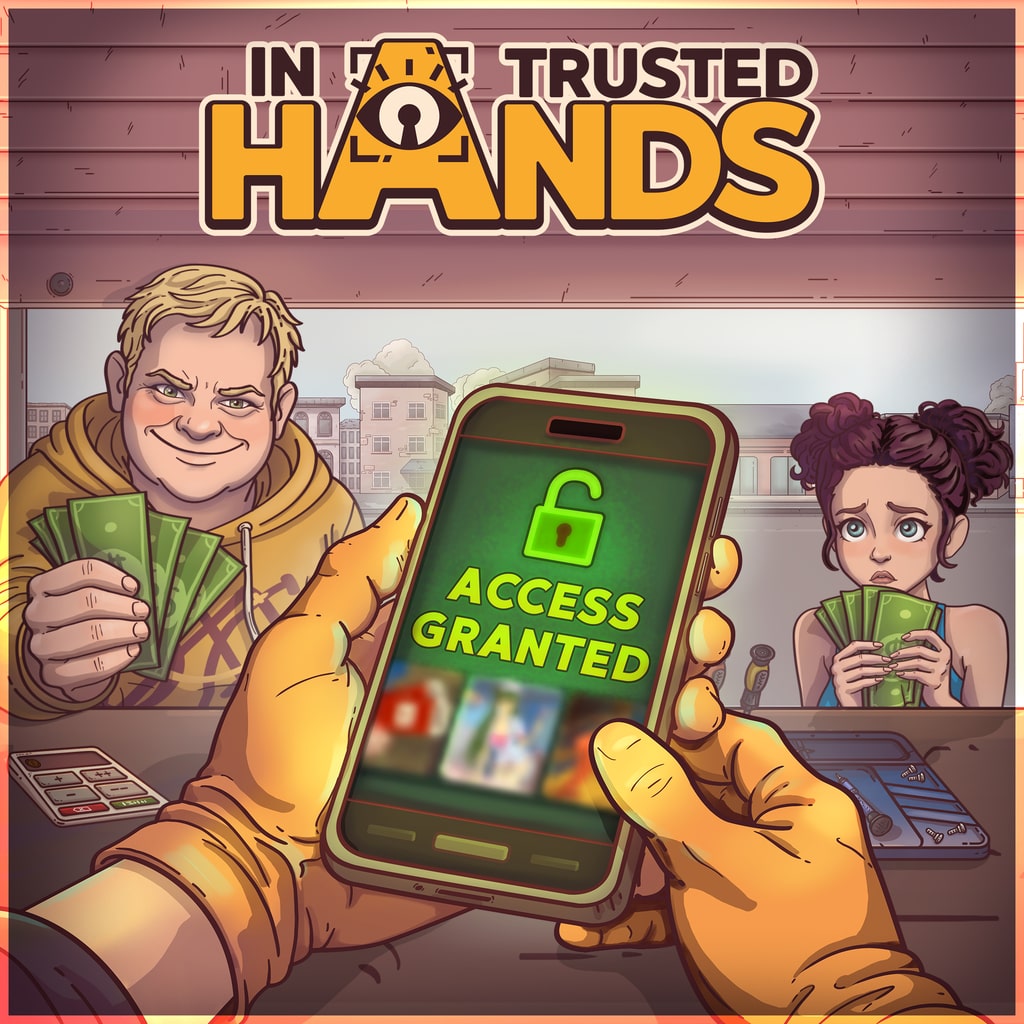
There is a particular kind of unease that does not come from jump scares, monsters, or end-of-the-world stakes. It comes from proximity. From knowing just enough about someone to recognise that you should stop looking, yet choosing not to. In Trusted Hands understands that feeling intimately and builds an entire game around it.
You play as a mobile phone repair technician in a dense, modern city where every cracked screen and faulty battery is a gateway into someone else’s private life. Officially, your job is simple: fix devices, return them, get paid. Unofficially, every phone that lands on your desk becomes an ethical crossroads. Messages, photos, hidden folders, encrypted chats. Nothing is off-limits once you decide to look. And the game never forces you to look. That is what makes it work.
A Workshop That Watches You Back
The workshop is your centre of gravity. It is a cramped, slightly worn space filled with tools, spare parts, paperwork, and the constant hum of routine. Days begin predictably. Clients arrive. Phones are placed on your desk. You run diagnostics, complete repairs, and manage your growing pile of responsibilities. But the structure slowly begins to bend under the weight of information.
Every device carries a story. Some are mundane, with relationships strained by misunderstandings, friends arguing over small betrayals, families drifting apart in silence. Others spiral into something more severe, with secrets tied to corruption, criminal networks, or personal histories never meant to leave the screen.
The genius of In Trusted Hands is that it never gamifies this discovery in a celebratory way. There is no reward for curiosity itself. There is only one consequence.
The Loop of Temptation
At its core, the game follows a deceptively simple loop: repair a phone, decide whether to explore it further, then live with the outcome. That loop grows increasingly complex as external pressures mount.
You have rent to pay. Taxes to manage. Fatigue that builds as you work longer hours. If you push yourself too far, your character begins to crack under the strain, limiting your ability to function the next day. The game quietly enforces the reality that exploitation, even of information, carries a cost.
Then there are the outsiders. Figures who begin to appear, offering money or influence in exchange for data. Sometimes they want specific files. Sometimes they want anything useful. Always, they want you to choose between stability and compromise. What makes this system effective is that it rarely feels like a binary moral choice. It feels like survival logic dressed as ethics.
The Illusion of Privacy
The most unsettling aspect of In Trusted Hands is how ordinary everything feels. These are not exaggerated dystopian horrors. They are recognisable lives. People arguing over messages that could appear in any group chat. Photos taken in moments of boredom or joy. Voice notes sent and forgotten.
The game strips away the distance between player and subject. You are not hacking into fortified systems or breaking into secret government archives. You are simply opening a phone handed to you for repair.
That subtle shift is what makes the experience so effective. It dispels the fantasy of intrusion and replaces it with something far more uncomfortable: permission.
Systems of Pressure
Beyond the moral framework, the game introduces a series of overlapping pressures that keep the experience grounded. Fatigue management ensures you cannot endlessly cycle through every device in a single sitting. Financial obligations force you to prioritise efficiency over curiosity. Time itself becomes a resource you constantly spend and mismanage.
There is also a sense of surveillance creeping in from the edges. Certain choices attract attention, and certain behaviours begin to echo out into the city. You are never entirely sure how much of what you uncover remains contained within the workshop. This uncertainty feeds into the game’s overall tone. It is not about whether your choices matter. It is about how far their consequences travel.
Lives on the Screen
The writing deserves particular attention. Each phone feels like a fragment of a larger world just beyond your reach. You never see these characters directly, but you build a mental image of them from their digital traces.
Some stories are quietly tragic. Others are uncomfortable in ways that resist easy interpretation. Occasionally, you encounter threads that feel deliberately ambiguous, forcing you to decide not only what someone did but also who they might become because of what you choose to do with that information. There is restraint in how these narratives unfold. The game rarely overexplains. It trusts the player to sit with discomfort rather than resolve it immediately.
Compromise as Progression
As the game progresses, the moral landscape grows less clear. Early decisions feel relatively contained. Later choices begin to overlap, with consequences that ripple across multiple systems.
You may help one client at the expense of another. You may leak information that stabilises your finances but alters the city’s political or social dynamics. You may align yourself with questionable figures who offer security in exchange for control. What begins as curiosity gradually becomes complicity. Not by force, but by accumulation.
Where It Frays
For all its ambition, In Trusted Hands is not flawless. The repair mechanics are intentionally simple, which occasionally creates a disconnect between the mechanical routine and the narrative’s emotional weight. You often switch between meaningful ethical decisions and fairly mechanical minigame interactions that do not always match the intensity of the story.
There are also moments when the pacing falters, particularly in stretches where narrative developments slow while financial pressure remains constant. These sections can feel slightly repetitive, even if they reinforce the game’s themes of exhaustion and obligation.
Final Verdict
In Trusted Hands is not interested in comforting its player. It is interested in observing them. Every action, every moment of curiosity, every decision to look a little deeper into someone else’s life becomes part of a broader reflection on privacy, responsibility, and the quiet erosion of boundaries in the digital age.
It succeeds most when it resists spectacle and leans into discomfort. It reminds you that the most invasive act is not breaking into something locked, but simply choosing to keep looking when you have already seen enough.