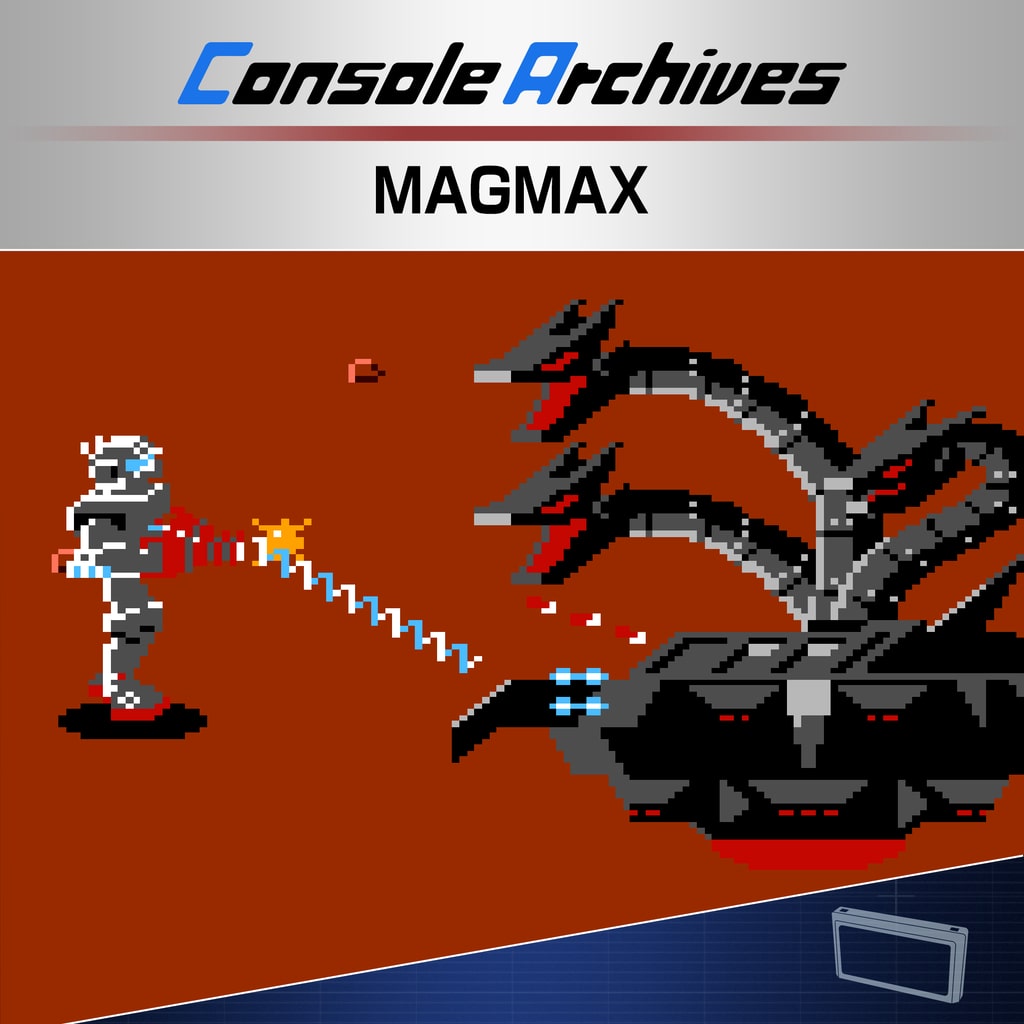
There is a particular kind of game that feels like a message from another era, not just in how it plays but in how it thinks. MAGMAX is one of those games. Originally released in 1986 for 8-bit home systems, it arrives now through HAMSTER Corporation’s Console Archives line, carefully preserved and lightly modernised for today’s systems. What you get is not a reinterpretation or a remake, but a time capsule that has been gently cleaned and returned to circulation. And against all odds, it still has a pulse.
A Simple Premise, A Surprisingly Flexible Machine
MAGMAX is fundamentally a horizontal shoot-’em-up game with a unique transformation element. You control a small spacecraft on a mission to rescue humanity from Babylon, a rogue alien computer that has deemed civilization unnecessary. The adventure takes place across surface and underground pathways, linked by warp points that continuously alter the flow of each level.
The most distinctive element is the transformation system. As you progress, you collect parts that gradually assemble your ship into a full humanoid mecha. It begins as something fragile and compact, but over time it becomes heavier, stronger and more imposing. That progression is not just cosmetic. It fundamentally changes how you survive encounters.
Early movement feels nimble but vulnerable. Later, once fully assembled, you become a slower but far more destructive force. There is a satisfying sense of escalation here that still holds up, even by modern standards.
Dual Layers of Combat and Movement
One of the more interesting aspects of MAGMAX is how it divides traversal between above-ground and underground segments. Warp holes serve as transitions between these layers, and learning when to switch between them becomes a core part of survival.
Above-ground sections are more open, often filled with faster enemies and direct confrontation. Underground areas feel tighter and more chaotic, with less space to manoeuvre and greater emphasis on reaction time.
The contrast prevents the pacing from becoming repetitive. Even though the core mechanics are simple, the constant switching between environments gives each stage a slightly different personality. It is not a complex system by modern standards, but it is an effective one. Its design is clear, making every action feel intentional.
The Console Archives Treatment
HAMSTER Corporation’s Console Archives series is built on preservation rather than reinvention, and MAGMAX follows that philosophy closely. The original structure remains intact, but it is supported by modern conveniences that make it far more approachable in 2026.
Save states and rewind functionality are the most impactful additions. The original difficulty curve, which could feel punishing in true 1980s fashion, is softened by the ability to undo mistakes. This does not remove the challenge entirely, but it shifts the tone from punitive to educational.
You are still expected to learn patterns, manage positioning and react quickly, but failure no longer feels like a full stop. Instead, it becomes a stepping stone.
Visual options also play an important role. CRT filters, scanline emulation and screen adjustments allow players to recreate the feel of original hardware, or strip it away entirely for a cleaner modern presentation. Neither approach feels definitive, which is fitting for a preservation-focused release.
A Game Defined by Progression Loops
What makes MAGMAX stand out, even today, is its sense of transformation over time. The parts collection system is simple yet effective at creating a long-term goal for each run. You are not just surviving moment to moment. You are building towards something larger and more powerful.
There is a quiet satisfaction in watching your small ship gradually evolve into a towering mecha. Each new component changes how you engage with enemies, and by the final stages you feel noticeably more capable than when you started. That sense of growth is what keeps the experience engaging, even when the underlying structure is straightforward.
Limitations of Its Era
It is important to acknowledge that MAGMAX is very much a product of its time. Enemy variety is limited, and stage design leans heavily on repetition. Movement physics feel rigid by modern standards, and encounters have a certain simplicity that may not hold the attention of players expecting depth or variation.
There is also little narrative development beyond the initial premise. Babylon is an effective abstract antagonist, but the game is not interested in storytelling beyond functional context.
However, these limitations are not surprising. They are part of the historical texture of the experience. The value here lies less in innovation and more in preservation.
Why It Still Matters
What makes Console Archives MAGMAX worth revisiting is not that it competes with modern shoot-’em-ups, but that it shows how many of the genre’s foundational ideas were already in place nearly four decades ago.
The transformation mechanic alone feels ahead of its time, handling progression through physical change rather than stat growth. The layered environments add a surprising amount of spatial awareness to what could have been a flat experience. Even the pacing, while simple, has a clarity that many modern games still struggle to replicate.
There is a directness here that feels refreshing. No excess systems. No layered progression trees. Just movement, shooting and incremental evolution.
Final Verdict
Console Archives MAGMAX is not trying to reinvent itself for a modern audience. It preserves a piece of early console design history and makes it playable in a way that respects both its limitations and its strengths.
It is short, mechanically simple and occasionally repetitive, yet it retains a purity of design that is increasingly rare. The transformation system gives it just enough identity to remain memorable, and modern quality-of-life features ensure it is no longer bound by the frustrations of its original hardware era.
For preservation enthusiasts and retro fans, it is an easy recommendation. For everyone else, it offers a glimpse into a formative moment in console gaming, when ideas were simple but ambition was already quietly taking shape.