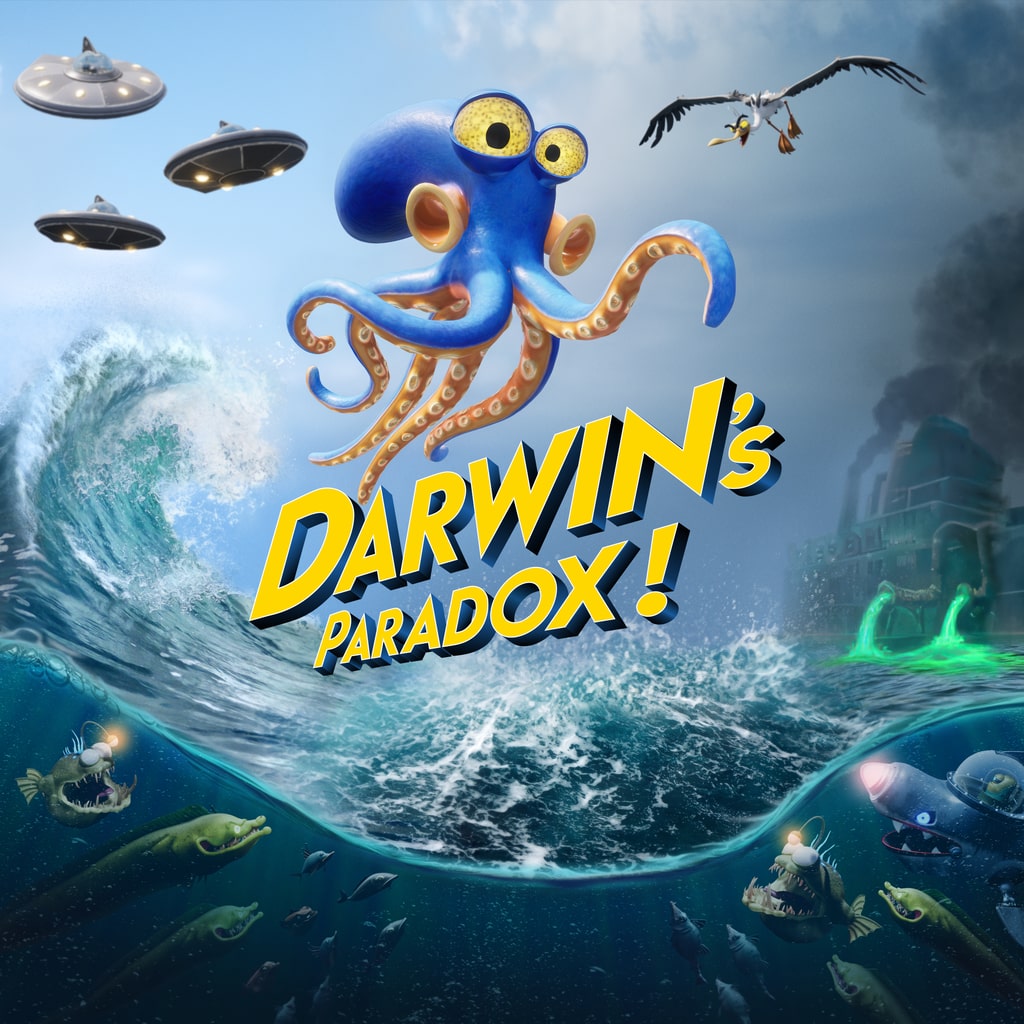
Few genres rely on atmosphere quite like the cinematic platformer. From Inside to Oddworld, these games thrive on restraint—using minimal dialogue, environmental storytelling, and carefully paced tension. Darwin’s Paradox! was developed by ZeDrimeTim and published by Konami, and it confidently follows this tradition. It introduces an unlikely hero—a curious octopus named Darwin.
Available on all major platforms and positioned as a key early title for the Nintendo Switch 2, Darwin’s Paradox! arrives with high hopes. Fortunately, it not only meets those expectations but often exceeds them, offering a thoughtful, visually stunning, and mechanically innovative adventure that aims to carve its own memorable path.
An Unlikely Hero in a Hostile World
The premise is surprisingly straightforward. Darwin, a curious octopus, is suddenly torn from his ocean home and dropped into a vast industrial complex. What unfolds is a compelling story of escape, discovery, and survival, as Darwin ventures into a world that is both unfamiliar and perilous. From the very beginning, the game highlights a strong sense of vulnerability. Darwin is no hero or warrior in the traditional sense; he is small, delicate, and always in danger. This sense of fragility influences every aspect of the experience, urging players to think carefully about each move they make.
Despite this, Darwin is not helpless. His unique abilities—such as camouflage, swimming, squeezing through tight spaces, and manipulating objects with his tentacles—are essential to the gameplay. Each skill is purposeful and blends naturally into both exploring the environment and solving puzzles, making every action feel meaningful and true to his character.
Stealth, Puzzle, Platforming—In Perfect Balance
At its heart, Darwin’s Paradox! is an intriguing mix of stealth, physics-based puzzles, and 2.5D platforming. What really stands out is how effortlessly these elements come together, creating a seamless experience. Stealth is at the core of the game, with many areas watched over by machines or hostile creatures, demanding careful timing and keen observation. Darwin’s ability to camouflage adds a satisfying layer of strategy, letting players blend into the surroundings during tense, near-silent moments that feel almost instinctive. There’s even a charming nod to Metal Gear, with alert sounds and optional cosmetic touches like a Snake skin, which bring a playful character to the game without disrupting its tone. It’s a world that invites you in, balancing challenge with a touch of wit, making every moment feel genuine and alive.
The puzzle design is just as impressive as the rest of the game. Environmental interactions feel natural and are layered with depth, often requiring players to think creatively and spatially. Whether you’re redirecting machinery, navigating water systems, or using physics to your advantage, the game consistently offers engaging challenges. The platforming is precise and responsive, adding to the experience. Darwin’s unique movement—fluid yet unpredictable—brings a subtle complexity. It’s not just about jumping from point A to point B. It’s about feeling your way through the environment, almost as if you’re part of it.
A World That Feels Alive—and Unsettling
Visually, Darwin’s Paradox! is truly captivating. The game heavily leans into a cinematic aesthetic, featuring carefully crafted scenes, dynamic lighting, and environments rich in detail. The industrial complex feels almost alive, acting as a character itself—cold and mechanical, yet layered with secrets and hazards. Rusted machinery, flickering lights, and expansive, cavernous spaces evoke a sense of scale that sharply contrasts with Darwin’s small figure. Yet, amidst the starkness, there is a quiet beauty. Moments of stillness—water dripping softly, light filtering through broken structures—offer brief, peaceful pauses amid the tension. This world feels alive and lived-in, even as it threatens to swallow you whole.
The animation deserves special praise. Darwin is a remarkable example of character design. His expressive movements communicate a full range of emotions—curiosity, fear, determination—without a single spoken word. Every subtle gesture brings him to life, making you feel his wonder and struggles as if they were your own.
Storytelling Without Words
Like the best games in its genre, Darwin’s Paradox relies heavily on environmental storytelling. There is very little direct exposition; instead, the story unfolds through visual details, background elements, and carefully staged sequences. What emerges is a narrative that intertwines personal survival with something much more ominous. The industrial complex is not just a backdrop—it’s part of a larger mystery, hinting at experimentation, exploitation, and consequences that go far beyond Darwin’s immediate struggle.
The pacing is deliberately measured, encouraging players to fully take in each moment. Some scenes feel almost like they belong in an animated film, with emotional beats that surprisingly resonate. However, the story sometimes relies a bit too much on ambiguity. While this adds a layer of intrigue, it can also leave certain aspects feeling underdeveloped. Not every thread is fully explored, and some players may find themselves wishing for clearer answers, yearning to understand more. Overall, the game invites you into a world where survival is intertwined with deeper, shadowy mysteries waiting to be uncovered.
Small Frictions in a Smooth Experience
Despite its many strengths, Darwin’s Paradox isn’t perfectly flawless. The game’s reliance on stealth, while generally effective, can sometimes lead to moments of frustration, especially during sections where enemy patterns aren’t immediately clear. Additionally, the physics-based elements, though quite impressive, occasionally feel a bit inconsistent. There are instances when interactions don’t quite behave as expected, causing minor hiccups in an otherwise smooth experience. These glitches are minor in isolation, but they stand out more in a game that otherwise demonstrates such careful craftsmanship.
A Standout in a Crowded Genre
What truly makes Darwin’s Paradox stand out is its remarkable ability to blend familiarity with originality. While it clearly draws inspiration from familiar genre classics, it then transforms those influences into something uniquely its own. A key part of this is Darwin himself; playing as an octopus is more than just a quirky gimmick—it’s a core element that deeply shapes how you engage with the game world. This perspective breathes new life into a well-worn formula, making it feel fresh and exciting. Coupled with stunning visual design, careful craftsmanship, and emotionally impactful moments, the game rises above many recent cinematic platformers to carve out its own memorable space.
Final Verdict
Darwin’s Paradox is a beautifully crafted adventure that draws you in with its blend of stealth, puzzles, and platforming. Its unique protagonist, immersive atmosphere, and cinematic style make it stand out, especially as an impressive showcase for newer hardware. While occasional frustrations with stealth and physics can disrupt the flow, they never overshadow the game’s many strengths. It’s a thoughtful, tense, and quietly moving experience—a journey that stays with you long after the credits have rolled.