Rhythm games have long balanced mechanical precision with emotional expression. At their best, they are not merely about hitting notes on time, but about capturing movement, flow, and the intangible feeling of music guiding the body. Dance Eden positions itself firmly within this philosophy, presenting a rhythm-driven experience that blends dance mechanics, stylised presentation, and a surprisingly reflective tone. Rather than chasing the bombast of mainstream rhythm titles, it opts for something more atmospheric and personal.
From the outset, Dance Eden makes it clear that this is not a conventional score-chasing arcade experience. While precision and timing remain central, the game places equal emphasis on mood, visual storytelling, and immersion. It aims to create a sense of harmony between player input, music, and environment—a design goal that shapes every aspect of the experience.
Core Gameplay and Rhythm Systems
At its foundation, Dance Eden is a rhythm game built around choreographed movement rather than traditional note highways. Players are asked to perform directional inputs, timing-based actions, and gesture-like commands that correspond to the music’s rhythm and phrasing. The emphasis is less on frantic button presses and more on maintaining flow and consistency.
This design choice makes the game immediately distinctive. Inputs feel deliberate and expressive, encouraging players to internalise the beat rather than react impulsively. Timing windows are forgiving early on, allowing newcomers to acclimate, but tighten as the game progresses, demanding greater precision and musical awareness.
What sets Dance Eden apart is how it interprets failure. Missing beats does not abruptly halt the experience or punish the player excessively. Instead, performance subtly alters visual intensity, scoring potential, and musical layering. This approach reinforces the game’s thematic focus on harmony rather than perfection, making it more inviting without sacrificing challenge.
Music and Audio Design
Music is the soul of Dance Eden, and it is handled with care and restraint. The soundtrack spans a range of electronic, ambient, and rhythmic compositions, each carefully matched to its corresponding stage. Tracks build gradually, often starting minimal before layering complexity as the level unfolds.
Rather than overwhelming players with constant intensity, the music encourages immersion. Beats are clear, melodies are evocative, and rhythmic cues are well communicated through both audio and visual feedback. This synergy makes it easier to learn patterns intuitively, reducing reliance on memorisation.
Sound effects are integrated seamlessly into the music, reinforcing successful inputs and transitions without breaking immersion. When combined with the adaptive audio layering, the result is a soundscape that feels reactive and alive.
Visual Presentation and Artistic Direction
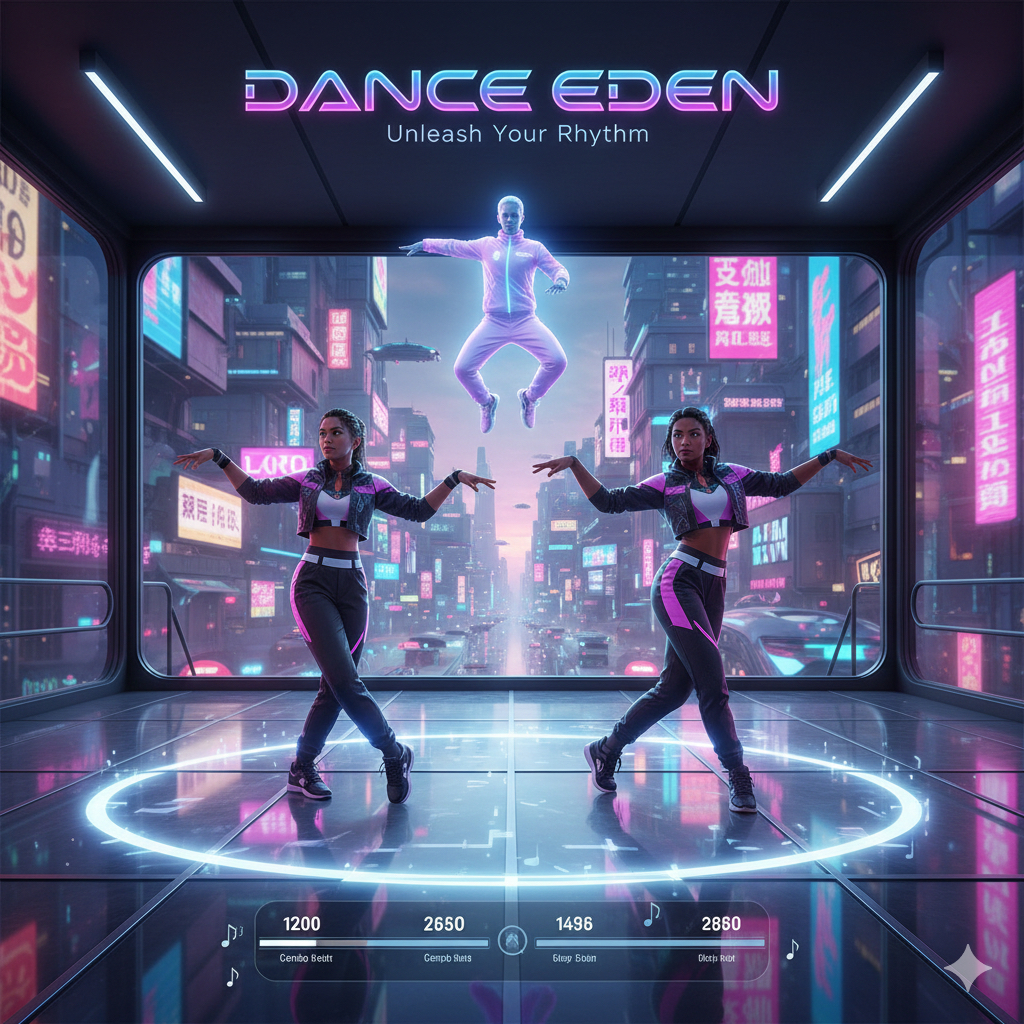
Visually, Dance Eden adopts a highly stylised aesthetic that prioritises abstraction over realism. Environments are dreamlike and symbolic, often evoking natural elements, flowing geometry, and surreal landscapes. The art direction reinforces the game’s title, presenting each stage as a kind of rhythmic sanctuary rather than a competitive arena.
Colour and motion are used deliberately. Successful sequences intensify lighting, particle effects, and environmental movement, while mistakes soften or dampen the visual response. This feedback loop creates a tangible connection between performance and presentation, making even subtle improvements feel rewarding.
Character representation is intentionally minimalistic. Rather than focusing on detailed avatars, the game treats the dancer as an extension of the environment, emphasising movement silhouettes and fluid animation. This abstraction helps players project themselves into the experience without distraction.
Structure and Progression
Dance Eden is structured around a series of themed stages, each introducing new rhythmic ideas or mechanical twists. Progression is steady, with new concepts layered carefully to avoid overwhelming the player. While there is a clear difficulty curve, it feels organic rather than artificially escalated.
Unlockables and progression systems are understated but effective. New tracks, visual modifiers, and performance challenges encourage replay without relying on excessive grinding. The game respects the player’s time, offering meaningful incentives rather than filler content.
Optional challenges provide additional depth for experienced players. These modes demand tighter timing, longer streaks, or altered input conditions, appealing to those who want to push mastery further without compromising the core experience for others.
Accessibility and Player Onboarding
One of Dance Eden’s strengths is its approachability. Controls are intuitive, tutorials are integrated naturally into early stages, and visual cues are clear without being intrusive. Players unfamiliar with rhythm games will find the learning curve manageable, while genre veterans can appreciate the game’s unique interpretation of familiar mechanics.
Accessibility options allow players to adjust timing tolerance and visual intensity, making the experience more inclusive. While not exhaustive, these options demonstrate a clear effort to accommodate a broad audience without diluting the game’s identity.
Technical Performance and Polish
From a technical standpoint, Dance Eden performs reliably. Frame rates remain stable, input latency is minimal, and transitions between stages are smooth. Given the precision required by rhythm gameplay, this consistency is essential and largely achieved.
Minor issues do exist, such as occasional visual repetition across stages or limited variety in environmental motifs. However, these are small concerns in an experience driven more by cohesion than scale.
Overall Impression
Dance Eden is a thoughtful and distinctive entry in the rhythm genre. It resists the urge to compete with more bombastic titles, instead carving out a quieter, more introspective space. Its focus on flow, atmosphere, and expressive input makes it feel as much like a meditative experience as a traditional game.
While players seeking high-octane challenge or competitive leaderboards may find it restrained, those who value immersion, artistry, and rhythm-driven gameplay will find much to appreciate. Dance Eden succeeds not by reinventing rhythm mechanics, but by reframing them around emotion and harmony.