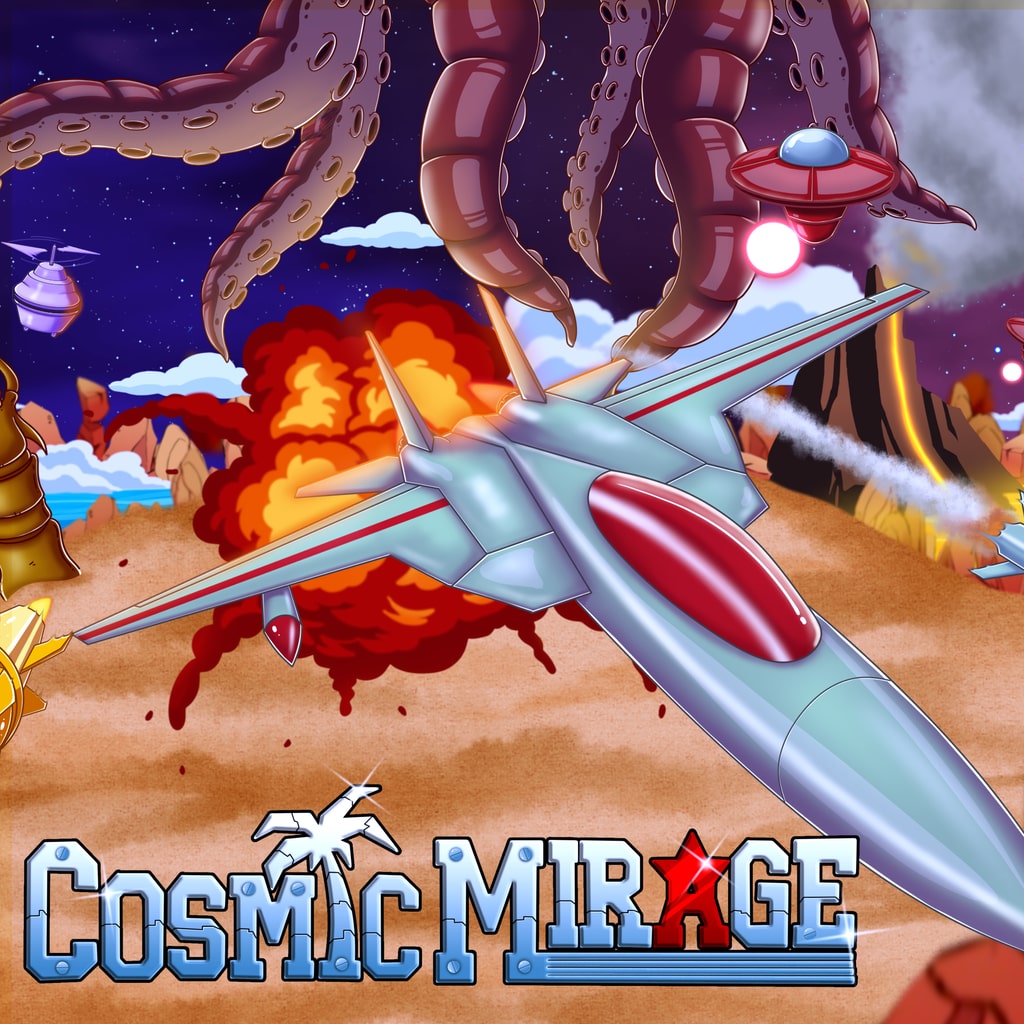
Shooters have always occupied an interesting space in gaming. They often ask very little of players in terms of story, yet somehow manage to create entire universes through movement, music, and momentum alone. Cosmic Mirage arrives with that same old-school spirit intact. It does not arrive with grand ambitions or genre-defining ideas. Instead, it offers a straightforward promise: jump into a starfighter, blast through enemy armadas, and save worlds swallowed by darkness.
The premise is simple but effective. Peaceful planets across the galaxy have fallen to a sinister invading force, their once-thriving ecosystems reduced to hollow “space mirages.” As the last dependable pilot left standing, players embark on a liberation campaign across alien landscapes and hostile skies. It is classic arcade storytelling in the purest sense. The narrative exists mainly to push you towards the next battle, but sometimes that is enough.
Straight Into the Action
From the opening moments, Cosmic Mirage wastes no time. You launch straight into combat, weaving through projectile patterns while firing into waves of enemy ships crossing the screen.
The controls are responsive and immediate, perhaps the game’s greatest strength. Movement feels tight, your fighter reacts precisely, and dodging incoming fire rarely feels unfair. In a genre where a fraction of a second can mean the difference between survival and defeat, that responsiveness matters.
Enemy formations arrive at a brisk pace, shifting from straightforward attack runs to denser bullet patterns as stages progress. Boss encounters punctuate levels with larger-scale confrontations that demand pattern recognition and constant movement. Nothing here feels revolutionary, but it works. There is an honesty to Cosmic Mirage. It knows exactly what kind of game it wants to be.
Worlds Painted in Neon Dust
Visually, Cosmic Mirage embraces retro sensibilities while layering modern polish over its pixel-inspired foundation. The various planetary settings provide the game with its strongest aesthetic moments. One stage may carry you across burning industrial zones glowing under alien skies, while another sends you drifting through fractured cosmic landscapes that feel abandoned and haunted.
The worlds themselves tell much of the story. These are not merely backdrops but reminders of what has been lost beneath the invaders’ occupation. There is a pleasant rhythm to moving through these environments. Colours shift, enemy designs evolve, and the scenery constantly changes just enough to keep the journey visually engaging.
The effects work also deserves praise. Explosions flash brightly without overwhelming visibility, weapon fire remains readable, and enemy projectiles stand out clearly against the environments. For a fast-moving shooter, clarity is essential.
Arcade Heart, Limited Evolution
Where Cosmic Mirage struggles is progression. The early stages are exciting because everything feels fresh. New enemy waves appear, bosses introduce fresh mechanics, and the visual variety keeps momentum high. As the campaign continues, however, repetition starts to creep in.
Enemy encounters begin to lean heavily on familiar patterns. Combat rarely introduces major mechanical surprises later in the game, leaving the experience largely dependent on the player’s enjoyment of the core shooting loop. That loop remains enjoyable, but there are moments when you wish the game pushed itself further.
Perhaps additional ship customisation, alternate weapon systems, branching routes, or more dramatic stage mechanics could have elevated the journey. Instead, Cosmic Mirage often chooses consistency over evolution. Some players will appreciate that simplicity. Others may finish wishing for a little more ambition.
Boss Battles Bring the Best Moments
The game shines brightest during boss encounters. These larger enemies inject energy back into the campaign whenever repetition threatens to settle in. Multi-stage attack patterns force players to stay alert, reading movement cues while balancing offence and defence. There is genuine satisfaction in surviving these battles.
Several encounters capture that classic arcade feeling, where victory arrives only after repeated attempts and gradual mastery. You learn the attack rhythms, adapt your positioning, and slowly transform chaos into confidence. That process remains one of gaming’s purest pleasures. The bosses also reinforce the liberation fantasy at the heart of the story. Each victory feels like reclaiming a small piece of the galaxy.
A Comfortable Throwback
One thing I appreciate about Cosmic Mirage is its refusal to overcomplicate itself. Modern indie shooters sometimes drown their identity in upgrade trees, progression currencies, meta systems, and endless unlock structures. Cosmic Mirage largely avoids that temptation. You play. You shoot. You survive. That purity gives the experience an almost comforting quality. It feels like something from an earlier era, when arcade games focused entirely on immediate satisfaction rather than long-term systems.
Of course, that simplicity cuts both ways. Players seeking deep progression or extensive replay hooks may find the package relatively lightweight. Yet there is still value in focused design. Not every game needs to become a lifestyle commitment.
The Soul of Small Scale Shooters
There is a quiet charm beneath Cosmic Mirage that keeps it from feeling disposable. Perhaps it comes from the sincerity of its presentation. Perhaps it is the way its worlds hint at forgotten civilisations beneath the action. Or perhaps it is simply that side-scrolling shooters still carry a kind of timeless magic. They ask players to trust their instinct. Move. React. Survive.
The genre strips gaming back to its fundamentals. Cosmic Mirage understands that language. It may not reach the heights of legendary shooters, nor does it rewrite the formula, but it delivers enough energy and heart to justify the journey.
Final Verdict
Cosmic Mirage is a modest yet enjoyable shooter that succeeds on solid fundamentals rather than innovation. Responsive controls, attractive environments, and satisfying boss encounters make for an experience that remains entertaining throughout its runtime, even when repetition occasionally slows the momentum.
It feels like a love letter to old arcade cabinets and after-school gaming sessions. Familiar, uncomplicated, and sincere. The galaxy may be fading into mirages, but this little adventure still finds moments worth remembering.