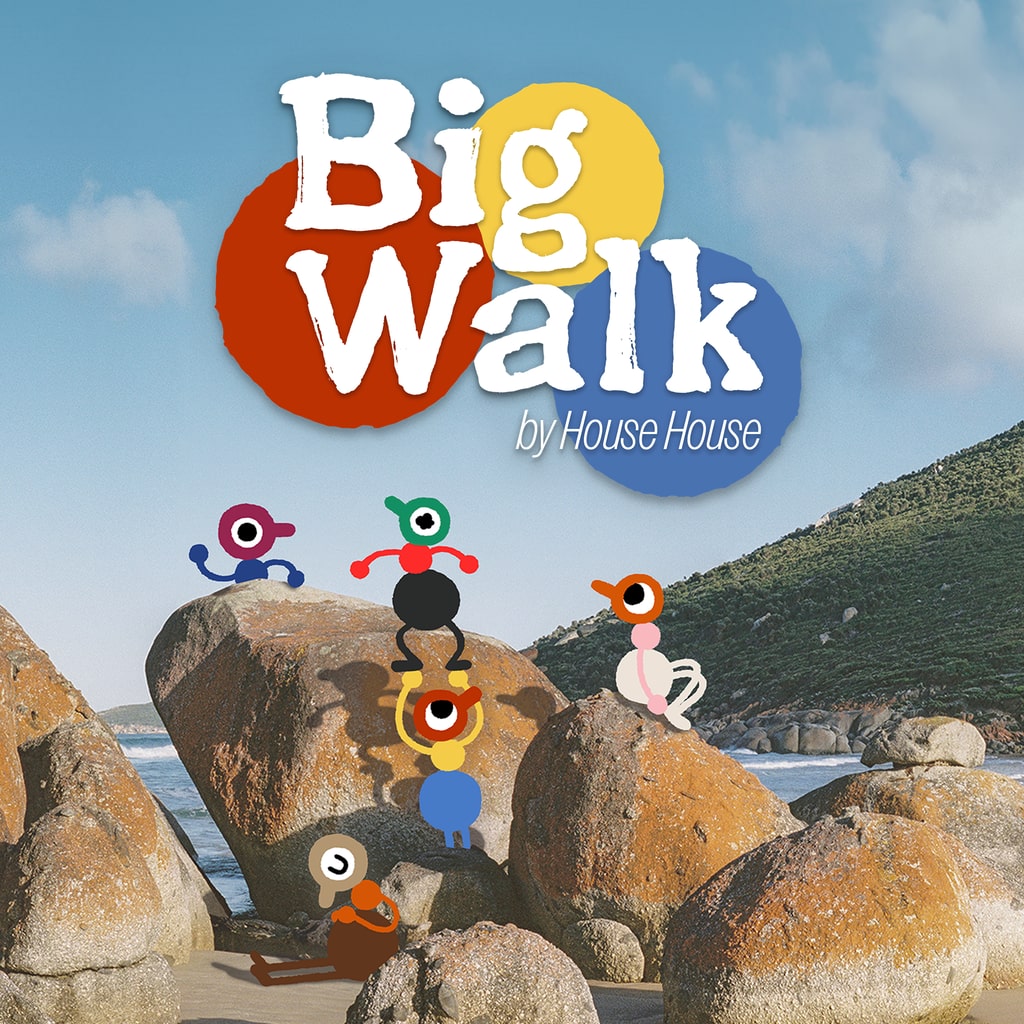
There is something wonderfully refreshing about a game that refuses to rush you. In an era when multiplayer experiences often revolve around constant combat, endless progression systems, or chasing the next seasonal reward, Big Walkquietly goes in the opposite direction. Developed by House House, the studio behind the brilliantly mischievous Untitled Goose Game, this cooperative adventure strips away traditional expectations and replaces them with something surprisingly simple. It is a game about wandering, talking, solving problems together, and, perhaps most importantly, enjoying the company of the people exploring alongside you.
That premise may sound almost too modest, but it quickly becomes clear that Big Walk understands something many online games have forgotten. Shared experiences are far more memorable than digital rewards. Whether you are laughing because a friend accidentally disappears over a cliff, frantically regrouping after becoming separated, or celebrating the solution to a particularly clever puzzle, the game constantly reminds you that the journey itself is the real prize.
Gameplay
Big Walk wastes little time before dropping players into its colourful open world, trusting curiosity to do the rest. Rather than overwhelming you with objective markers, quest logs or lengthy tutorials, it encourages natural exploration. Every hill, valley and winding path invites investigation, while subtle landmarks gently draw your attention towards the next discovery without ever feeling forced. It is a confident approach that rewards players willing to slow down and simply enjoy the adventure.
The world is packed with environmental puzzles that rely heavily on cooperation rather than individual skill. Some challenges require multiple players to operate mechanisms from different locations, while others ask groups to relay information across large distances. Solving these puzzles never feels repetitive because each introduces new ideas that encourage genuine teamwork rather than simply assigning everyone the same task. The result is an experience where every member of the group feels useful, regardless of gaming experience.
Progression is deliberately relaxed, allowing players to tackle challenges at their own pace. There is rarely any pressure to move quickly, and that slower rhythm gives every discovery room to breathe. You might spend several minutes solving a puzzle, only to be distracted by an unusual landmark or an amusing interaction between your friends. Those unexpected detours become some of the game’s greatest strengths because they feel completely organic.
The pacing also encourages experimentation. Without enemies constantly interrupting exploration, players naturally begin testing the various tools scattered throughout the island. Some have practical uses during puzzles, while others exist almost entirely to create entertaining moments between friends. That balance between structured objectives and playful freedom gives the adventure an easygoing charm that remains enjoyable from beginning to end.
Communication Becomes the Core Mechanic
The feature that truly separates Big Walk from almost every other cooperative game is its remarkable communication system. Voice chat is not simply included as a convenience. Instead, it becomes one of the game’s central mechanics, shaping how players move, cooperate and solve problems throughout the adventure.
Conversations change naturally with your surroundings. Voices grow quieter as friends move further away, echoes bounce through tunnels and valleys, and walls muffle speech exactly as you would expect in the real world. Walk too far from your group and their voices gradually fade into the distance, creating a surprisingly powerful sense of isolation. Suddenly, staying together becomes important for reasons that have nothing to do with combat or survival.
To compensate, the game provides a collection of wonderfully inventive communication tools. Walkie-talkies enable distant conversations, laser pointers help direct teammates towards important locations, and whiteboards prove surprisingly effective when spoken instructions are not enough. Even seemingly silly items such as cowbells and oversized props eventually find practical uses before inevitably becoming sources of hilarious distraction. House House clearly understands that memorable multiplayer moments often emerge from player creativity rather than scripted events.
Perhaps the most impressive aspect is how naturally these systems encourage cooperation. Nobody needs to be told to stick together because the world itself makes communication enjoyable. Groups naturally develop their own shorthand, inside jokes and methods of navigating the island, creating stories that belong entirely to the players rather than the developers.
A Beautiful World Built for Exploration
The island itself deserves enormous credit for supporting the game’s unique design philosophy. Rather than creating an enormous empty landscape, House House has crafted an environment in which every region feels carefully considered. Distinct landmarks help players build a mental map without constantly relying on menus, making exploration rewarding rather than confusing.
Each location has its own personality. Dense forests gradually give way to rocky cliffs, peaceful beaches open into mysterious ruins, and hidden pathways often reveal unexpected discoveries. Visual storytelling quietly fills the world with intrigue, encouraging players to speculate about the island’s history without relying on lengthy dialogue or exposition. The sense of mystery persists throughout, quietly motivating exploration even when no obvious objective lies ahead.
The lack of traditional combat also allows the scenery to take centre stage. Players have time to stop, admire the view and appreciate the atmosphere without feeling guilty about slowing the group’s progress. Some of the most memorable moments occur when everyone simply pauses to enjoy a sunset before continuing towards the next puzzle.
Presentation
Big Walk adopts a clean, colourful art style that complements its relaxed atmosphere. Rather than chasing photorealism, it embraces a timeless visual identity that remains expressive without becoming cluttered. Character animations are wonderfully exaggerated, making gestures and body language an important part of communication even when players cannot speak directly.
The sound design deserves particular praise for constantly reinforcing the sense of physical space. Wind rustles through trees, distant wildlife fills quiet moments, and subtle environmental sounds make every location feel alive. The dynamic voice system remains the true highlight, transforming ordinary conversations into an immersive gameplay mechanic unlike anything else currently available.
Music is used sparingly but effectively, allowing silence to be as important as the soundtrack itself. During quieter moments, the sounds of nature combine with conversations between friends to create an atmosphere that feels remarkably genuine. Rather than overwhelming the player, the presentation quietly supports every aspect of the adventure.
Playing Together
Supporting between two and twelve players gives Big Walk remarkable flexibility. Smaller groups experience a focused cooperative adventure in which every individual plays an important role in solving puzzles and navigating the environment. Larger groups naturally become more chaotic, but that chaos often creates the funniest stories as conversations overlap, players wander off in different directions and unexpected situations unfold.
Cross-platform support makes assembling groups refreshingly straightforward, removing one of the biggest frustrations in modern multiplayer games. Whether friends are playing on console or PC, everyone can explore the island together without unnecessary barriers. That accessibility perfectly matches the game’s welcoming nature, ensuring the emphasis always remains on spending time together rather than worrying about technical limitations.
The social design extends beyond puzzle-solving. Players are actively encouraged to experiment, joke around and create their own entertainment between objectives. Whether someone decides to borrow a pair of binoculars and promptly throw them into the sea, or rings a cowbell at exactly the wrong moment, the game constantly produces unscripted comedy that feels entirely unique to each group.
Final Verdict
Big Walk proves that multiplayer games do not need explosions, endless progression systems or competitive rankings to leave a lasting impression. Instead, it builds its identity on conversation, cooperation and genuine human interaction. Every puzzle, every tool and every stretch of beautiful countryside reinforces the simple idea that adventures become far richer when shared with friends.
Its relaxed pace will not appeal to everyone, particularly players seeking relentless action or constant rewards. However, those willing to embrace its slower rhythm will find one of the most thoughtful and genuinely original cooperative experiences released in recent years. House House has once again demonstrated an impressive ability to take a simple concept and transform it into something unforgettable, through clever design and remarkable confidence.
Big Walk succeeds because it understands that the best multiplayer memories cannot be scripted. They emerge naturally through laughter, mistakes, teamwork and unexpected discoveries shared with people whose company you genuinely enjoy. Long after the puzzles have been solved, those moments remain, making Big Walk an adventure that feels as meaningful as it is entertaining.