
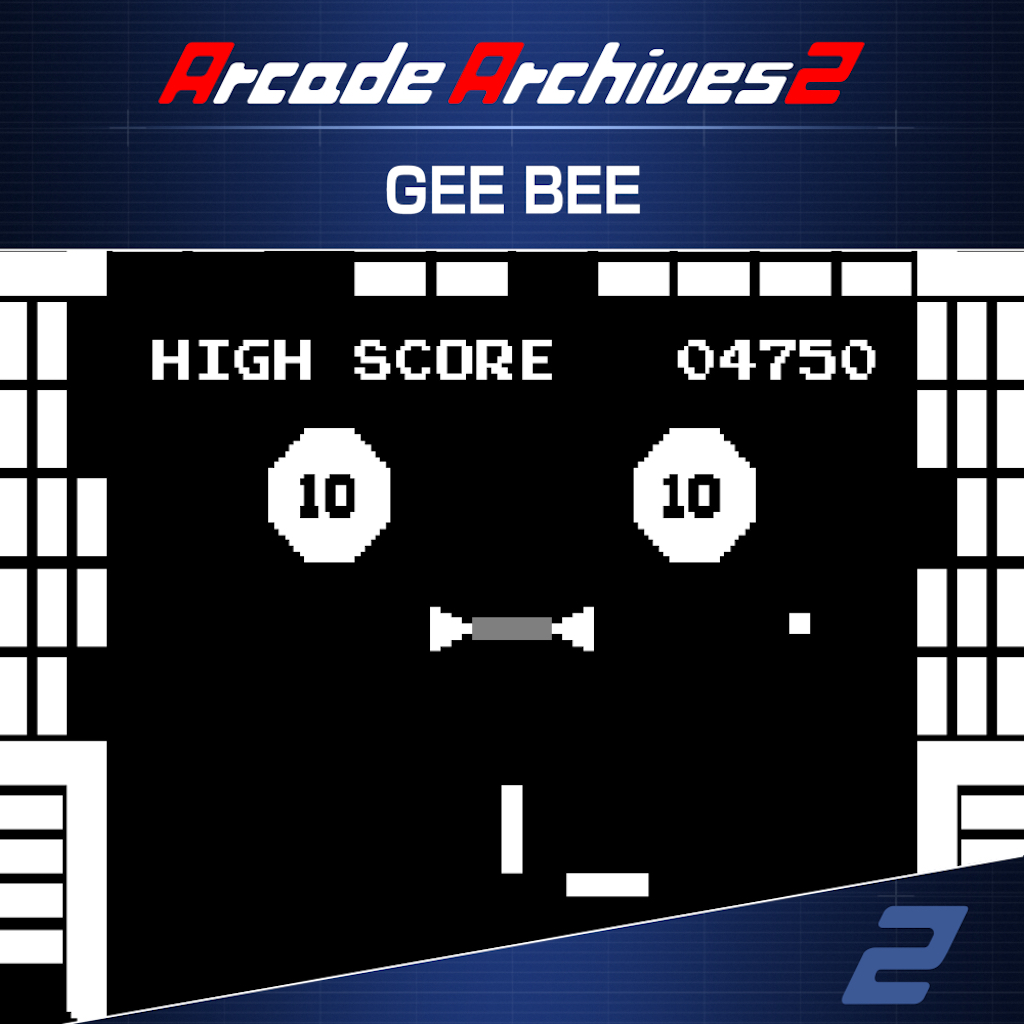
Among the many titles preserved under the Arcade Archives 2 banner, GEE BEE stands out not because of spectacle, speed, or technical fireworks, but because of its sheer historical significance. Originally released in the late 1970s, GEE BEE represents one of the formative moments of arcade game design — a time when developers were still discovering what video games could be. With Arcade Archives 2 GEE BEE, players are invited to step back into that experimental era, where simplicity, imagination, and mechanical creativity ruled.
This is not a game that aims to impress through modern sensibilities. Instead, it challenges players to appreciate the roots of arcade gaming, offering an experience that is minimalist, demanding, and surprisingly engaging once its rhythms are understood.
A Snapshot of Arcade History
GEE BEE comes from a period before genres were clearly defined. Part pinball, part brick-breaker, and part score-attack experiment, it reflects an industry still borrowing ideas from mechanical amusements and translating them into digital form. Arcade Archives 2 GEE BEE faithfully preserves this identity, presenting the game as it was originally conceived rather than attempting to modernise it.
From the moment you begin, it’s clear this is a product of its time. The visuals are stark and functional, the playfield compact, and the objectives simple. Yet within these limitations lies a fascinating glimpse into the early philosophy of arcade design — one built around short sessions, escalating challenge, and the pursuit of mastery through repetition.
Gameplay: Simple Rules, Demanding Execution
At its core, GEE BEE is deceptively straightforward. Players control flippers at the bottom of the screen, batting a ball upward to clear blocks and hit targets while keeping it from falling out of play. It’s a concept instantly recognisable, but one that demands far more precision than it initially appears.
Timing is everything. The ball’s movement can be unpredictable, and the limited control options mean mistakes are punished quickly. There’s no room for improvisation or recovery once things go wrong. Instead, success comes from understanding angles, anticipating movement, and reacting decisively.
Arcade Archives 2 GEE BEE doesn’t soften these mechanics. There are no tutorials or assists to ease players in. You learn by failing, and improvement is gradual but tangible. Each successful run feels earned, reinforcing the satisfaction that early arcade games were built upon.
Difficulty and Score Chasing
Difficulty in GEE BEE ramps up subtly but relentlessly. As stages progress, layouts become trickier, ball speed increases, and the margin for error shrinks. What initially feels manageable soon turns tense, pushing players to sharpen their reflexes and decision-making.
Score chasing is central to the experience. Without narrative progression or unlock systems, the primary motivation is to beat your previous best. This creates a compelling loop where short play sessions naturally encourage “just one more try.” It’s a design philosophy that modern games rarely embrace so purely, yet it remains effective decades later.
The challenge may feel unforgiving by contemporary standards, but it’s also refreshingly honest. There’s no artificial padding, no randomness designed to inflate playtime — only skill, practice, and perseverance.
Presentation: Functional but Authentic
Visually, Arcade Archives 2 GEE BEE is as minimal as arcade games come. The playfield is clean and uncluttered, with simple shapes and clear contrasts ensuring readability at all times. While some players may find this austere, it perfectly suits the game’s mechanical focus.
Animations are basic but purposeful, conveying essential information without distraction. Every bounce, collision, and deflection is immediately readable, which is crucial for a game so reliant on timing and precision.
Audio design follows a similar philosophy. Sound effects are simple and repetitive, but they provide important feedback for player actions. There’s a certain charm to these early arcade sounds — a reminder of a time when audio cues were designed for noisy arcades rather than immersive soundscapes.
Modern Enhancements Through Arcade Archives 2
As part of the Arcade Archives 2 series, GEE BEE benefits from thoughtful modern features that enhance accessibility without altering the original experience. Customisable display options, controller mappings, and performance settings allow players to tailor the game to their setup while preserving its authenticity.
These enhancements are particularly valuable for a title this old. They help bridge the gap between vintage design and modern expectations, making GEE BEE approachable for new players without diluting its original intent.
Importantly, these features never interfere with gameplay. The experience remains focused on mastering the core mechanics, not navigating menus or optional systems.
Who Is This For?
Arcade Archives 2 GEE BEE is not a game for everyone. Players seeking narrative depth, visual spectacle, or modern quality-of-life features may struggle to connect with its stark simplicity. However, for those interested in gaming history, mechanical purity, or the origins of arcade design, it offers something genuinely valuable.
This is a game best approached with curiosity rather than expectation. When viewed as an interactive artifact rather than a modern release, its strengths become far more apparent.
Why GEE BEE Still Matters
Playing GEE BEE today highlights just how much of modern gaming’s foundation was laid by simple concepts executed well. The emphasis on player skill, the focus on short but intense sessions, and the reliance on clear feedback loops are all ideas that still resonate across countless genres.
In that sense, Arcade Archives 2 GEE BEE isn’t just a curiosity — it’s a reminder of where it all began. It shows that compelling gameplay doesn’t require complexity, only thoughtful design and a willingness to challenge the player.
Final Verdict
Arcade Archives 2 GEE BEE is a modest but meaningful entry in the Arcade Archives 2 lineup. It won’t dazzle with visuals or overwhelm with content, but it offers an authentic, challenging, and historically important experience that rewards patience and precision.
For players willing to engage with its minimalist design and demanding mechanics, GEE BEE provides a fascinating glimpse into the early days of arcade gaming — and a reminder that great design often starts with the simplest ideas.












[…] Arcade Archives 2 GEE BEE and Arcade Archives 2 BOMB BEE, for example. These early titles showcase a time when arcade games […]