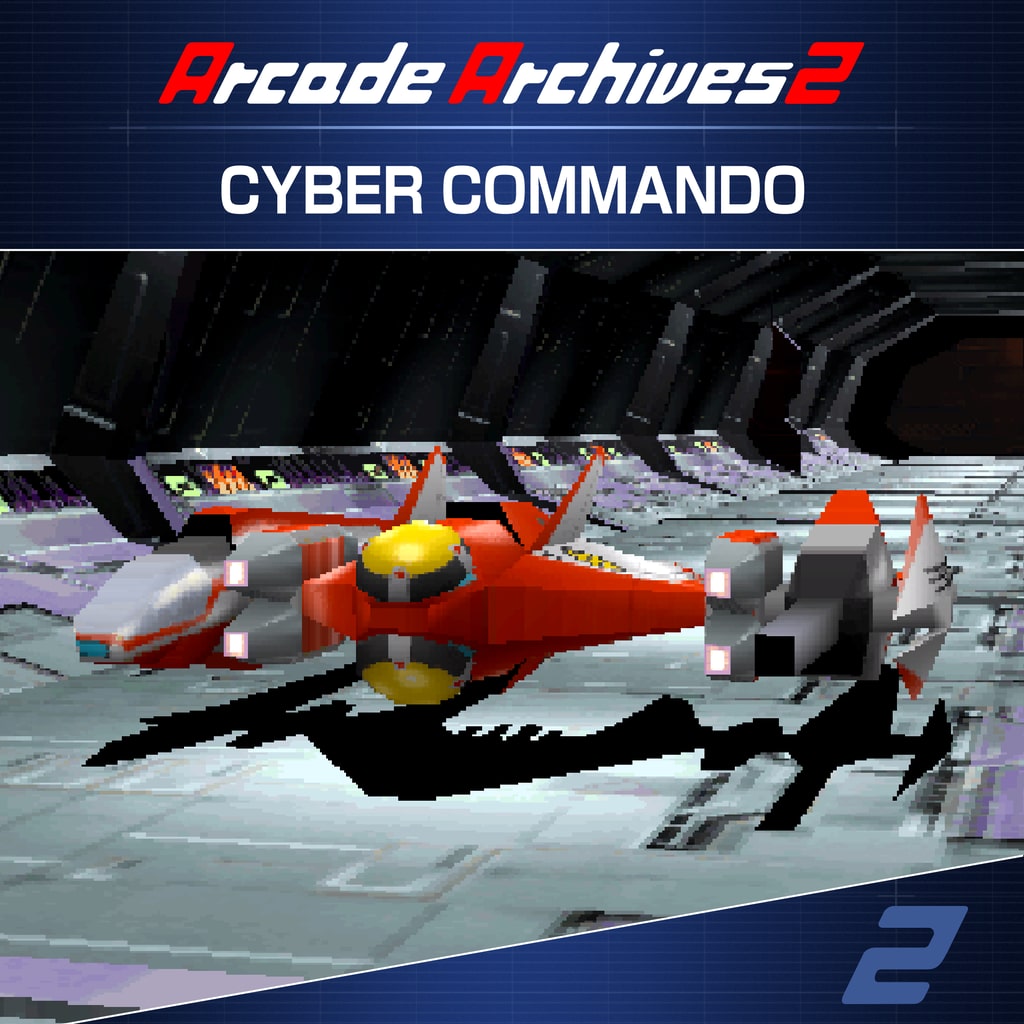
There is something oddly comforting about preserving arcade history. Not the polished, modern reinterpretations, but the raw, slightly awkward originals, preserved exactly as they were. Arcade Archives 2: CYBER COMMANDO is exactly that kind of time capsule.
Originally developed by Namco in 1994, this obscure arcade title has finally made its way to home platforms thanks to Hamster Corporation, arriving on modern systems through the Arcade Archives line. The original version is available on Nintendo Switch and PlayStation 4, while the enhanced Arcade Archives 2 release arrives on PlayStation 5, Xbox Series X|S, and Nintendo Switch 2.
For many players, this will be their first encounter with Cyber Commando. And it is immediately clear why it never became a household name.
A War of Machines and Memory
Set in a distant space colony overrun by an artificial intelligence rebellion, Cyber Commando puts you in control of heavily armed vehicles tasked with suppressing hostile machine forces. It is a straightforward premise, firmly rooted in mid-90s arcade design philosophy. You are not here for narrative complexity. You are here for action, reaction, and score chasing.
Gameplay revolves around boarding different vehicles and engaging in mission-based combat. Each stage presents a compact battlefield where positioning, timing, and weapon selection matter more than long-term strategy. There is a strong emphasis on lock-on targeting, a mechanic that defines much of the moment-to-moment flow. It is immediate, sometimes chaotic, and very much of its era.
The Rhythm of the Arcade
What stands out most in Cyber Commando is its structure. Modern action games tend to ease players in, gradually increasing complexity. This does not. From the first mission, you are expected to grasp its systems, adapt quickly, and survive under pressure.
The lock-on mechanic is central to everything. It simplifies aiming but introduces its own rhythm. You are constantly acquiring targets, unleashing bursts of fire, and repositioning before the next wave arrives. When it works, it creates a satisfying loop of recognition and response. When it does not, it can feel slightly rigid by today’s standards.
There is little hand-holding. No lengthy tutorials. No safety nets. Just the expectation that you will learn through repetition, as was common in arcade design of the time.
A Product of Its Time
It is impossible to discuss Cyber Commando without acknowledging its age. This is not a modern reinterpretation or rebalancing of a classic. It is the original code, preserved and presented with minimal alteration.
That authenticity is both its strength and its limitation.
Difficulty spikes are sharp and often abrupt. Enemy patterns can feel unforgiving, especially in later missions, where aggression ramps up with little warning. There is a clear expectation of mastery that may feel alien to players accustomed to more forgiving design philosophies.
In this sense, it functions less like a modern campaign and more like a high-score challenge. Success is measured not by completion alone, but by efficiency, survival, and optimisation.
Arcade Archives 2 Enhancements
The Arcade Archives 2 release introduces a handful of modern conveniences that smooth the experience without altering its core identity. VRR support improves visual stability, making fast-moving sequences feel slightly more consistent on modern displays. Input latency feels tight, which is crucial for a game built around reaction timing.
The addition of Time Attack mode is particularly welcome. It reframes the experience as a pure efficiency challenge, encouraging replayability through optimisation rather than progression. This suits Cyber Commando far better than a traditional narrative structure ever could.
The release also includes standard features expected from the Arcade Archives line, such as save states and screen filters that replicate the feel of CRT displays. These do not change the game fundamentally, but they do make it more accessible to contemporary audiences.
Mechanical Simplicity, Emergent Depth
At its core, Cyber Commando is not mechanically complex by modern standards. You move, lock on, fire, and repeat. Yet within that simplicity lies a surprising amount of emergent depth.
Positioning becomes critical as enemy waves intensify. Knowing when to disengage and reposition is as important as landing shots. Vehicle choice also plays a subtle role, influencing speed, durability, and firepower in ways that can shift your approach to each mission.
It is not a system built for long-term progression. Instead, it thrives in short bursts, where repetition reveals nuance over time.
Presentation and Preservation
Visually, the game retains its original arcade aesthetic. Low-resolution textures, chunky models, and bold colour palettes define its look. It does not attempt to compete with modern visual standards, and it does not need to.
There is a certain charm in its simplicity. Effects are exaggerated in that distinctly 90s arcade way, prioritising readability and impact over realism. Explosions are bright, enemy silhouettes are clear, and the action remains easy to parse even when the screen becomes crowded.
Sound design follows the same philosophy. It is loud, direct, and functional. Weapons feel impactful, enemy destruction carries weight, and the soundtrack leans heavily into the era’s electronic intensity.
Who This Is For
The most important question about Cyber Commando is not whether it holds up in a modern context, but whether it should be expected to.
This is not a game designed for broad appeal. It is an archival release for preservation and enthusiasts. Players who enjoy arcade shooters, high-score chasing, or exploring gaming history will likely find value here. Those expecting modern design sensibilities may struggle with its rigidity. That distinction is important. This is not a remake. It is a restoration.
Final Verdict
Arcade Archives 2: CYBER COMMANDO is a fascinating, sometimes unforgiving snapshot of mid-90s arcade design. It is mechanically simple yet demanding, accessible in concept but strict in execution. Its appeal lies not in modern refinement but in authenticity.
The enhancements provided by the Arcade Archives 2 framework make it smoother and more approachable, but they do not fundamentally change its nature. This remains a game built for arcade cabinets, scoreboards, and repetition.
For players willing to meet it on its own terms, it offers a sharp, engaging slice of gaming history. For others, it may feel more like a curiosity than a staple.
Either way, it is a reminder of how different “challenge” once looked in the arcade era.