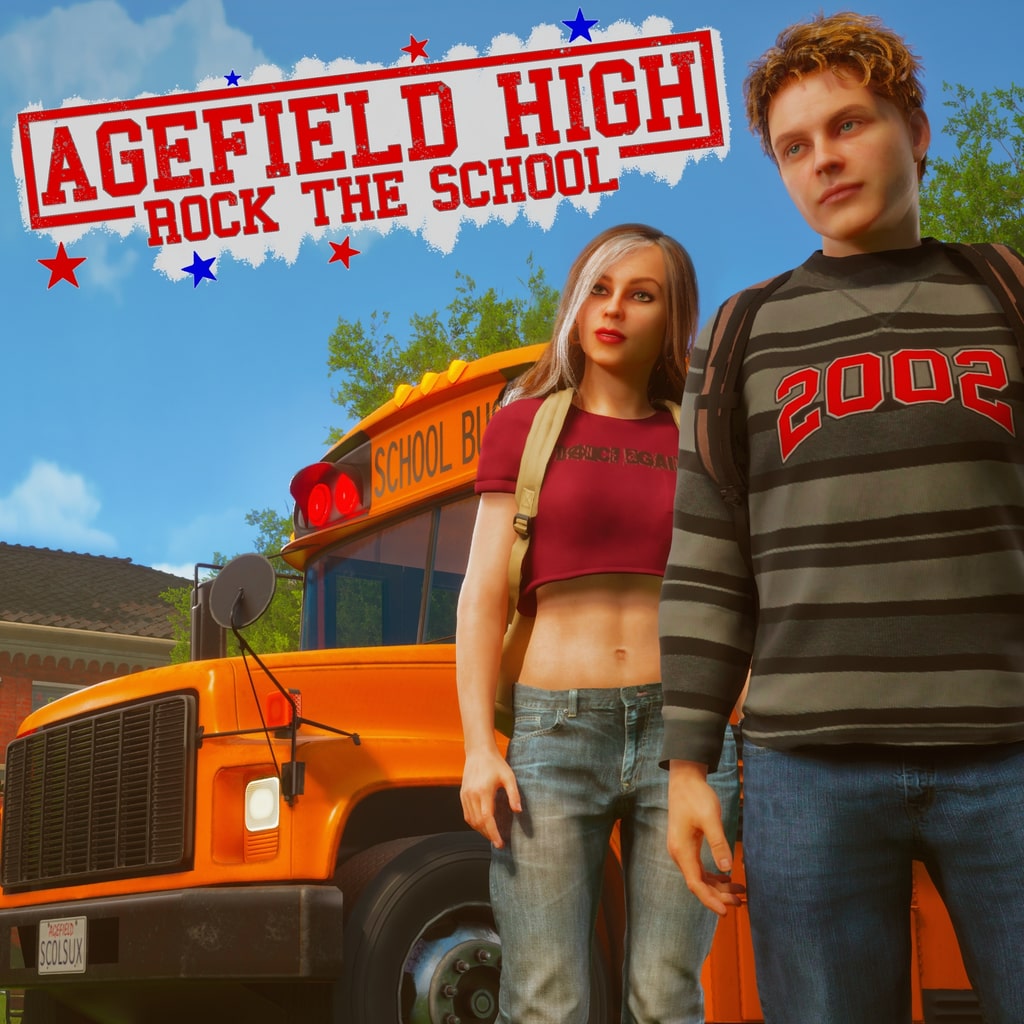
There is a particular kind of nostalgia attached to the early 2000s that seems to be growing stronger with every passing year. It was an era of oversized mobile phones, questionable fashion, pop punk blaring from bedroom stereos, and teen comedies that seemed determined to see just how far they could push a joke. Agefield High: Rock the School knows exactly which decade it wants to drag us back to, wrapping its open-world school adventure in the sort of outrageous teenage chaos that once filled cinema screens.
It is also very obvious where much of its inspiration comes from. Rockstar’s Bully is practically sitting on the game’s shoulder throughout, while the likes of American Pie and other early 2000s teen comedies provide the tone, humour and general sense of adolescent mischief. The problem is that inspiration is one thing, while actually capturing the charm of those influences is another. Agefield High has the ingredients for a wonderfully silly coming-of-age adventure, but far too often it feels like a rough imitation rather than a confident homage.
You play as Sam, a new student who has just moved to the small town of Agefield with graduation only a few months away. Rather than quietly getting through his final stretch of school, Sam is recruited by Kale and Axel to help execute their increasingly ridiculous plan to “Rock the School” and become legends before graduation. Between attending lessons, completing missions, exploring the town, earning money and generally causing trouble, Sam’s final months at school are supposed to become one unforgettable adventure.
There is certainly a decent idea buried underneath all of this. Unfortunately, Agefield High struggles to turn that idea into a polished or consistently entertaining game.
Welcome to Agefield
The setting is arguably the game’s greatest asset. Agefield is a relatively small open world, but it attempts to capture a snapshot of early 2000s suburban America, complete with the school campus, residential areas, town centre and surrounding countryside. It is not enormous, and the decision to create a compact world suits the premise better than an unnecessarily huge map would have.
There is something appealing about being able to leave school grounds and wander around the surrounding town. You can pick up side missions, earn some pocket money, buy clothes, change your hairstyle, acquire bikes and generally indulge in the sort of teenage freedom the game is trying to sell. There is a sense that the developers understood why the school and its surrounding neighbourhoods worked so well as the foundation for this kind of adventure.
Sadly, the technical presentation frequently gets in the way. The world can feel strangely lifeless, with stiff character animations and environments that lack the personality needed to make Agefield feel like a convincing place. Instead of stumbling across amusing little details that make you want to explore, you can sometimes find yourself simply moving from one objective marker to another.
That is particularly frustrating because a school-based open world should be packed with character. The best games in this style make you curious about the people and places around you. Agefield High often feels as though the world exists primarily to provide somewhere for missions to happen.
School’s Out, But Not Quite
One of the more interesting ideas is the game’s time and school system. Sam is expected to attend classes during the week, so you cannot simply spend every waking hour causing trouble around Agefield. If you want to stay on the right side of the school authorities, you have to turn up for lessons before you can get back to your extracurricular activities.
Of course, the whole point is that you can also choose to skip class. That creates a simple risk-and-reward structure, with the rebellious approach letting you get on with side missions and earn money, but potentially attracting the attention of teachers and police.
It sounds considerably more dynamic on paper than it feels in practice. The school timetable provides structure, but it does not transform the experience into the living school simulation you might hope for. There is a difference between having a clock telling you that you should be in class and creating a believable school environment where relationships, rivalries and consequences genuinely develop around your choices.
Still, I have to give the developers credit for trying. The school system at least gives the open world a rhythm, and the basic idea of balancing education with rebellion is exactly the sort of thing that could have made this game special with more polish and depth.
Rock the School
The central storyline revolves around Kale’s plan to make his final months at school legendary. Axel, a self-proclaimed rockstar, is recruited alongside Sam, and the trio set out to cause enough chaos to leave their mark on Agefield High.
The concept is perfectly suited to the game’s influences. There is nothing inherently wrong with making a deliberately immature, outrageous teenage comedy in game form. In fact, done properly, it could be enormous fun. The difficulty is that the writing needs to be genuinely funny rather than simply throwing increasingly juvenile situations at the player.
Unfortunately, much of the humour struggles to land. The game often seems desperate to remind you that it is supposed to be edgy and outrageous, rather than allowing the characters and situations to create comedy naturally. Some of the adult-themed writing and side content has also been criticised for crossing from deliberately crude into genuinely uncomfortable territory.
That distinction matters. Early 2000s teen comedies could certainly be crude, but the best examples had characters and relationships that gave the silliness some warmth. Agefield High frequently lacks that underlying charm, making some of its attempts at raunchy humour feel awkward rather than mischievous.
Lessons in Repetition
The game features five lesson types covering English, Maths, Geography, German and Music. On paper, that is a nice touch and fits naturally into the school setting. It also offers something different to do between the larger missions.
The trouble is that these activities do not fully overcome the game’s broader lack of variety. Once you have experienced the basic structure of the lessons and missions, there is not always enough progression to keep the experience feeling fresh.
There are 30 main missions and 15 side missions, along with two different endings, which sounds respectable for an adventure advertised as an eight-to-ten-hour experience. Yet quantity is not necessarily the same as variety. A game can offer dozens of missions and still feel repetitive if the underlying activities rarely change.
Unfortunately, that is what happens here. Rather than building towards increasingly memorable situations, some missions feel more like variations on a basic template. The result is an adventure that can feel strangely padded despite its relatively short runtime.
BMX, Bikes and Broken Momentum
The bikes are another area where the game’s ambitions do not quite translate into enjoyable gameplay. Getting around a school town on two wheels should be one of the most entertaining aspects of an open-world game like this. Instead, the bike physics can feel awkward and imprecise, making travel more frustrating than liberating.
This is one of those problems that might sound minor when listed alongside crashes and broken quests, but movement is fundamental to an open-world game. If travelling between objectives is unpleasant, the entire world begins to feel like an obstacle rather than somewhere you actually want to explore.
It is particularly disappointing because bikes fit the period and setting so well. A compact early-2000s American town filled with teenagers on BMXs should practically write its own gameplay mechanics. The opportunity was there, but the execution feels unfinished.
Characters Without Much Character
Perhaps the most damaging technical issue is the presentation of the characters themselves. The models can look uncanny, the animations are stiff, and the voice performances often lack the natural energy needed to sell the comedy.
That is a major problem for a game built almost entirely around teenagers, friendships and personality. If Sam, Kale and Axel are going to carry an eight-to-ten-hour coming-of-age story, you need to care about them. You need to believe they are friends, understand their motivations, and actually want to see their ridiculous plan succeed.
Instead, the characters can sometimes feel like mannequins delivering lines rather than teenagers caught up in an adventure. The flat delivery makes jokes that might have worked with stronger performances fall completely flat.
This also makes the game’s more uncomfortable material harder to stomach. When the presentation is already artificial and the writing is trying desperately to be provocative, the result can feel less like cheeky nostalgia and more like a game struggling to find the tone it wants to achieve.
A Nostalgic Idea That Needed More Time
What makes Agefield High: Rock the School frustrating rather than simply forgettable is that the basic concept has real potential. There is a reason people still talk fondly about Bully, and there is clearly an audience for a modern game that captures the irreverent school-adventure spirit of that era.
The combination of school attendance, skipping lessons, friendships, side missions, customisation, bikes and a small open world is perfectly sensible. There is even something appealing about making the final few months before graduation into one enormous act of rebellion.
The problem is that virtually every one of those ideas needed more development. The school could have been more dynamic, the relationships could have mattered more, the missions could have been more inventive, and the open world could have contained far more memorable characters and events. Instead, the game often feels as though it has reached the end of development while still waiting for another substantial pass of polish.
Can You Still Have Fun?
Despite everything, I would not say there is absolutely nothing to enjoy here. If you approach Agefield High as a short, deliberately silly throwback rather than expecting a modern equivalent of Bully, there are occasional moments when the nostalgia works.
The early 2000s setting is appealing, the compact open world has the foundations of something enjoyable, and the basic idea of balancing school life with rebellion remains fun. There is also a certain curiosity in seeing a smaller developer attempt this particular genre, especially when so many larger studios have moved away from this kind of contained, mischievous open-world adventure.
The difficulty is that you have to work rather hard to find those moments. Technical problems, awkward physics, repetitive missions, stiff characters, and uneven writing constantly interrupt the experience. Instead of disappearing into Agefield, you are often reminded that you are playing a game that needed more time in the workshop.
Final Verdict
Agefield High: Rock the School is a game I desperately wanted to like. The early 2000s setting is appealing, the Bully-inspired school-adventure formula still has enormous potential, and the idea of following a group of teenagers attempting to make their final months legendary is exactly the sort of premise that could have produced a wonderfully irreverent adventure.
Sadly, the execution falls well short. The technical problems are too obvious, the character presentation is frequently awkward, the mission design lacks variety, and the humour often mistakes juvenile shock value for genuine comedy. The small open world, school timetable, and customisation systems provide glimpses of a better game, but those ideas are not developed far enough to carry the experience.
Perhaps the biggest disappointment is that Agefield High does not need to reinvent the formula. It simply needed to understand what made its inspirations so enjoyable. Bully worked because its world was packed with characters, relationships, routines, and little stories that made the school feel alive. The great teen comedies of the early 2000s worked because, underneath all the crude jokes, there were characters you could actually care about.
Agefield High: Rock the School remembers the jokes, the rebellion, and the nostalgia, but too often forgets the heart. There is a decent little game buried somewhere inside Agefield, but getting to it requires tolerating far too many rough edges along the way.
For those desperate for a modern, school-based open-world adventure, there may be some curiosity value here. For everyone else, this is a nostalgia trip that sadly feels more like a rough sketch of a much better idea.