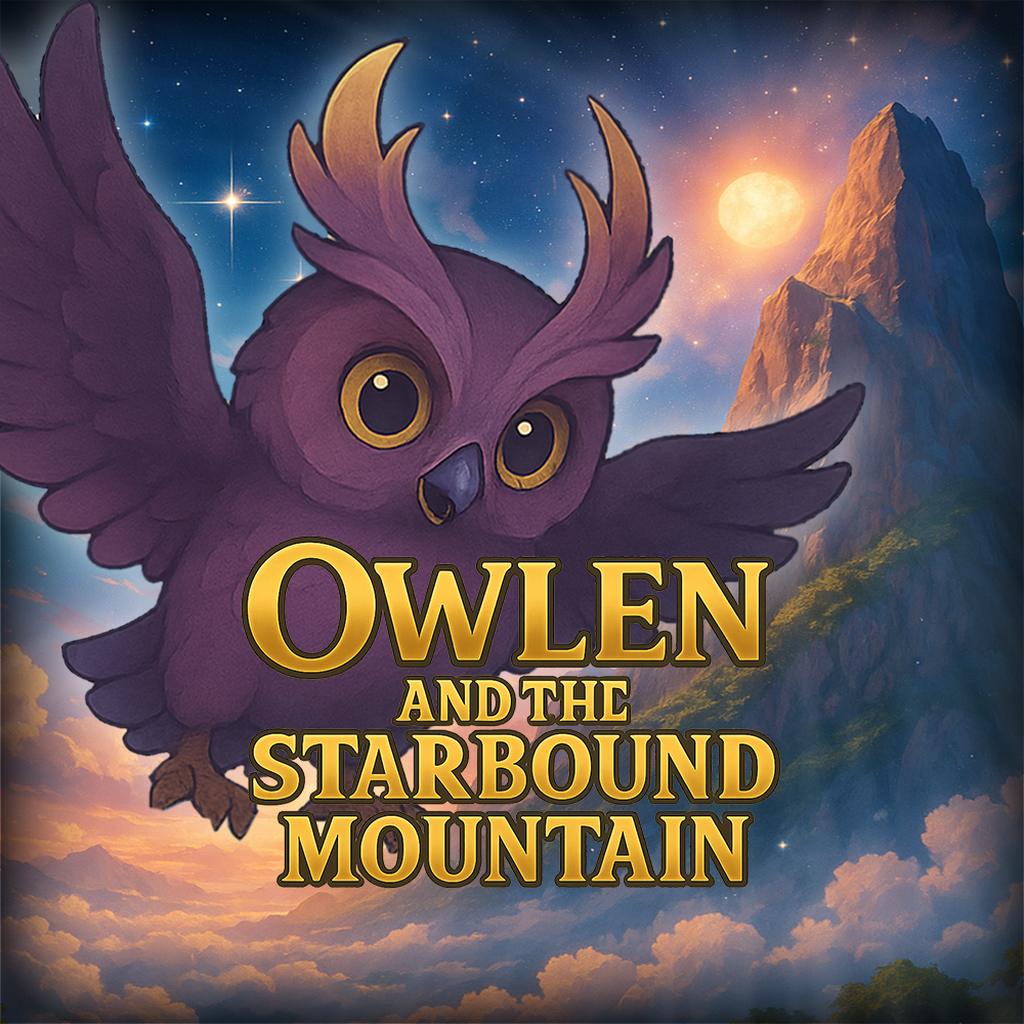
There are games that throw you into the middle of a war, games that ask you to save the world from some enormous evil, and then there are games that simply ask you to take a breath, spread your wings and enjoy the view. Owlen and the Starbound Mountain very much belongs in that latter category. Developed and published by EpiXR Games, this gentle flight adventure trades explosions and frantic objectives for icy peaks, distant stars, drifting clouds and the simple pleasure of flight.
You play as Owlen, a young owl attempting to reach the summit of the mysterious Starbound Mountain. Along the way, you will soar through frozen landscapes, ancient structures and magical cloudscapes, guided by spirits who seem to know far more about the mountain than Owlen does. There is a story here, but it is deliberately understated, revealed through memory shards and whispered fragments rather than lengthy cutscenes or dramatic exposition.
That restraint is important because Owlen and the Starbound Mountain is not really trying to be a traditional adventure game. It is closer to a playable meditation, an atmospheric journey where the destination matters, but the journey itself is the real attraction. For anyone looking for something peaceful to play after a long day, there is something rather lovely about that.
Taking Flight
The first thing that stands out about Owlen and the Starbound Mountain is how pleasant it feels to take to the skies. Owlen glides across vast frozen landscapes, dipping between mountain peaks and drifting through clouds as the world gradually opens up around you. There is no sense of being hurried towards the next objective, which immediately gives the game a very different rhythm from most modern adventures.
Flight is built around momentum, with Owlen gaining and maintaining movement as you navigate the environment. Magical rings provide much of the structure, encouraging you to guide your owl through carefully positioned checkpoints while maintaining a smooth flow through the landscape. It is a simple system, but there is a certain satisfaction in getting into a rhythm and watching Owlen sweep gracefully through the air.
The controls are intentionally approachable, too. This is not a flight simulator, and you are not expected to master complicated manoeuvres or wrestle with a sophisticated aerodynamics model. Instead, the mechanics are designed to make you feel as though you are soaring, rather than forcing you to think about every technical aspect of flying. That simplicity will undoubtedly be viewed as a positive by players looking for relaxation, although those expecting something more mechanically demanding may eventually find themselves wanting a little more depth.
A Mountain Made for Looking At
Where the game truly earns its wings is in its presentation. Starbound Mountain is an undeniably beautiful place, filled with towering icy formations, shimmering surfaces, enormous skies and strange remnants of an ancient civilisation. The further you progress, the more the environment begins to feel like something from a dream, with celestial lighting and glowing flora adding a magical quality to the otherwise harsh landscape.
There is a wonderful contrast between the mountain’s coldness and the warmth introduced by Owlen’s journey. Frozen areas gradually begin to awaken as you pass through magical circles, with star-touched plants and other elements of the landscape springing back to life. This gives your actions a tangible sense of purpose, even though the game never bombards you with conventional objectives.
It is also an experience that benefits from being played slowly. There is something satisfying about simply stopping for a moment, looking around and taking in the scenery. The environments are designed to encourage that behaviour, and the absence of constant enemies or urgent threats means you can appreciate the work that has gone into creating the world.
A Story Told on the Wind
Narratively, Owlen and the Starbound Mountain takes a similarly gentle approach. At the start of each level, spirits offer fragments of history that gradually establish the mountain’s significance and the journey ahead. Their voices occasionally return as you explore, carried on the wind to offer warnings, guidance, or brief glimpses into the stories of those who came before.
The real storytelling, however, comes through the memory shards scattered throughout the world. These collectibles are hidden in icy caverns, tucked between jagged peaks, and suspended among the stars. Finding them gives you additional information about the mountain, its guardians, and Owlen’s own purpose.
I particularly like this approach because it gives exploration a reason to exist beyond simply ticking collectibles off a list. You are not just gathering shiny objects because the game says you should. Each shard adds another piece to a much larger picture, and the gradual revelation suits the reflective nature of the experience.
That said, players looking for a substantial narrative may find the storytelling somewhat light. There are no huge character arcs or dramatic twists driving the adventure, and the mystery is more about atmosphere and suggestion than traditional storytelling. Personally, I think that fits the game, but it does mean expectations need to be in the right place.
Finding Your Way Through the Heights
Progression is tied to collecting enough memory shards to unlock new regions of the mountain. Each area has its own visual identity and atmosphere, giving the journey a sense of gradual escalation as Owlen climbs higher towards the summit.
The environments provide enough variety to keep things visually interesting, although the core gameplay loop remains largely unchanged. You fly, explore, pass through rings, search for collectibles and take in the scenery before moving on to the next region. There are no huge mechanical surprises around every corner, and the game is perfectly content to keep doing what it does best.
This is perhaps where Owlen and the Starbound Mountain will divide players. If you enjoy games such as AER: Memories of Old, Spirit of the North, or other atmospheric exploration experiences, the uncomplicated structure is likely to feel wonderfully inviting. If you need constant progression, combat, puzzles, or increasingly complex challenges, however, the simplicity could begin to feel limiting.
There is also the question of length. This is very much a bite-sized experience rather than a sprawling adventure that demands dozens of hours. I think that works in its favour to a point. Not every game needs to consume an entire month of your life, and there is something refreshing about an experience that knows exactly what it wants to be.
Sound, Silence and the Space Between
The soundtrack deserves a mention because audio plays a major role in establishing the game’s mood. Rather than filling every second with music, Owlen and the Starbound Mountain allows the environment to breathe. Ambient sounds, gentle musical passages and the spirits’ voices create a sense of isolation that suits a mountain reaching towards the stars.
There are moments when the quiet becomes almost therapeutic. You can glide through a cloud bank with nothing but the sound of the wind around you, before emerging above another enormous icy landscape. It is simple, but it works because the game understands that silence can be as effective as a dramatic soundtrack.
That atmosphere is ultimately what makes the experience memorable. The mechanics may be modest, but the combination of flight, scenery, sound and gentle storytelling creates a surprisingly cohesive package.
A Little Adventure With a Big Sense of Calm
There is no getting around the fact that Owlen and the Starbound Mountain is a simple game. Its flight mechanics are uncomplicated, its objectives are straightforward, and there is little here for players seeking mechanical complexity. The collectible hunt can also become repetitive, particularly if you approach the experience expecting a traditional adventure game.
Yet simplicity is not necessarily a weakness. In this case, it is central to what EpiXR Games is attempting to achieve. The game does not need combat, complicated upgrade trees, or dozens of systems competing for your attention, because its real purpose is to provide a peaceful journey through a beautiful world.
I also appreciate that the game does not constantly interrupt its own atmosphere. There is no need to stop every five minutes to deal with an enemy encounter or complete some unrelated task. You are there to fly, explore, and gradually uncover the mountain’s secrets, and the game generally respects that.
The Summit Awaits
Owlen and the Starbound Mountain is unlikely to satisfy everyone, and that is perfectly fine. It does not set out to compete with enormous open-world adventures or deep, narrative-driven experiences. Instead, it offers something considerably more modest, but arguably just as valuable: a short, peaceful escape into a beautiful world.
Its greatest achievement is the atmosphere it creates. Soaring above icy cliffs, drifting between clouds and watching dormant landscapes awaken lend the journey a genuine sense of tranquillity. The memory shards add just enough mystery to encourage exploration, while the spirits provide a subtle narrative thread without ever overwhelming the experience.
The simplicity occasionally works against it, particularly for anyone seeking more substantial gameplay variety or a longer adventure. There is certainly room for deeper flight mechanics, more elaborate challenges and a richer narrative framework in a future game. Even so, what is here feels deliberately crafted rather than incomplete.
There are times when a game does not need to shout to get your attention. Owlen and the Starbound Mountain understands that beautifully. It invites you into its frozen world, gives you a pair of wings and simply asks you to follow the stars.
For players who enjoy calm exploration, atmospheric adventures and games that can be enjoyed at their own pace, there is plenty to like here. It may be a relatively small journey, but it leaves behind the sort of warm feeling that much larger games sometimes struggle to create.