
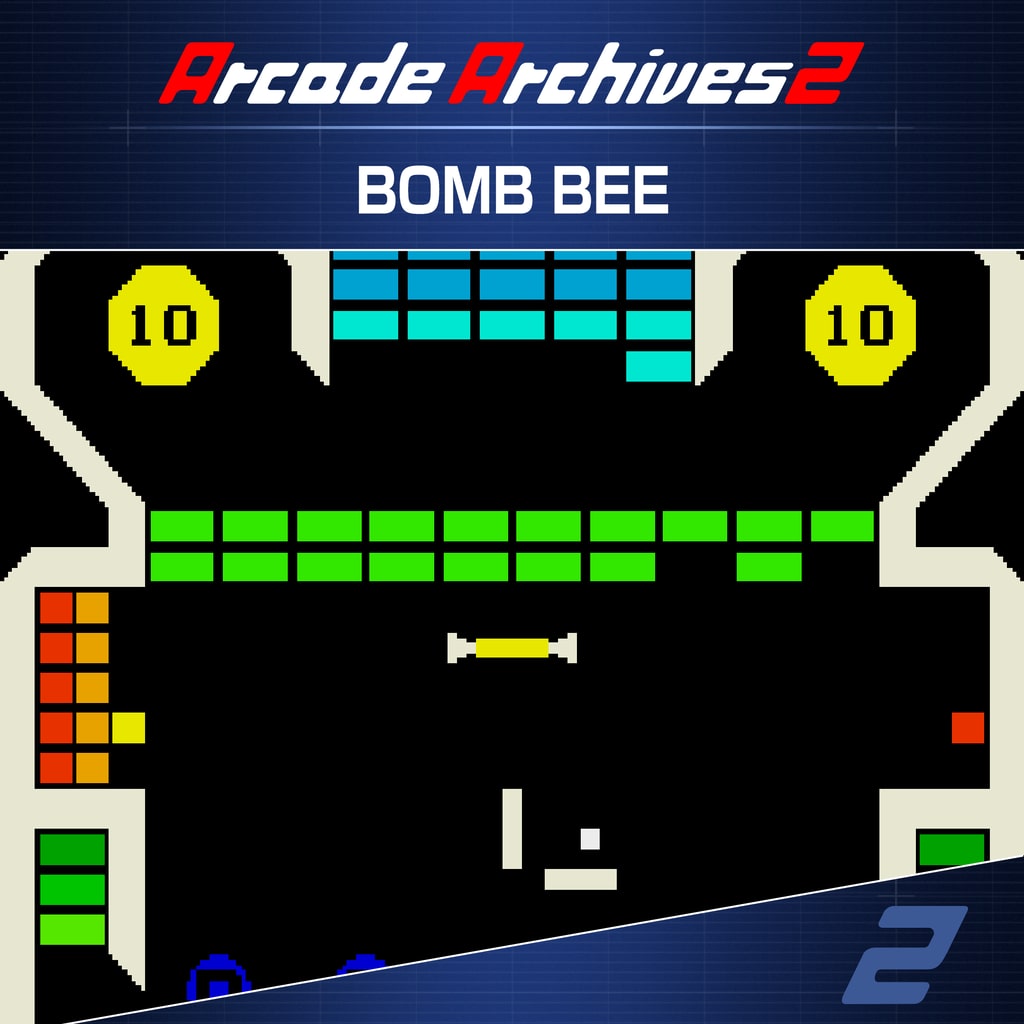
Classic arcade preservation has become more than nostalgia—it’s cultural stewardship. While modern collections often spotlight household names like Pac-Man, Dig Dug, or Space Invaders, the Arcade Archives line continues to champion the forgotten, the foundational, and the quietly significant titles that helped shape gaming’s earliest decades. BOMB BEE, the follow-up to Namco’s Gee Bee, is one such relic.
Originally released in 1979, BOMB BEE represents a transitional moment in arcade history—bridging the gap between electromechanical pinball machines and the glowing video cabinets that would soon dominate arcades. It’s a simple concept executed with elegance: a breakout-style board blended with pinball scoring, controlled with just a single paddle on each side. Now, revitalised in Arcade Archives 2, BOMB BEE arrives with modern conveniences while preserving the authentic rhythm of early arcade gameplay.
But how does a 45-year-old game stand today? Surprisingly well—if you understand what it is, why it mattered, and how its mechanical purity still holds appeal.
A Snapshot of Proto-Arcade Design
To appreciate BOMB BEE, it helps to understand the climate of late-1970s arcades. Video games were still finding their identity. Cabinets were evolving from mechanical hybrids into fully digital experiences. Developers were experimenting with:
- score-based gameplay loops
- attract modes
- evolving difficulty curves
- player retention techniques
BOMB BEE embodies this experimental era. It isn’t complex. It isn’t flashy. It doesn’t escalate in dramatic ways. But it is polished, focused, and surprisingly addictive.
The playing field resembles a brightly coloured pinball board: rows of bricks, rolling ball physics, bumpers, and scoring zones. Your job? Use left and right paddles to keep the ball in play while clearing brick formations for points. That’s it. That’s the magic.
Gameplay: Simple Mechanics, Timeless Challenge
BOMB BEE’s minimalist design works precisely because it demands accuracy and rhythm. The core loop consists of:
1. Paddle Control
Instead of a single bottom paddle, BOMB BEE uses dual side paddles, angled inwards like flippers. They reflect the ball upward and inward, encouraging strategic timing rather than simply blocking the ball from falling.
2. Breakout-Style Brick Clearing
Coloured bricks line the centre board. Each has different point values. Clearing the top bricks is riskier because the paddles give less upward control. Skilled players learn how to “angle” the ball using paddle timing.
3. Pinball-Like Scoring
Bumpers and zones multiply your score. Hitting certain bumpers triggers a sound cue and briefly speeds up gameplay—an early example of dynamic difficulty adjustment.
4. Ball Physics With Personality
The ball is lighter and faster than in Breakout, and more unpredictable than in Pong. It bounces with momentum that feels surprisingly physical for a 1979 release.
5. No Lives, Just Limited Misses
BOMB BEE’s intensity comes from its unforgiving structure. Lose the ball and the round ends. Precision is everything.
Why BOMB BEE Still Works Today
While minimal compared to modern games, BOMB BEE retains charm thanks to the following strengths:
Elegant Design
Everything serves a purpose. Every bumper, brick, and angle feeds into the puzzle of ball control.
Short Bursts of High Focus
A single round lasts minutes, encouraging replay after replay. You always want “just one more try.”
Score-Chasing Excellence
Arcade Archives 2 provides global leaderboards and replays, turning a small game into a competitive challenge.
Perfectly Faithful Reproduction
The digital version maintains original physics, timings, and visuals. Purists will appreciate the authenticity.
Pick-up-and-play Accessibility
Anyone can understand the game in seconds, but mastery requires hours.
New Features in Arcade Archives 2
True to the Hamster Co. trademark, Arcade Archives 2 introduces useful enhancements:
1. Hi-Score Mode
A player-vs-player leaderboard challenge that standardises settings.
2. Caravan Mode
A timed score-attack challenge perfect for speed-focused or competitive players.
3. Customisable Settings
- Screen filters
- Scanline options
- Display resizing
- Dip-switch accuracy modes
- Input adjustments
These keep the game flexible and accessible while respecting its original structure.
4. Perfect Emulation
No stutter, no lag, no compromised sound. Even the charmingly crude 70s sound cues are intact.
Presentation: Simple but Iconic
Let’s be clear—BOMB BEE is visually primitive. Its coloured blocks, neon paddles, and geometric shapes were cutting-edge in 1979 but are rudimentary by today’s standards. Yet there’s an undeniable charm in its visual clarity.
- Bright, readable colours
- Crisp movement
- Minimal clutter
- Vintage arcade sound effects
There’s an authenticity to its simplicity. It feels like a time capsule, not a relic.
Who Is This Game For?
BOMB BEE will resonate strongest with:
- fans of arcade history
- score-chasers
- players who enjoy simple-but-difficult gameplay
- retro collectors
- enthusiasts of Breakout, Pong, Arkanoid, or pinball hybrids
Younger players unfamiliar with minimalist arcade loops may find the gameplay limited, but those who appreciate precision and rhythm will find surprising depth.
Where It Shows Its Age
Not every aspect of BOMB BEE survives translation to modern expectations:
Limited Content
There’s one board, one mode (beyond Archives additions), and static difficulty escalation.
Primitive Audio
Sound effects are charming but sparse.
No Progression
Modern players accustomed to unlocks or upgrades may feel unmotivated.
Brutal Fail-State
A single mistake ends your run, which won’t appeal to everyone.
Verdict: A Faithful, Valuable Slice of Arcade History
Arcade Archives 2: BOMB BEE isn’t meant to compete with modern action games. It’s an act of preservation—a perfectly emulated snapshot of a fascinating moment in gaming evolution. For fans of vintage arcade design, it’s a gem worth celebrating. For score hunters, it’s a fresh challenge wrapped in neon simplicity. For casual players, it’s an easy-to-learn diversion.
BOMB BEE endures because clear rules, tight mechanics, and skill-based play never go out of style. It may be small, but it’s historically important and surprisingly addictive.













[…] Arcade Archives 2 GEE BEE and Arcade Archives 2 BOMB BEE, for example. These early titles showcase a time when arcade games were still finding their […]