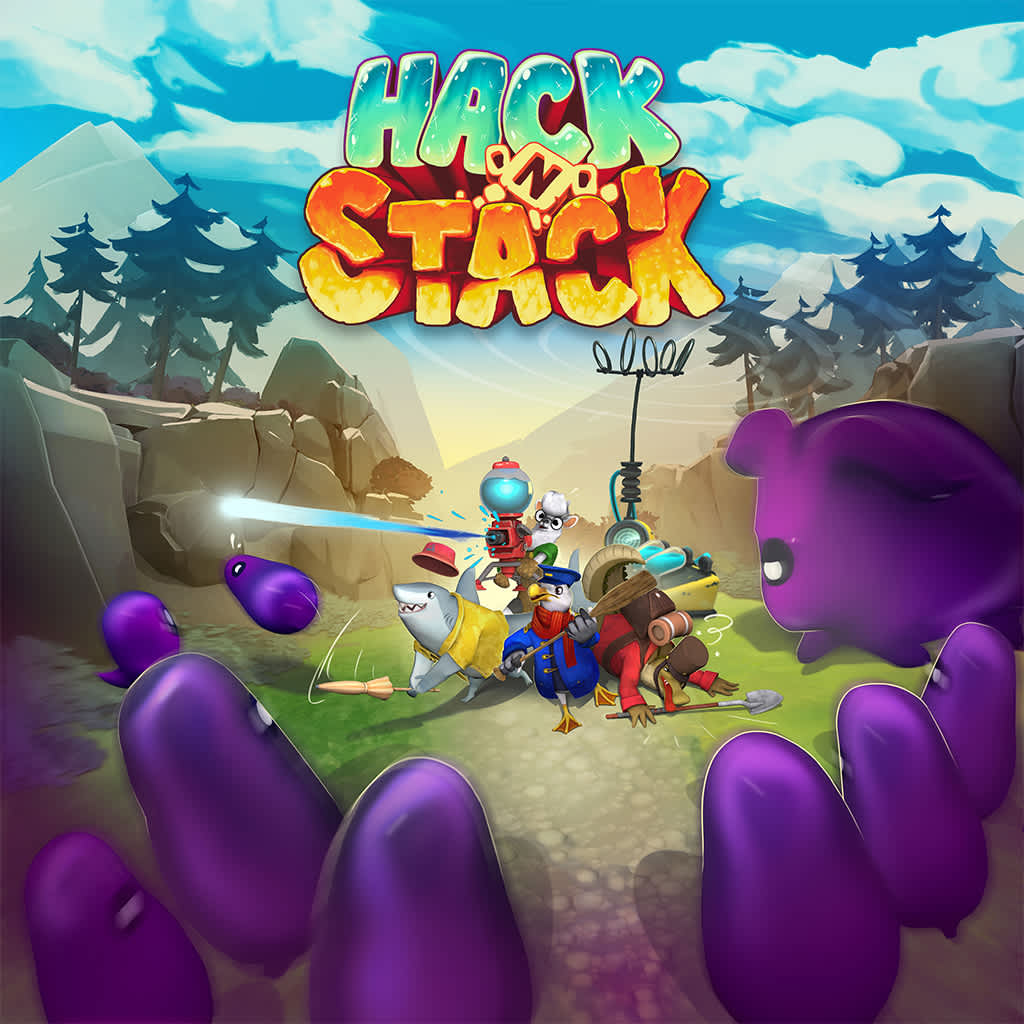
There are games where you build something beautiful, carefully place every component, and stand back to admire your architectural masterpiece. Hack ‘n’ Stack is not one of those games. Here, construction is less about precision engineering and more about desperately throwing whatever you can find into a vaguely defensible pile while a horde of angry enemies marches towards you. When that carefully constructed pile inevitably collapses, usually at exactly the wrong moment, you are left with the sort of glorious chaos that makes you laugh rather than reach for the restart button.
Developed by Canadian studio Triple Boris, Hack ‘n’ Stack takes the familiar foundations of tower defence and throws a wonderfully unpredictable physics system into the mix. Up to four players can work together to gather debris, build barricades and deploy turrets before wave after wave of enemies arrives to tear everything apart. It is simple, colourful and immediately accessible, but beneath the cheerful exterior lies a game that understands something very important about multiplayer entertainment: sometimes the best moments happen when absolutely everything goes wrong.
Build Something, Anything
The basic premise is wonderfully straightforward. Enemies are coming, your kingdom needs protecting, and you have to make use of whatever materials happen to be lying around. Rather than handing you a neat collection of predetermined defensive structures, Hack ‘n’ Stack gives you the freedom to gather debris and turn it into improvised fortifications.
That freedom is where the game’s personality really comes alive. You might begin a wave with a carefully considered plan involving a sturdy barricade and a strategically positioned turret, only to discover that your construction isn’t quite as sturdy as you imagined. Perhaps an enemy knocks one section loose, another crashes into it, and suddenly your entire defensive line starts wobbling like a particularly nervous game of Jenga. The resulting disasters are often just as entertaining as the victories.
Tower Defence With A Twist
Anyone familiar with tower defence games will immediately understand what they are supposed to do, but Hack ‘n’ Stack doesn’t simply ask you to sit back and watch your carefully placed defences do the work. You are actively involved in gathering materials, constructing your barricades and reacting to what is happening around you. Every wave becomes a frantic mix of preparation, improvisation and damage control.
The physics system makes that process particularly unpredictable. Structures have weight, momentum and a tendency to behave in ways you didn’t necessarily intend. A barricade that looks perfectly secure can suddenly shift, topple or be battered apart when enough enemies start hurling themselves against it. It gives the game an enjoyable sense of uncertainty because even the best-laid plans can go spectacularly wrong.
Four Players, One Very Bad Plan
This is where Hack ‘n’ Stack really finds its groove. Playing with up to four people transforms the experience into something far more entertaining than simply defending a castle. Everyone can have a role, whether that means running around collecting useful materials, building defensive structures, or trying to keep the increasingly chaotic battlefield under control.
Of course, teamwork doesn’t always run as smoothly as you might hope. Someone will inevitably build something in the wrong place. Someone else will decide that a particular piece of debris would make a wonderful addition to the barricade without consulting anyone else. Before long, everyone is shouting suggestions while doing something completely different, and somehow that becomes part of the fun.
The best multiplayer games create stories that exist outside their mechanics, and Hack ‘n’ Stack has plenty of potential for those moments. You remember the time your entire fortress collapsed five seconds before the final wave arrived. You remember the friend who insisted their turret placement was perfect right up until an enemy smashed through it. You remember the ridiculous last stand when nobody quite knew what they were doing but somehow survived.
When Physics Becomes The Enemy
The physics aren’t simply decorative. They are a fundamental part of the strategy, and learning to work with them becomes increasingly important as the difficulty rises. A structure needs to be useful, but it also needs to withstand the punishment coming its way.
That creates some wonderfully emergent situations. A barricade can redirect enemies, provide valuable breathing room, or protect an important defensive position, but it can also become a liability when it starts collapsing in the wrong direction. The unpredictability can occasionally feel frustrating, but more often than not it produces something entertaining.
There is a fine line between chaos that feels exciting and chaos that feels unfair. Hack ‘n’ Stack generally stays on the enjoyable side of that line, although the later stages can become extremely busy. Once multiple structures are collapsing, enemies are pouring in, and players are scrambling for materials, it can become difficult to understand exactly what is happening. For some players, that will be part of the appeal, while others may find the visual clutter a little overwhelming.
Simple To Learn, Easy To Enjoy
One of the game’s biggest strengths is its approachability. You don’t need to spend an hour reading tutorials to grasp the basics, and the controls are straightforward enough that you can hand the game to someone who has never played a tower defence game before and have them contributing almost immediately.
That accessibility is particularly important for a game designed around groups. Hack ‘n’ Stack doesn’t require everyone to have the same level of gaming experience. One person can focus on construction while another learns how the turrets work, and someone else can simply run around collecting anything that looks remotely useful.
There is something quite refreshing about that simplicity. Modern games often bury their best ideas beneath layers of systems and progression mechanics, whereas Hack ‘n’ Stack understands that sometimes you just need to give people a playground and let them get on with it.
The Joy Of A Wobbly Fortress
The construction mechanics are arguably the star of the show. Building a barricade should be a strategic decision, yet the physics make it feel tactile and unpredictable. There is a certain satisfaction in gathering debris and turning it into something that actually looks capable of stopping an incoming army.
Even better is when your creation survives. You watch enemies crash into it, pieces shift under pressure, and turrets keep firing as the whole structure threatens to collapse. When it somehow holds together long enough to survive the wave, it feels like an achievement because you know it wasn’t simply a predetermined animation playing out.
Then, inevitably, you will build something that falls apart almost immediately. Strangely enough, those failures can be just as memorable.
Turrets, Barricades And Panic
The defensive side of the game gives the construction mechanics a much-needed purpose. Barricades can slow or redirect enemies, while turrets provide the firepower needed to deal with increasingly dangerous waves. The trick is working out how the two elements can complement each other rather than simply throwing everything into one enormous pile.
As the pressure increases, the battlefield becomes a constant series of decisions. Do you reinforce the damaged section of your wall or build something new elsewhere? Do you spend precious time gathering more materials or focus on keeping your existing defences standing? Do you trust your friends to handle one side while you concentrate on another?
These decisions aren’t particularly complicated individually, but the speed at which you sometimes have to make them gives the game its energy. You rarely have enough time to create the perfect defensive arrangement, so improvisation becomes just as important as planning.
Playing Alone
Unfortunately, Hack ‘n’ Stack isn’t quite as compelling when you remove the other players from the equation. The mechanics still work, and there is certainly enjoyment to be found in experimenting with construction and defence, but the experience loses a considerable amount of its personality.
The game’s physics-driven comedy thrives on human unpredictability. When four people are trying to construct a functioning fortress at the same time, mistakes become funny and unexpected events become stories. When you’re playing alone, there is nobody else to blame when the wall collapses, and nobody beside you to laugh at the resulting disaster.
It doesn’t make the single-player experience bad, but it does make it feel like the supporting act rather than the main event. Hack ‘n’ Stack feels most comfortable when several people are sharing the chaos.
Cartoon Chaos
Visually, the cheerful cartoon style suits the game perfectly. There is no need for grim realism when your carefully assembled defensive structure is about to be demolished by a wave of enemies. The bright presentation helps keep everything light-hearted, even when the battlefield becomes a complete mess.
The art style also contributes to the game’s accessibility. Everything is clear and approachable, which is particularly useful when four players are moving around the same space and structures are beginning to collapse. There are occasions when the amount of activity becomes visually confusing, particularly in later levels, but the overall presentation succeeds in creating the friendly party atmosphere the game is clearly aiming for.
A Game Best Shared
Ultimately, Hack ‘n’ Stack knows exactly what sort of game it wants to be. It isn’t trying to compete with the deepest strategy games or offer hundreds of hours of solitary progression. Instead, it aims to give groups of players an excuse to sit down together, build something ridiculous, and then watch it be destroyed in spectacular fashion.
That is a perfectly worthwhile goal, and the game achieves it surprisingly well. There is enough strategy beneath the chaos to make your decisions matter, but enough unpredictability to ensure that no two defensive efforts feel exactly the same. Most importantly, it creates the sort of situations that make people laugh.
Final Verdict
Hack ‘n’ Stack is a wonderfully cheerful piece of multiplayer chaos that takes the familiar tower defence formula and gives it a brilliantly unstable, physics-driven twist. Gathering debris, constructing barricades and positioning turrets sounds straightforward enough, but once the enemy waves arrive and your carefully assembled defences begin to wobble under pressure, things can become gloriously unpredictable.
The physics are undoubtedly the game’s greatest strength. They create situations that feel genuinely emergent rather than scripted, and when you’re playing with friends, a collapsing fortress can be more entertaining than successfully completing an entire level. The accessible controls and colourful presentation also make this a game that is easy to introduce to almost anyone.
It isn’t without weaknesses. Solo play doesn’t have anywhere near the same appeal as multiplayer, and later levels can become extremely cluttered when enemies, debris and collapsing structures all occupy the screen at once. There are also moments when the physics can feel more chaotic than strategic, particularly when a carefully planned defensive structure decides it has had enough and falls apart.
But perhaps that’s missing the point slightly. Hack ‘n’ Stack isn’t about creating the perfect fortress. It’s about trying to create one, watching it fall apart and laughing with your friends when everything goes spectacularly wrong. In a gaming landscape filled with increasingly serious and complicated experiences, there is something genuinely refreshing about a game that simply wants you to build a wobbly wall and see what happens.