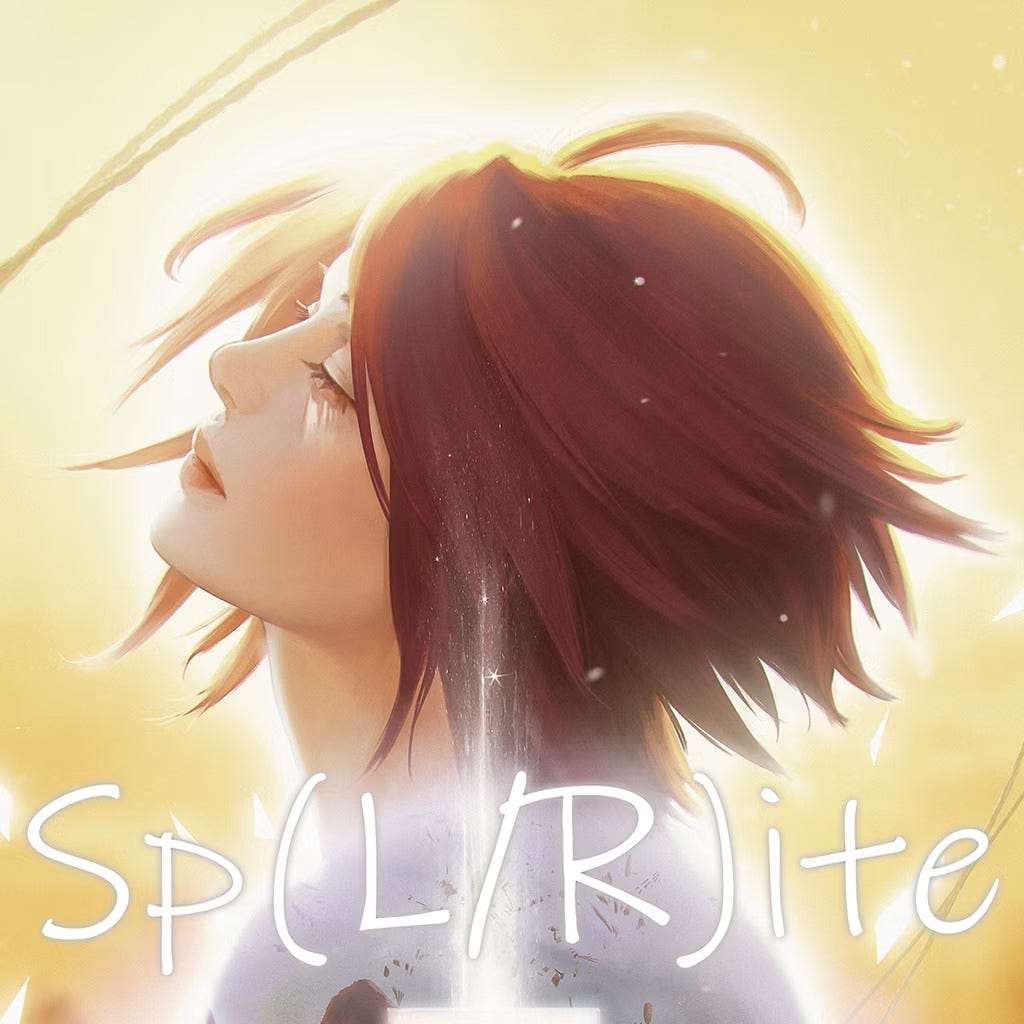
Some games immediately tell you what they are. You know the genre, understand the objective, and within minutes you are comfortably settling into familiar routines. Then there are games like Sp(L/R)ite, which seem to exist just beyond the edge of normal understanding. It is a strange, dreamlike adventure built around floating rooms, forgotten memories, mysterious threads of fate, and a neighbour who is impossible to ignore. It does not always explain itself in conventional terms, but that uncertainty is part of what makes the journey so intriguing.
At its heart, Sp(L/R)ite is an adventure about trying to escape a mysterious house trapped in another dimension. The setting feels less like a traditional location and more like a fragment of someone’s imagination, with rooms suspended in an impossible space and seemingly ordinary objects taking on greater significance. As you explore, you gradually piece together what has happened, why you are there, and what connects the strange world around you. It is the sort of experience that encourages curiosity rather than simply pointing you towards the next objective.
Welcome To Somewhere Else
The first thing that makes Sp(L/R)ite stand out is its atmosphere. The game drops you into a crumbling house surrounded by an unsettling void, with little indication of how you arrived there or how you are supposed to get out. There is something wonderfully unsettling about wandering through these disconnected spaces, particularly because the environment never feels entirely trustworthy. A room might look harmless at first glance, only for a small detail to make you wonder whether you have really understood what you are seeing.
The concept of the threads of fate is particularly effective. These mysterious strands have been spun by Akrida, the game’s energetic and rather unusual Goddess of Fate, and they become an important part of understanding the world. Rather than simply acting as decorative mythology, the threads contribute to the game’s wider themes of memory, connection and the choices that shape what comes next. This gives the adventure a slightly mystical quality without drowning it in complicated lore.
The floating-room structure also gives the game a distinctive visual identity. Instead of exploring one enormous world, you move through a collection of strange spaces that feel like pieces of a much larger puzzle. There is a constant sense that these rooms are connected somehow, even when the connections are not immediately obvious.
A Very Unusual Neighbour
Then there is Jean. One of the most enjoyable aspects of Sp(L/R)ite is the relationship between the protagonist and this mysterious neighbour. Jean is on the other side of a wall, hardly the conventional setup for a meaningful partnership, yet the limitation makes their interactions more interesting. You cannot simply walk over and have a normal conversation. Instead, communication becomes part of the experience.
Jean provides companionship in a world that could otherwise feel very lonely. Their presence also adds personality to what might otherwise have been a purely environmental puzzle adventure. There is something strangely charming about having someone to talk to while being completely separated from them, and the conversations gradually become one of the reasons you want to keep exploring.
Akrida brings a completely different personality to the adventure. Her energetic nature provides a welcome contrast to the mysterious and occasionally melancholic surroundings. The combination of Akrida and Jean gives the protagonist two very different relationships to bounce off, and both help make the game’s strange world feel more alive.
Piecing Together The Past
Exploration is closely tied to memory in Sp(L/R)ite. You will discover objects, interact with the environment, and reconstruct pictures as you attempt to recover pieces of what has been forgotten. These activities are not merely obstacles placed between you and the next room. They help build the larger mystery.
The picture-reconstruction mechanic is particularly fitting because the entire game feels like it is trying to put something broken back together. Individual pieces might not mean much when discovered, but gradually they begin to form a clearer image. It is a simple idea, yet it works surprisingly well within the context of the story.
The game’s puzzles generally favour observation and logical thinking rather than demanding complicated solutions. Players looking for brutally difficult brainteasers may find some of them a little too straightforward, but I think the gentler approach suits Sp(L/R)ite. The focus is much more on discovering what happened and understanding the world than on proving how clever you are.
That does mean experienced adventure players may occasionally find themselves solving things before the game has had much chance to build tension around them. There is rarely the feeling of being completely stuck for hours, which makes the experience accessible but also means some puzzles lack the satisfying difficulty spike that could have made certain discoveries more rewarding.
Choices And Consequences
What makes Sp(L/R)ite more interesting is how it handles choices. Your decisions can influence what happens later, giving the adventure a little more weight than a straightforward linear mystery.
This matters because the game is ultimately concerned with connections between people and the memories they carry. Choices therefore feel more meaningful when you understand that the characters are not simply there to deliver exposition. Their relationships are part of the mystery itself.
I particularly enjoyed the sense that the game was asking me to pay attention to the people rather than simply the environment. It would have been easy for Sp(L/R)ite to become another atmospheric puzzle adventure where the setting does all the talking, but the character interactions give it a warmer emotional centre. There is a surprisingly human quality beneath all the surreal imagery.
A Beautifully Minimalist World
Visually, Sp(L/R)ite adopts a deliberately minimalist approach. It does not attempt to overwhelm you with photorealistic environments or enormous set pieces. Instead, it defines its identity through composition, unusual spaces and a restrained visual style that lets the stranger elements of the world stand out.
The floating rooms are particularly effective, making the environment feel disconnected from reality without requiring elaborate visual effects. There is something almost dreamlike about stepping from one space into another when you know the architecture should not logically work.
The presentation also benefits from knowing when to hold back. Not every room needs to be filled with clutter, and not every moment needs to scream for attention. That restraint gives the more important discoveries greater impact.
On the Nintendo Switch 2, the experience benefits from improved resolution and frame rate, while mouse support via the Joy-Con 2 adds another option for interacting with the environment. These improvements are not transformative, but they help make an already distinctive adventure feel more comfortable on the newer hardware.
The Sound Of Mystery
The audio design works in much the same way as the visuals. Rather than constantly bombarding you with music, Sp(L/R)ite uses its soundscape to support the feeling of isolation and uncertainty.
The character interactions are particularly important here, as hearing Jean and Akrida helps break up the quiet of the environments. Their voices give the world a sense of companionship that the visuals alone could not provide. It is a subtle soundtrack to an equally subtle adventure, and that suits the game perfectly.
A Little Too Short
If there is one area where Sp(L/R)ite left me wanting more, it is the overall length. There is something satisfying about an adventure that knows when to finish rather than padding itself out with unnecessary content, but this journey can feel as though it reaches the final door just as you are becoming properly invested.
The straightforward puzzles also mean that experienced players are unlikely to spend huge amounts of time wrestling with individual challenges. The result is an adventure that feels more like a carefully constructed mystery than a sprawling puzzle game.
That is not necessarily a criticism of its design philosophy, but it does mean the asking price and expectations around longevity will matter to some players. Those who enjoy compact narrative adventures may appreciate the focused approach, while anyone looking for a lengthy puzzle epic may be left wishing there were a few more rooms to explore.
Beyond The Final Door
What I ultimately enjoyed most about Sp(L/R)ite is that it does not need to shout to leave an impression. Its story is strange, its environments unusual, and its characters wonderfully eccentric, yet there is a genuine warmth beneath it all.
The relationship between the protagonist, Jean, and Akrida gradually becomes the emotional glue holding the adventure together. What initially feels like a bizarre journey through disconnected rooms slowly becomes more personal, as memories, decisions and relationships give the surreal setting a purpose.
It is not a perfect adventure. The puzzles could have been more challenging, and the relatively short runtime means the experience ends sooner than you might expect. Yet there is a charm here that is difficult to dismiss. Sp(L/R)ite feels like the kind of small, unusual game you remember precisely because it is willing to do things a little differently.
Final Verdict
Sp(L/R)ite is a wonderfully strange little adventure that blends environmental puzzles, surreal exploration and character-driven storytelling into something refreshingly different. The floating rooms provide an excellent backdrop for its mystery, while the threads of fate, recovered memories and fragmented pictures give the player plenty of reasons to keep looking beneath the surface.
Its greatest strength is arguably its atmosphere. There is a genuine sense of discovery in moving through these impossible spaces, while Jean and Akrida ensure the journey never becomes emotionally cold. The puzzles are perhaps too forgiving for seasoned adventure fans, and the relatively short runtime prevents the game from developing into something truly substantial, but neither issue completely undermines what it sets out to achieve.
Sometimes a game does not need hundreds of hours, elaborate combat systems or enormous worlds to make an impression. Sometimes all it needs is a strange house, a few forgotten memories, an impossible friendship and a final door that you desperately want to open.