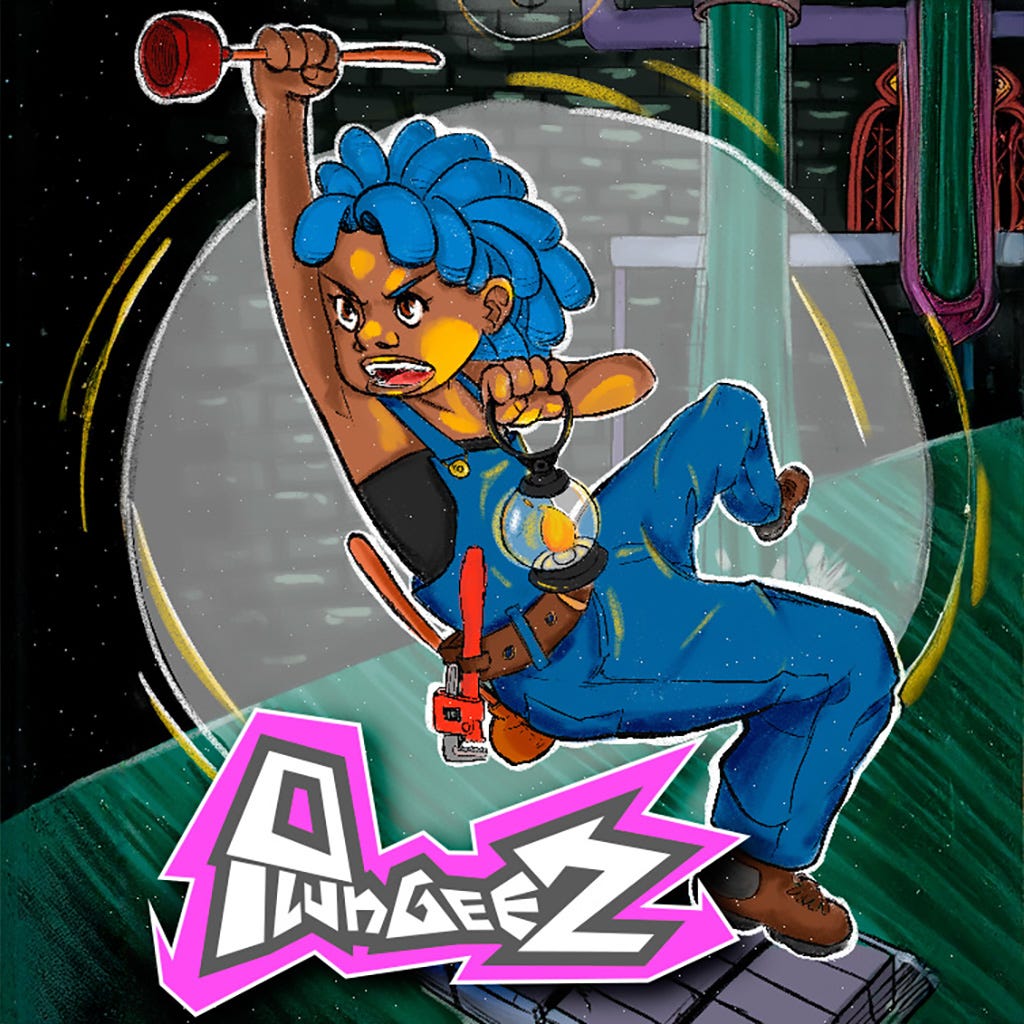
There is something wonderfully refreshing about a game that revisits a familiar genre and asks a simple question: what if we took away the bit everyone expects? Plungeez does exactly that with the Metroidvania, removing combat almost entirely and replacing swords, guns and supernatural powers with plungers, wrenches, water channels and good old-fashioned observation. It sounds ridiculous on paper, particularly when the hero is a municipal water treatment worker who has fallen into an underground labyrinth, but there is genuine intelligence behind the silliness. Beneath its charming 16-bit presentation and playful plumbing jokes, Plungeez is a thoughtful puzzle adventure that understands the satisfaction of figuring something out for yourself.
Developed by Brazilian indie studio Team Zeroth and published by QUByte Interactive, Plungeez takes players beneath the historic Brazilian city of Salvador, Bahia. You play as Bôni, a dedicated municipal worker whose ordinary working day takes an unexpected turn when she falls through a manhole and finds herself trapped in a forgotten underground network. There are no armies of monsters waiting to be defeated and no countdown threatening to end your adventure. Instead, the underground becomes a giant mechanical puzzle box, with each new piece of equipment potentially revealing another route through the labyrinth.
That shift in emphasis gives Plungeez a personality of its own.
Down the Rabbit Hole
The opening premise is deliberately playful, but the setting quickly proves more interesting than the joke suggests. Beneath Salvador lies an interconnected world of chambers, passageways, submerged areas and forgotten infrastructure, all rendered in colourful 16-bit pixel art. The environments have a visual simplicity that lets the important details stand out, which is particularly useful in a puzzle game where noticing something unusual can be the difference between being stuck and having a sudden breakthrough.
The game’s connection to Salvador also gives the adventure a cultural identity that many small Metroidvania games lack. Rather than presenting another vaguely medieval fantasy kingdom or generic science fiction facility, Plungeez draws inspiration from a real Brazilian city and builds its subterranean world around that setting. There is a sense that the underground spaces belong to somewhere rather than simply existing because the designers needed somewhere to put their puzzles. That gives the exploration a little more character and makes the journey feel like a discovery of a hidden side of the city.
Bôni is also a welcome change from the traditional Metroidvania protagonist. She is not a warrior, chosen hero or genetically enhanced superhuman. She is a worker who knows how things operate, and that knowledge becomes the foundation of the game’s mechanics. When you encounter a strange valve or an inaccessible water channel, the solution feels connected to the world rather than being another arbitrary video game ability.
A Metroidvania Without the Fighting
Removing combat from a Metroidvania is a bold decision, as fighting has traditionally been one of the genre’s primary ways of maintaining tension. Plungeez instead creates tension through uncertainty, asking whether you have correctly understood the environment and whether that strange mechanism you passed ten minutes ago might now be useful. Exploration becomes less about clearing enemies and more about building a mental map of how the world fits together.
That approach works surprisingly well because the interconnected structure remains intact. You will discover areas that are currently inaccessible, acquire a new piece of equipment, and eventually realise that something you saw much earlier can now be reached. The familiar Metroidvania feeling of returning to an old location is therefore preserved, but the reward is not another combat upgrade or a larger health bar. Instead, you get the satisfaction of finally understanding what the environment was trying to tell you.
There is something particularly pleasant about that kind of progression. The game trusts you to remember things, and it rewards you when you do. You are not constantly being pointed towards the next objective, which means that paying attention becomes a genuine gameplay skill.
The Plunger Is Mightier Than the Sword
The equipment is where Plungeez really starts to show its sense of humour. One of the game’s most distinctive tools is a pair of plungers that let Bôni interact with vertical surfaces and reach areas otherwise inaccessible. It is an absurd image, but the mechanic itself becomes a perfectly sensible part of the game’s movement system once you understand how it works.
That is one of the game’s recurring strengths. Its equipment sounds comedic when described individually, yet the mechanics are generally designed around practical problems. A heavy wrench is not simply a funny substitute for a traditional weapon; it allows you to operate valves and manipulate the environment. A diving suit is not merely an amusing costume; it opens up submerged sections of the map.
The result is a progression system where every upgrade feels meaningful. You are not collecting equipment because the game needs to give you something new every hour. You are collecting tools because the world has been deliberately designed around their possibilities. Each new ability therefore changes how you look at the map.
The Joy of the Eureka Moment
The best puzzle games are not necessarily the ones that make you feel clever all the time. They are the ones that make you feel clever at exactly the right moment. Plungeez is built around those little flashes of understanding when several pieces of information suddenly connect.
You might have spent time exploring an apparently useless corridor, noticed a strange mechanism, and then carried on because you had no idea what to do with it. Hours later, after acquiring a new tool or understanding how water moves through the environment, the memory returns. Suddenly you know exactly what you need to do, and the solution feels like something you discovered rather than something the game handed to you.
That distinction is important. Puzzle games can easily become glorified scavenger hunts where the player simply follows instructions until the next answer appears. Plungeez is more interested in encouraging observation and experimentation. It wants you to look at the environment and ask questions.
Water Is More Than Decoration
Given the game’s setting and plumbing theme, water naturally becomes one of its most important environmental elements. Channels can be manipulated, submerged areas can conceal routes, and valves can alter how the underground spaces function. These mechanics give the world a satisfying sense of physical logic because you are not merely opening doors with arbitrary keys. You are changing how the environment operates.
That makes the underground feel like a connected system rather than a collection of puzzle rooms. One action can have consequences elsewhere, and understanding those relationships is part of the challenge. It encourages you to think beyond the immediate obstacle and consider what your actions might change elsewhere on the map.
This also contributes to the game’s sense of discovery. Water is not just another obstacle that exists to stop you reaching the next room. It becomes part of the language through which the world communicates its puzzles. Once you start understanding that language, the environments become considerably easier to read.
Getting Lost Is Part of the Fun
Non-linear exploration can be intimidating, particularly in a puzzle game where getting lost can make it hard to tell whether you are genuinely stuck or simply looking in the wrong place. Plungeez embraces that uncertainty rather than constantly trying to eliminate it. There will be times when you have no obvious idea where to go next, but the game encourages you to retrace your steps and revisit previously visited areas with new knowledge.
That can be immensely satisfying for players who enjoy exploration. You start building your own mental map of the underground, remembering unusual walls, inaccessible platforms and mechanisms that seemed important even if you could not yet understand why. When a new tool suddenly gives meaning to one of those details, the world feels more interconnected.
The absence of combat also makes getting lost considerably less stressful. You are not constantly worried about losing health while searching for the correct route, and there is no ticking clock pushing you to rush. You can simply stop, think and try something else.
A Relaxed Kind of Challenge
There is a welcome gentleness to Plungeez. The game is challenging because its puzzles can demand careful observation, but it does not constantly punish experimentation. There are no strict timers forcing you to solve problems under pressure, and the absence of combat means failure rarely carries the same frustration found in more conventional adventure games.
That makes it particularly easy to settle into. You can spend several minutes simply wandering and taking in the environment before deciding what to investigate. If an idea does not work, you can try another without feeling as though the game is actively working against you.
This does not mean the puzzles are simplistic. Some require you to understand how several environmental systems interact, and the game’s non-linear structure means you may have to remember something from much earlier in your journey. The challenge comes from your own understanding rather than the reflexes of your thumbs.
Pixel Art With Personality
Visually, Plungeez embraces its 16-bit inspiration without feeling entirely trapped in nostalgia. The pixel art gives the underground environments a colourful, approachable look, which contrasts nicely with the potentially grim idea of being trapped beneath a historic city. There is enough visual variety to distinguish different areas, while the relatively clean presentation ensures that important interactive objects remain legible.
That legibility is essential for a puzzle game. If every background object looked equally important, exploration would become an exercise in clicking on everything until something happened. Plungeez generally gives its mechanisms enough visual presence that players can recognise when something deserves closer attention.
There is also a charm in the contrast between the serious business of municipal infrastructure and the game’s playful presentation. Plumbing is not exactly the most glamorous subject in video games, but Plungeez turns it into something unexpectedly appealing.
Bôni’s Unlikely Adventure
Bôni herself helps hold the experience together. Making her a water treatment worker grounds the adventure and gives her professional knowledge a believable reason for interacting with the underground systems. She is not suddenly an expert at defeating monsters because the plot requires it. Instead, she approaches problems with the tools and knowledge she already has.
That makes the game’s humour feel more natural. The joke is not simply that the hero carries a plunger. The joke is that a profession most games would ignore becomes the foundation for an entire adventure. There is something genuinely endearing about watching an ordinary worker tackle an extraordinary situation with practical equipment.
The narrative is relatively light compared with larger adventure games, but that is not necessarily a problem. Plungee understands that the puzzles and exploration are the main attraction. The story provides enough motivation to keep moving without constantly interrupting the experience.
Where Plungeez Could Improve
The game’s greatest strength can occasionally become its biggest weakness. Because so much depends on observation and memory, there will inevitably be moments when progression feels less like solving a puzzle and more like trying to remember which seemingly insignificant object you passed several rooms ago. The non-linear structure is rewarding when everything clicks, but it can become frustrating when you have exhausted the obvious possibilities and cannot tell what you missed.
Some additional quality-of-life features could have helped with that problem. A slightly more detailed map, clearer indication of previously inaccessible areas, or subtle reminders of important discoveries might have reduced unnecessary backtracking without taking away the satisfaction of solving the puzzles. The trick would be to provide guidance without turning the game into a checklist.
There is also the matter of pacing. Players who need constant action may find the deliberately relaxed approach too quiet, particularly because there are no combat encounters to break up the exploration. Plungeez is asking you to enjoy the process of thinking, and that requires a certain amount of patience from the player.
A Little Game With a Big Idea
What makes Plungeez so appealing is that its central idea extends beyond its plumbing jokes. It understands that a Metroidvania does not need combat to be compelling. Exploration, progression and discovery are enough when the world is intelligently designed around them.
The game also shows why smaller indie projects can be so refreshing. Rather than competing with huge productions on scale, Plungeez focuses on one unusual concept and explores it properly. A plumber with plungers might sound like the setup for a joke, but the developers have built an entire mechanical language around the idea.
That commitment gives the game personality. You may not remember every individual puzzle after finishing the adventure, but you are unlikely to forget the first time you realised that your latest piece of plumbing equipment could completely change how you understood an earlier section of the map.
Final Verdict
Plungeez is a charming and intelligently designed puzzle adventure that proves a Metroidvania does not need combat to keep players engaged. Its underground interpretation of Salvador provides a distinctive setting, while the combination of utility-based progression, environmental puzzles and non-linear exploration gives the adventure a satisfying sense of discovery. Most importantly, it trusts the player to observe, remember and experiment rather than constantly pointing towards the correct answer.
The plumbing theme could easily have been little more than a running joke, but Team Zeroth has done considerably more with it. Plungers become movement tools, wrenches become keys to environmental systems and diving equipment opens entirely new sections of the world. Each ability changes how you understand the map, creating those wonderful moments when something you saw much earlier suddenly makes perfect sense.
The lack of combat is equally important. By removing enemies, timers and unnecessary fail states, Plungeez creates an experience where the challenge comes from thought rather than reflex. That makes it a wonderfully relaxed game to explore, although players who need constant action may find its deliberate pace difficult to embrace.
There are moments when the non-linear structure can leave you wondering what you missed, and a little more guidance could have made the experience smoother without sacrificing its intelligence. Even so, those frustrations are outweighed by the satisfaction of figuring things out for yourself. When Plungeez clicks, it produces exactly the feeling a good puzzle adventure should.
There is something rather lovely about a game that asks you to slow down and pay attention. In an industry often obsessed with bigger worlds, louder weapons and increasingly elaborate systems, Plungeez finds its charm in a forgotten underground, a handful of practical tools and a player willing to look at the world from a slightly different angle.
It is funny without relying entirely on its jokes, relaxing without becoming boring and challenging without becoming cruel. Most importantly, it feels like a game made with genuine affection for exploration and puzzle-solving. Plungeez may not have the biggest world or the most elaborate production values, but it has something arguably more valuable: a clear idea of what it wants to be, and the confidence to stick with it.