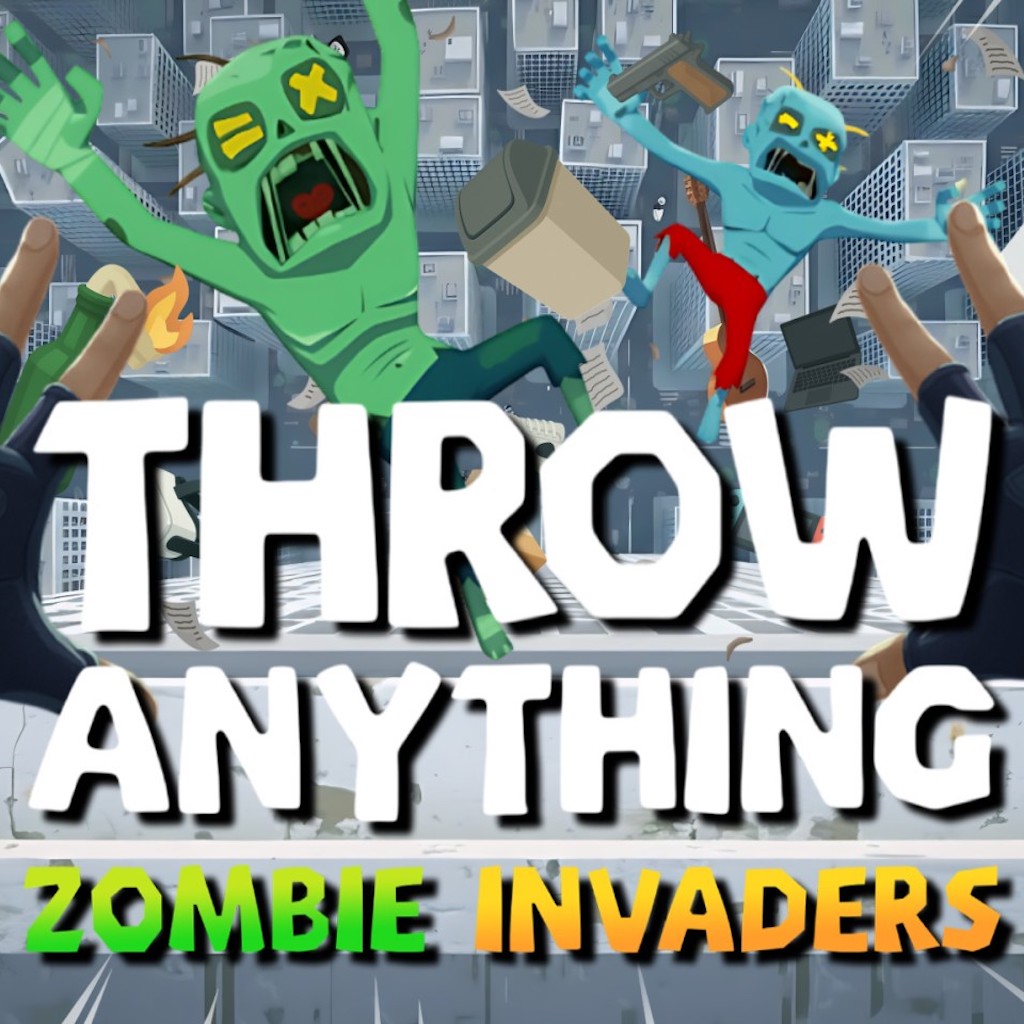
Developed by Visual Light and published by CFK Co., Ltd., Throw Anything: Zombie Invaders arrived on Nintendo Switch in April 2026 as a reimagining of the original VR concept. Stripped of the headset requirement, it retools its physics-based survival chaos into a controller-driven arcade experience without losing its core identity.
The premise is gloriously unhinged in the best possible way. A mad scientist known as Science X is on the verge of global domination after unlocking the power of the Nexus Cube, a relic capable of bending time and space. When his colleagues shatter the Cube into five fragments and scatter them across the world, Science X unleashes a zombie outbreak to recover them.
Civilisation collapses. Governments fall silent. Humanity is reduced to pockets of resistance. Into that vacuum steps the Special Delivery Agency, or SDA, a covert organisation masquerading as an ordinary international shipping company. You are one of their top agents, tasked with retrieving the fragments, stopping Science X, and restoring order. On paper, it sounds like a spy thriller. In practice, it is a physics-driven free-for-all where anything not nailed down is a weapon.
Gameplay
Throw Anything: Zombie Invaders is a loud, fast and often ridiculous arcade experience that thrives on its simplicity. It turns everyday clutter into weapons of survival and builds an entire gameplay loop around the joy of improvisation.
While it lacks deep mechanical evolution and can occasionally feel repetitive in extended play, its core concept is executed with enough confidence and charm to carry it through. There is a certain purity to its design that is increasingly rare, a focus on one idea taken as far as it can reasonably go. It may not stay with you long after you put it down, but while you are playing, very little else matters except what you can grab next.
Structure and Presentation
The game is divided into six distinct zones, each with its own visual identity and object pool. A police station might offer desks, barriers and filing cabinets, while a museum introduces heavier, clumsier exhibits that behave unpredictably when thrown. A skyscraper stage, meanwhile, leans into verticality and environmental destruction, heightening the sense of scale.
This variety keeps the core loop from feeling static, even when the underlying mechanics remain unchanged. Each stage feels like a contained experiment in how much chaos the engine can support before tipping into absurdity.
Narratively, Throw Anything is surprisingly committed to its premise, even if it never takes itself too seriously. The SDA framing adds just enough structure to justify the mission-based progression, while Science X serves as a classic over-the-top antagonist, functioning more as a catalyst for chaos than as a deeply explored character.
The tone leans heavily into humour, often deriving comedy not from scripted dialogue but from emergent situations. Watching a zombie horde get flattened by a poorly aimed refrigerator never stops being funny, even hours into the experience.
Design Strengths and Limitations
Where Throw Anything excels is clarity of intent. It knows exactly what it is trying to do and refuses to overcomplicate that vision. The physics system is the star, and everything else exists to support it.
That said, simplicity is both its greatest strength and its most noticeable limitation. Enemy variety, while functional, does not evolve significantly over time. Later stages introduce tougher or faster variants, but the core behaviours remain largely consistent. This can lead to a sense of repetition once the initial novelty wears off.
The “Infinite Mode” adds replay value, offering an endurance-based challenge that pushes your reflexes and adaptability further. It is a welcome addition, though it does not fundamentally alter the long-term structure of the experience.
Occasionally, the physics can lean into unpredictability in ways that feel less intentional and more chaotic than intended. Most of the time, this enhances the fun, but there are moments when precision throws do not behave quite as expected, especially during crowded encounters.
Despite these rough edges, the game maintains a strong sense of momentum. It rarely gives you time to dwell on imperfections because something is always moving towards you and needs to be thrown immediately.
Critical Analysis
Throw Anything: Zombie Invaders succeeds because it fully commits to its central gimmick. It does not stray from its core idea into unnecessary directions. Instead, it refines and repeats that idea in increasingly chaotic contexts.
The result is a game that feels less like a traditional action title and more like an interactive toybox centred on destruction. There is an honesty to that approach. It understands that its appeal lies in moment-to-moment absurdity rather than long-term systems depth.
It is not a game that will dominate your attention for weeks on end, nor does it try to. It is designed for bursts of energy, short sessions of controlled chaos where experimentation is the primary reward.
Final Verdict
Throw Anything: Zombie Invaders is a loud, fast and often ridiculous arcade experience that thrives on its simplicity. It turns everyday clutter into weapons of survival and builds an entire gameplay loop around the joy of improvisation.
While it lacks deep mechanical evolution and can occasionally feel repetitive in extended play, its core concept is executed with enough confidence and charm to carry it through. There is a certain purity to its design that is increasingly rare, a focus on one idea taken as far as it can reasonably go. It may not stay with you long after you put it down, but while you are playing, very little else matters except what you can grab next.