There is a particular kind of excitement that comes with rediscovered history. Not the kind polished into remakes or reimagined for modern sensibilities, but the raw artefacts themselves, preserved with all their roughness intact. Console Archives: ROHGA: ARMOR FORCE fits firmly into that category.
Originally developed by Data East in 1996 under its Japanese title Wolf Fang, this 32-bit side-scrolling run-and-gun mech shooter has resurfaced through HAMSTER Corporation’s new Console Archives initiative. Unlike their long-running Arcade Archives line, this series focuses on home console preservation, bringing slightly deeper cuts from gaming history back into circulation.
On PlayStation 5 and Nintendo Switch 2, ROHGA: ARMOR FORCE arrives not as a remake or reinterpretation, but as a straightforward emulation of a mid-90s experiment in mech-based action design. And it is absolutely an experiment.
Steel, Scrap and Customisation
At the heart of ROHGA: ARMOR FORCE is its mech assembly system, and even nearly three decades later, it remains the most compelling reason to play.
Before each mission, you construct your mech from three modular components (body, arms and legs). Each category offers multiple variants, and combining them yields one of 64 possible configurations. These are not cosmetic differences. They meaningfully alter how your mech behaves in combat.
Some builds prioritise raw durability, turning you into a slow but relentless tank. Others lean into speed, sacrificing defence for mobility and evasive potential. Certain combinations shift weapon behaviour entirely, changing the rhythm of how you approach encounters.
This system gives the game a surprising amount of replay value. Even if individual missions remain structurally similar, experimenting with different builds keeps the experience fresh far longer than expected. It is a reminder that 90s design often hid depth in systems rather than in surface complexity.
The Rhythm of Destruction
Moment-to-moment gameplay is pure side-scrolling action. You move through industrial wastelands, enemy strongholds and mechanical battlegrounds, firing across crowded screens filled with hostile machines and environmental hazards.
The structure is simple. Move forward, destroy threats, survive waves of increasing intensity. Yet within that simplicity lies a very specific rhythm that defines the experience.
Combat is built around positioning and timing. You rarely stand still. Instead, you constantly adjust, weaving through enemy fire while maintaining offensive pressure. The pace is relentless but readable once you adjust to its cadence.
There is a clear emphasis on “stop-and-pop” shooting. You pause to fire, reposition, then repeat. It is a design style that feels distinctly rooted in its era, less about fluid mobility and more about controlled bursts of action.
For modern players accustomed to constant motion and layered ability systems, this may feel rigid. But for those willing to adapt, there is a deliberate satisfaction in mastering its rhythm.
A Product of Its Time, Unfiltered
It is impossible to discuss ROHGA: ARMOR FORCE without acknowledging its age. This is not a modernised reinterpretation. There are no quality-of-life overhauls, no rebalanced difficulty curves, no structural redesigns. What you are playing is a direct window into mid-90s design philosophy. That authenticity is both its strength and its limitation.
Enemy placement can feel unforgiving. Difficulty spikes arrive abruptly. Health and damage balancing often leans towards punishing rather than forgiving. These are not flaws in the traditional sense but reflections of a different design era, one that prioritised mastery through repetition.
There is little in the way of onboarding. The game expects you to learn by doing, failing, and gradually internalising its systems. For some players, that will feel refreshing. For others, it will feel unnecessarily harsh.
HAMSTER’s Preservation Philosophy
What makes this release noteworthy is not just the game itself, but the framework around it. HAMSTER Corporation continues to refine its approach to preservation, and the Console Archives initiative is a clear expansion of that philosophy.
While Arcade Archives focuses on arcade history, Console Archives highlights home console titles that often fall into the shadow of more prominent releases. This matters. Games like ROHGA: ARMOR FORCE are not widely remembered outside dedicated retro circles, yet they mark an important period of experimentation in action design.
On modern hardware, the emulation is clean and stable. Load times are minimal, input response is tight, and the presentation remains faithful to the original release. There is a respect for authenticity here, avoiding unnecessary embellishment. This is not about reimagining the game. It is about preserving it.
Visual Identity and Mechanical Clarity
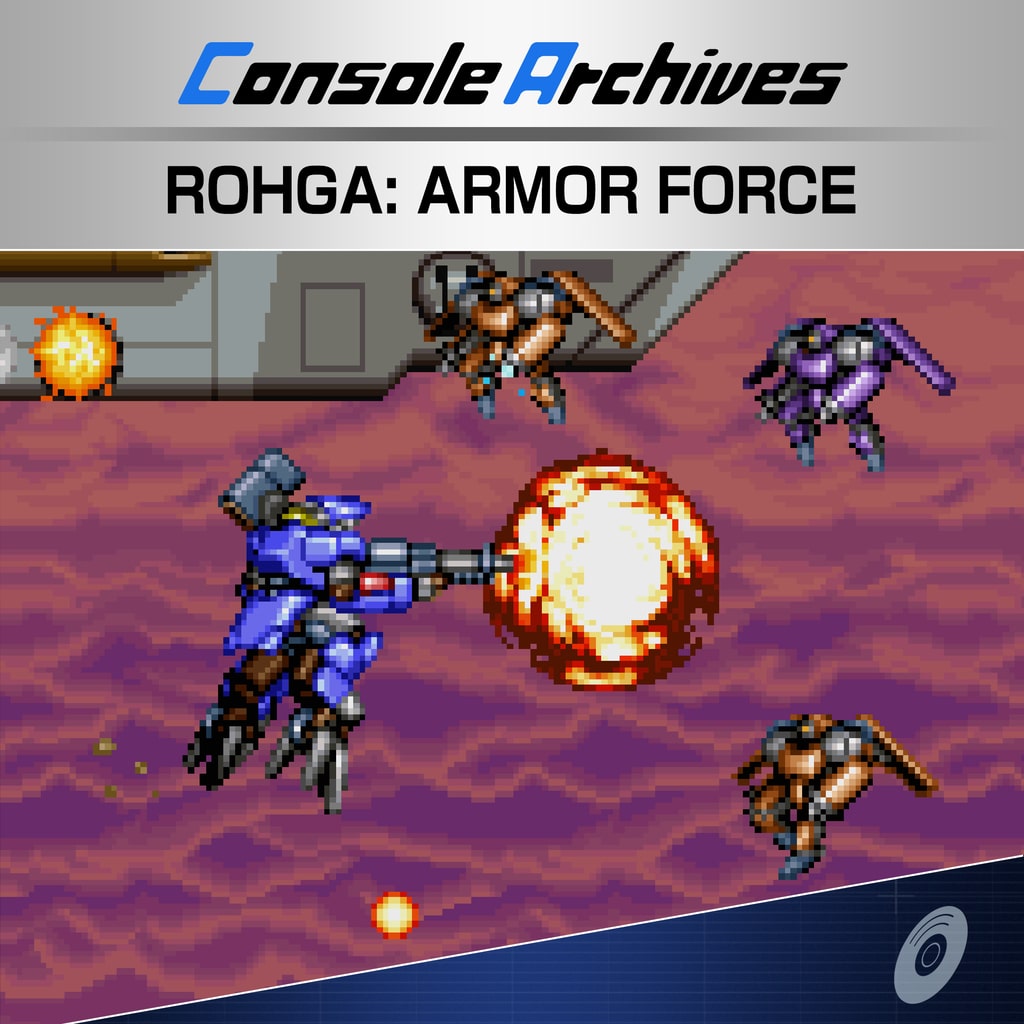
Visually, ROHGA: ARMOR FORCE sits comfortably within its mid-90s identity. Industrial backdrops, metallic environments and heavily mechanical enemy designs define its aesthetic. It is not trying to be realistic in a modern sense, but it is consistent and readable.
The mech designs themselves carry weight. Even within limited hardware constraints, there is a strong sense of physicality to your machine. Each component combination visibly alters your silhouette, reinforcing the importance of the assembly system.
Effects are simple but effective. Explosions are bold, enemy destruction is clear, and combat readability remains strong even when the screen becomes crowded.
Sound design follows the same philosophy. It is functional, punchy and distinctly arcade-influenced, with an emphasis on impact over subtlety.
Depth Beneath the Surface
What keeps ROHGA: ARMOR FORCE engaging is not its moment-to-moment polish, but its willingness to let systems interact in slightly unpredictable ways. Mech combinations create genuine variation in how each run plays out. Some builds encourage aggressive play, while others reward patience and positioning.
There is an underlying tactical layer here that becomes more apparent the longer you play. It is not immediately accessible, but it reveals itself through repetition and experimentation.
However, this depth is somewhat limited by the era it comes from. There is no long-term progression system, no meta unlock structure, and no modern retention design. Once you understand the systems, mastery becomes a matter of refinement rather than expansion.
Who This Is For
This is not a game designed for broad appeal. It is a preservation piece first and foremost. Players expecting modern pacing, narrative framing or accessibility features will likely find it abrasive.
But for those interested in 90s action design, or for players who enjoy dissecting older mechanical systems, there is real value here. It offers a rare opportunity to engage with a relatively obscure entry in 32-bit action history, unfiltered and uninterpreted.
Final Verdict
Console Archives: ROHGA: ARMOR FORCE is a fascinating and faithful preservation of a deeply mechanical 32-bit run-and-gun experience. Its mech-assembly system remains inventive, its action is challenging and deliberate, and its design philosophy is unmistakably rooted in its era.
It is also uncompromising, occasionally punishing, and firmly resistant to modern expectations of accessibility or flow. That tension defines the experience. As a historical snapshot, it is excellent. As a modern game, it is more complicated.