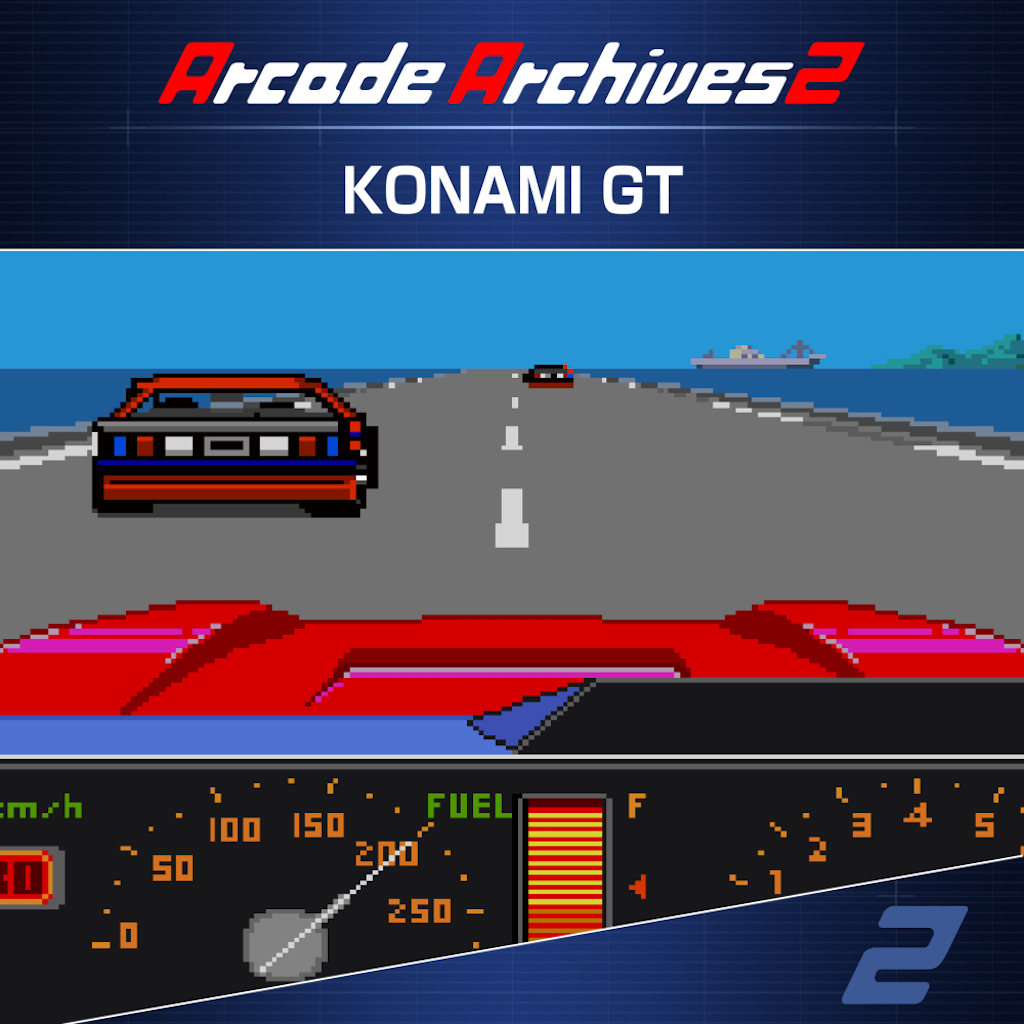
There is a certain purity to early arcade racing games that modern titles rarely attempt to replicate. Before photorealism, open worlds, and simulation physics, the genre was built on immediacy: accelerate, dodge, survive, repeat. Arcade Archives 2 KONAMI GT, released on April 16, 2026 for the Nintendo Switch 2, PlayStation 5, and Xbox Series X|S, is a deliberate return to that philosophy.
Originally developed by KONAMI in 1985, KONAMI GT is preserved here as part of the long-running Arcade Archives initiative, which focuses on faithful arcade restoration with modern conveniences. This release, delivered through the enhanced Arcade Archives framework, is not a remake or reinterpretation. It is a carefully curated restoration of a historical arcade experience, complete with optional enhancements that respect, rather than replace, its original identity.
Gameplay & Core Structure
At its core, KONAMI GT is a checkpoint-based racing game centred on endurance and fuel management. The objective is simple: race through six increasingly difficult stages while carefully managing limited fuel supplies. Every decision matters. Every slowdown carries risk. Every mistake can end your run prematurely.
Unlike modern racers, it lacks an elaborate handling model or complex vehicle tuning. The car responds immediately, almost bluntly, to player input. Steering is tight, acceleration is constant, and the challenge comes not from mastering physics but from surviving the constraints of the design.
Fuel management is the defining mechanic. Players must constantly balance speed with efficiency, ensuring they reach checkpoints before running dry. This creates a subtle but persistent tension throughout each stage. Do you push forward aggressively to gain time, or ease off to conserve fuel for later sections? The game rarely gives you enough resources to be careless.
Track Design & Visual Identity
Despite its age, KONAMI GT maintains a strong visual identity through its varied environments. Each of the six stages offers a distinct backdrop, ranging from coastal highways and arid wastelands to plains bathed in sunset light. These shifts are not merely cosmetic; they reinforce progression and scale.
The visual presentation is faithfully preserved in this release. Rather than modernising the graphics, the Arcade Archives 2 version retains the original sprite-based aesthetic, offering optional display filters and screen settings. This allows players to experience the game either in its raw arcade form or with subtle enhancements that improve clarity on modern displays.
The simplicity of the visuals works in its favour. There is no attempt to overwhelm the player with detail. Instead, clarity and readability are prioritised, ensuring that obstacles, road boundaries, and checkpoints remain immediately legible even at high speed.
Difficulty & Design Philosophy
Like many mid-1980s arcade titles, KONAMI GT is unapologetically difficult. It is built on repetition, mastery, and incremental improvement. Early failures are expected, even encouraged, as part of the learning process.
The difficulty curve is steep but consistent. Later stages introduce tighter turns, denser traffic, and more demanding fuel constraints. Success depends less on reaction speed alone and more on route memorisation and risk assessment.
What makes this structure compelling is its clarity. There are no hidden systems or opaque mechanics. Everything the player needs to understand is visible on screen. Failure is almost always due to execution rather than confusion.
Arcade Archives 2 Enhancements
The modern value of this release lies in its inclusion within the expanded Arcade Archives 2 framework. Alongside faithful emulation of the original game, players gain access to several quality-of-life features that significantly improve accessibility without altering core gameplay.
These include adjustable difficulty settings, screen customisation options, rewind functionality, rapid-fire toggles, and multiple save slots. Each feature serves a specific purpose. Rewind, for example, allows players to recover from minor mistakes without restarting entire runs, making the experience more forgiving for modern audiences.
More significantly, this release introduces new modes that expand replayability. Standard modes such as Original Mode, Hi Score Mode, and Caravan Mode return from the broader series, while the addition of Time Attack Mode adds a fresh layer of competition. In this mode, the focus shifts from score optimisation to pure completion speed, encouraging more aggressive play and route optimisation.
Online leaderboards further enhance longevity, allowing players to compare performance globally. While KONAMI GT is inherently simple, these competitive structures give it surprising endurance.
Performance & Presentation on Modern Hardware
On current-generation systems, including PlayStation 5 and Xbox Series X|S, the game runs flawlessly. Input response is immediate, and the emulation layer is stable across all tested platforms. The Nintendo Switch 2 version maintains parity, benefiting from hardware improvements that ensure consistent performance even in handheld mode.
One of the more interesting additions is VRR support, which helps smooth frame pacing and brings the experience closer to the original arcade responsiveness. While subtle, this enhancement contributes meaningfully to the game’s feel, especially during high-speed sections.
Display options are extensive, allowing players to customise aspect ratios, scanline filters, and screen curvature effects. These features may seem cosmetic, but they play an important role in preserving the authenticity of the arcade presentation while accommodating modern display standards.
Historical Value & Preservation
The importance of Arcade Archives 2 KONAMI GT lies less in its mechanical depth than in its preservation value. This is a snapshot of early arcade design philosophy, in which simplicity and difficulty were not design flaws but foundational principles.
Playing it today offers insight into how racing games evolved. There is a directness here that contrasts sharply with modern genre expectations. No tutorials, no narrative framing, no progression systems beyond increasing difficulty. Just road, car, fuel, and survival.
For players interested in video game history, this release serves as a valuable reference point. It shows how much of modern game design complexity has been layered on top of extremely minimal foundations.
Limitations & Modern Appeal
Despite its strengths as a preservation piece, KONAMI GT has limitations. Its simplicity, while historically significant, can feel sparse by modern standards. There is limited mechanical variety, and once its systems are understood, long-term engagement relies heavily on personal challenge rather than evolving content.
The absence of deeper progression systems or alternative vehicle types means replayability is largely self-directed. Players who do not engage with score chasing or time trials may find its longevity limited.
Additionally, while modern enhancements improve accessibility, they do not fundamentally alter the core experience. This is intentional, but it also means the game remains firmly rooted in its original design constraints.
Final Verdict
Arcade Archives 2 KONAMI GT is neither a reinvention of a classic nor an attempt to modernise it beyond preservation and accessibility enhancements. Instead, it stands as a carefully maintained artefact of early arcade racing design.
Its strengths lie in clarity, immediacy, and historical authenticity. Its limitations stem from the same source: a design philosophy built for a different era and different expectations.
For those interested in arcade history, minimalist racing design, or score-based competition, this is an elegant and respectful preservation. For others, it may feel more like a curiosity than a fully engaging modern game.