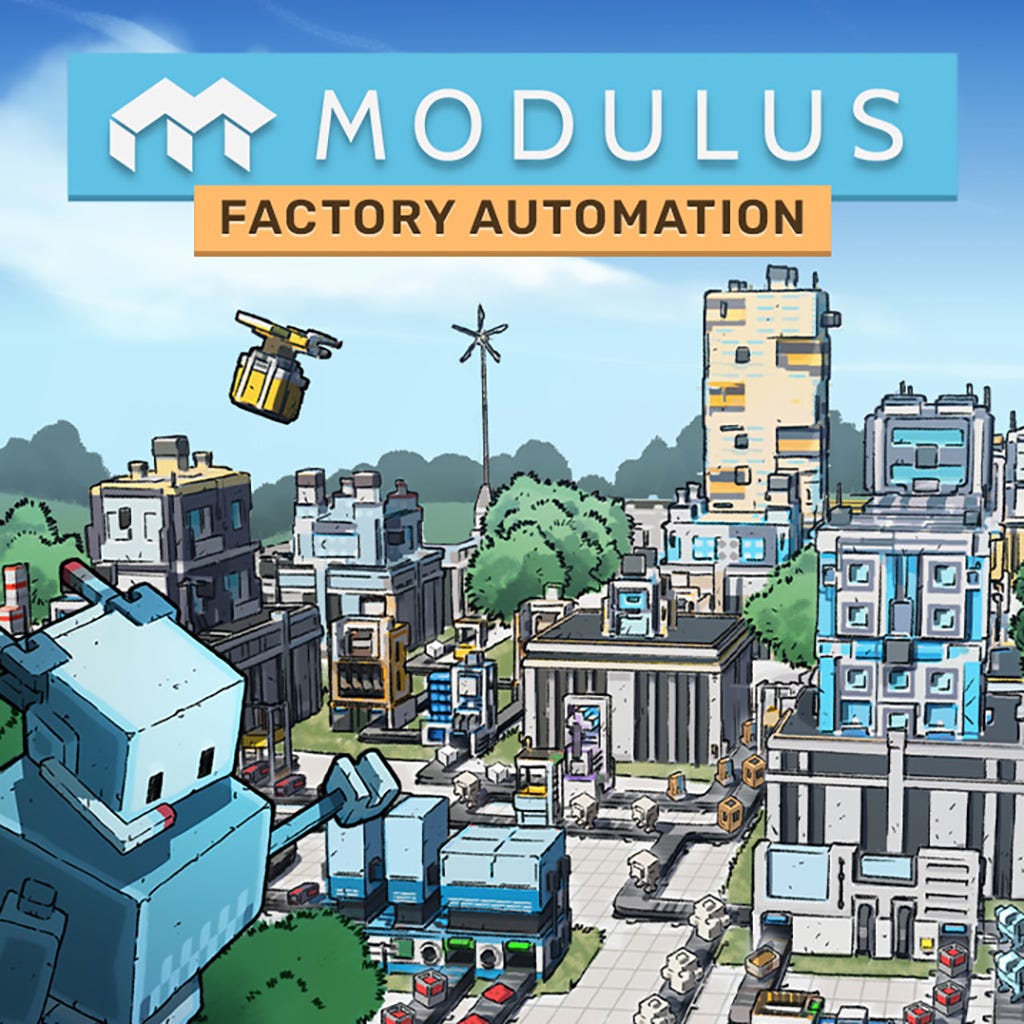
Released on 2 April 2026, Modulus: Factory Automation signifies a notable change for developer Happy Volcano, best known for the chaotic physics comedy of You Suck at Parking. Published by Kwalee, this new project substitutes humour and chaos with precision, calm, and creativity, offering a factory automation sandbox that emphasises aesthetic expression as much as logical systems.
At first glance, Modulus comfortably fits within the established automation genre. You gather resources, process materials, and build increasingly complex production chains. However, it quickly becomes apparent that this is not a game focused on optimisation under pressure. There are no enemies. No timers. No imminent threat of failure. Instead, Modulus invites players into a tranquil, system-driven environment where experimentation is the main reward, and efficiency is merely one of many possible routes.
It is, in many respects, a factory builder that intentionally resists stress.
A Different Philosophy of Automation
Most factory simulation games are defined by urgency. Conveyor belts must be optimised, production lines must scale, and inefficiency is punished either by resource starvation or external threats. Modulus rejects this entirely.
Instead, it introduces a design philosophy rooted in calm iteration. Your goal is not to survive or outpace collapse, but to construct increasingly complex “Neural Monuments”—massive, evolving structures built from modular components that you cut, paint, stamp, and assemble yourself.
The core loop is deceptively simple. You begin with basic resources and rudimentary production tools. From there, you gradually unlock systems that allow for deeper manipulation of materials, eventually enabling the construction of sprawling, multi-layered architectural machines that function as both factories and sculptures.
The absence of pressure fundamentally changes how you engage with the genre. Rather than reacting to inefficiency, you are encouraged to observe it, understand it, and reshape it at your own pace.
Modular Design as Creative Expression
The standout feature of Modulus is its modular engineering system. Unlike traditional automation games where components are represented as icons or simple machines, here every element exists as a physical, visible block within your growing structure.
You do not simply “produce” materials—you cut them, shape them, paint them, and physically incorporate them into your evolving factory. This fosters a strong sense of material presence. Every decision leaves a visual footprint, and each optimisation alters the appearance of your creation.
As your systems expand, they begin to resemble intricate architectural artworks rather than industrial facilities. Conveyor paths form geometric patterns. Production hubs develop into layered structures of interlocking modules. Even inefficiencies contribute to aesthetic character.
This is where Modulus finds its strongest identity: it transforms automation into something expressive, not just functional.
The “Neural Monument” concept reinforces this notion. These vast constructions are not simply end goals but evolving organisms shaped by your engineering choices. They feel less like factories and more like living systems gradually spreading across the grid.
Pacing Without Pressure
One of the most striking features of Modulus is its pacing—or, more precisely, its refusal to impose any pacing at all. There are no timers controlling production cycles, no enemy waves forcing defensive adjustments, and no failure states that halt experimentation.
This creates an unusual yet compelling rhythm. You are free to step away from optimisation whenever you wish, revisit systems when inspiration strikes, and rebuild entire production chains without facing consequences.
For some players, this will feel liberating. For others, it may seem aimless. The game trusts you to set your own goals, whether that is maximum efficiency, aesthetic perfection, or experimental chaos.
Creative Mode takes this philosophy even further, removing all constraints altogether. With unlimited resources and full access to tools, players can concentrate purely on design, creating voxel-style structures, abstract forms, or highly complex logistical experiments.
It is in this mode that Modulus most clearly shows its true identity: a sandbox for systems thinking as an artistic practice.
Systems That Reward Understanding, Not Speed
Despite its relaxed tone, Modulus remains a deeply system-driven experience. As production expands, complexity grows considerably. New mechanics, tools, and materials create layered dependencies that demand careful planning.
However, unlike traditional automation games, the challenge is not about managing urgency but understanding relationships. How materials move, how modules interact, and how structures develop over time become the central intellectual puzzle.
There is a quiet satisfaction in watching a poorly performing system gradually transform into a coherent, self-sustaining network—not because you were racing against failure, but because you chose to improve it.
This makes progress feel natural. You are not optimising under pressure; you are refining through curiosity.
Presentation and Atmosphere
Visually, Modulus features a clean, minimalist aesthetic that emphasizes clarity and readability. The voxel-based structures are simple yet expressive, allowing complex systems to remain visually understandable even at large scales.
As factories expand into monumental constructions, they acquire an almost meditative quality. Movement along conveyor lines, shifting colours from painted modules, and rhythmic production cycles all contribute to a soothing sensory experience.
Audio design reinforces this atmosphere with subtle mechanical hums and ambient tones that avoid overwhelming the player. Instead of noise and urgency, the game stresses rhythm and flow.
It is a rare factory builder that feels genuinely tranquil rather than merely functional.
Narrative Layering – The Signal Beyond the System
Although primarily a sandbox experience, Modulus introduces a subtle narrative framework centred around the “Grand Neural Network.” As you develop your automated systems for the mysterious Colony, a distant signal begins to shift your purpose, prompting you to create increasingly intricate Neural Monuments.
This narrative element is intentionally understated, unfolding through system progression rather than conventional storytelling. It adds thematic depth without disrupting the core sandbox experience.
Rather than imposing narrative urgency, it enhances the game’s central concept: systems evolving beyond their original design.
Final Thoughts
Modulus: Factory Automation is a thoughtful reimagining of what a factory simulation can be. By removing pressure, combat, and failure states, it shifts the genre away from survival and optimisation under stress, and towards experimentation, creativity, and visual expression.
Its modular construction system is both intuitive and deeply expressive, turning logistical design into something closer to digital architecture. While it may lack the high-stakes tension of traditional automation titles, it compensates with freedom, clarity, and a strong sense of creative ownership.
It is not a game about solving problems quickly — it is a game about understanding systems well enough to turn them into art.