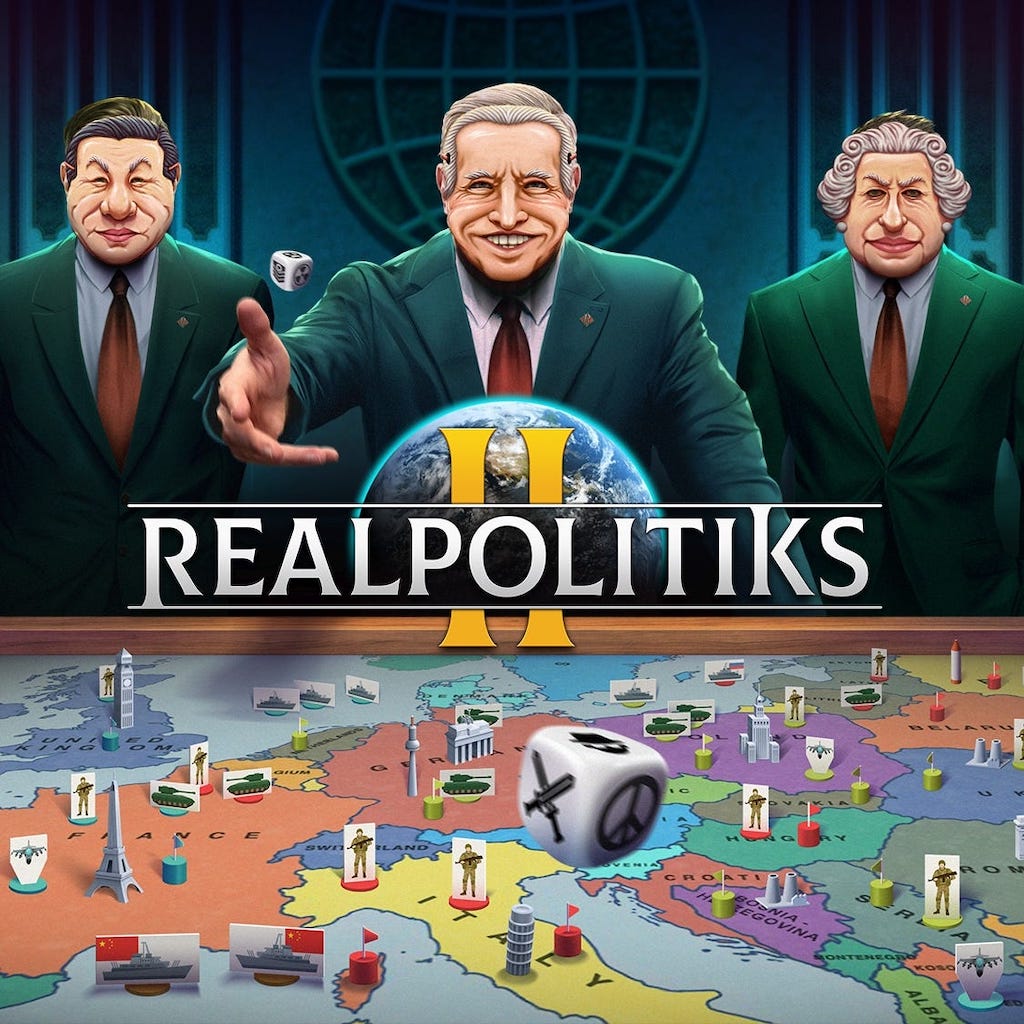
Grand strategy games often promise total control—over nations, economies, even history itself. Realpolitik II takes that promise and pushes it into the volatile terrain of the modern world, where power is rarely absolute and consequences are seldom predictable. As a sequel to the 2017 original, it broadens its scope significantly, offering more systems, more nations, and more ways to shape (or destabilise) the global order.
But ambition in strategy games is a double-edged sword. While Realpolitik II delivers a wide range of options that’s undeniably impressive, it also struggles to balance that complexity with clarity, resulting in an experience that is as absorbing as it is occasionally unwieldy.
A World in Your Hands
From the beginning, Realpolitiks II clearly shows its scope. With over 200 playable nations—from global superpowers to microstates like Sealand—you have almost complete freedom in how you approach your campaign. Want to lead a struggling nation to economic prosperity? You can. Prefer to dominate through military strength or covert operations? That’s equally possible.
This flexibility is one of the game’s greatest assets. Starting conditions vary greatly depending on your chosen country, requiring you to adapt your strategy. Playing as a major power provides immediate influence but involves complex responsibilities, while smaller nations demand careful planning and opportunism to survive, let alone prosper.
The modern setting adds an extra layer of relevance. Issues such as pandemics, terrorism, and economic instability aren’t just theoretical—they’re active systems that require attention. The world feels reactive, even if it doesn’t always seem entirely coherent.
Systems Within Systems
At its core, Realpolitiks II is a management game. Economy, diplomacy, espionage, infrastructure, and military all interconnect, creating a complex network of interdependent systems. Success hinges on your ability to manage these elements effectively.
The expanded management system introduces over 700 projects and technologies, enabling extensive customisation of your nation’s development. You can shape your political system, influence social policies, and invest in infrastructure that supports your long-term objectives.
This depth is impressive but can also be daunting. The game offers little guidance for new players navigating its systems, and the interface, while functional, often struggles to display information clearly. Moving through menus and understanding the full impact of your decisions can be a challenge in itself.
Diplomacy and Deception
Diplomacy has seen notable improvements in this sequel. The addition of favour and investment systems introduces more complexity to international relations, enabling you to build influence gradually rather than relying solely on immediate negotiations.
AI leaders are more confident, making diplomacy feel less predictable. Agreements require careful thought, and relationships can change swiftly based on your actions. It’s a system that promotes long-term strategy, even if it sometimes lacks transparency.
Espionage fits this well. Spies can be sent to gather intelligence, steal technology, or sabotage rival nations. These covert operations offer alternative routes to power, especially for smaller countries that cannot compete militarily.
However, both systems are somewhat opaque. Outcomes aren’t always clearly explained, and failures can seem random. While this unpredictability adds tension, it can also cause frustration.
Warfare Reimagined
One of the most notable additions in Realpolitiks II is its redesigned combat system. Unlike its predecessor, which relied more on abstracted conflict, this sequel offers more direct control over military units.
Battles now consider terrain, weather, and equipment, adding a layer of tactical depth. Naval combat, in particular, feels more impactful, with control of sea regions playing a vital role in global dominance.
In theory, this system marks a significant advancement. In practice, it can be somewhat inconsistent. While the additional control is welcomed, the execution can sometimes feel awkward, especially when managing multiple fronts. The interface does not always keep up with the system’s complexity, leading to moments of confusion during critical engagements.
Events and Replayability
With over 1,000 events, Realpolitiks II ensures that no two campaigns unfold in exactly the same way. These events range from minor domestic issues to global crises, often forcing you to make tough decisions with far-reaching consequences.
This unpredictability is one of the game’s strongest features. It keeps campaigns interesting and encourages adaptability. However, the large number of events can sometimes lead to repetition, especially during longer play sessions.
The three available campaigns provide extra structure, though they don’t fundamentally change the core experience. Instead, they offer different contexts in which to engage with the game’s systems.
Console Transition
Bringing a grand strategy game to consoles is no small feat, and the Xbox Series X|S version of Realpolitiks II makes a commendable effort. Controls have been adapted for a controller, and while they’re functional, they cannot fully replicate the precision of a mouse and keyboard.
Navigating menus and managing multiple systems is inevitably slower on console, and this can impact the overall pacing. That said, performance is stable, and the game runs smoothly, even during more complex simulations.
For players accustomed to PC strategy games, the console version may feel like a compromise. For others, it’s an accessible way to experience a genre that’s often confined to desktop platforms.
Where It Falls Short
Despite its many strengths, Realpolitiks II is held back by a lack of polish. The interface, in particular, is an ongoing issue, making it more difficult than necessary to interact with the game’s systems.
Balance is another issue. Some strategies can seem disproportionately powerful, while others feel ineffective. This doesn’t ruin the game, but it does weaken the sense of strategic variety.
There’s also a feeling that the game sometimes overreaches. Its ambition is commendable, but not every system feels fully developed. The outcome is an experience that can seem fragmented, especially for players trying to understand its full scope.
Final Verdict
Realpolitiks II is an ambitious and expansive grand strategy game that offers a compelling view of modern geopolitics. Its wide range of systems and freedom of choice create a sandbox where players can experiment, adapt, and influence the world in meaningful ways.
However, that ambition comes with a cost. The complexity can be daunting, the interface can be unwieldy, and some systems lack the refinement needed to fully realise the game’s vision.
Even so, there’s a depth here that’s hard to overlook. For players willing to invest time and effort, Realpolitiks II offers a rich, challenging experience that reflects the unpredictability of global politics.
It’s not always elegant, but it is undeniably engaging.