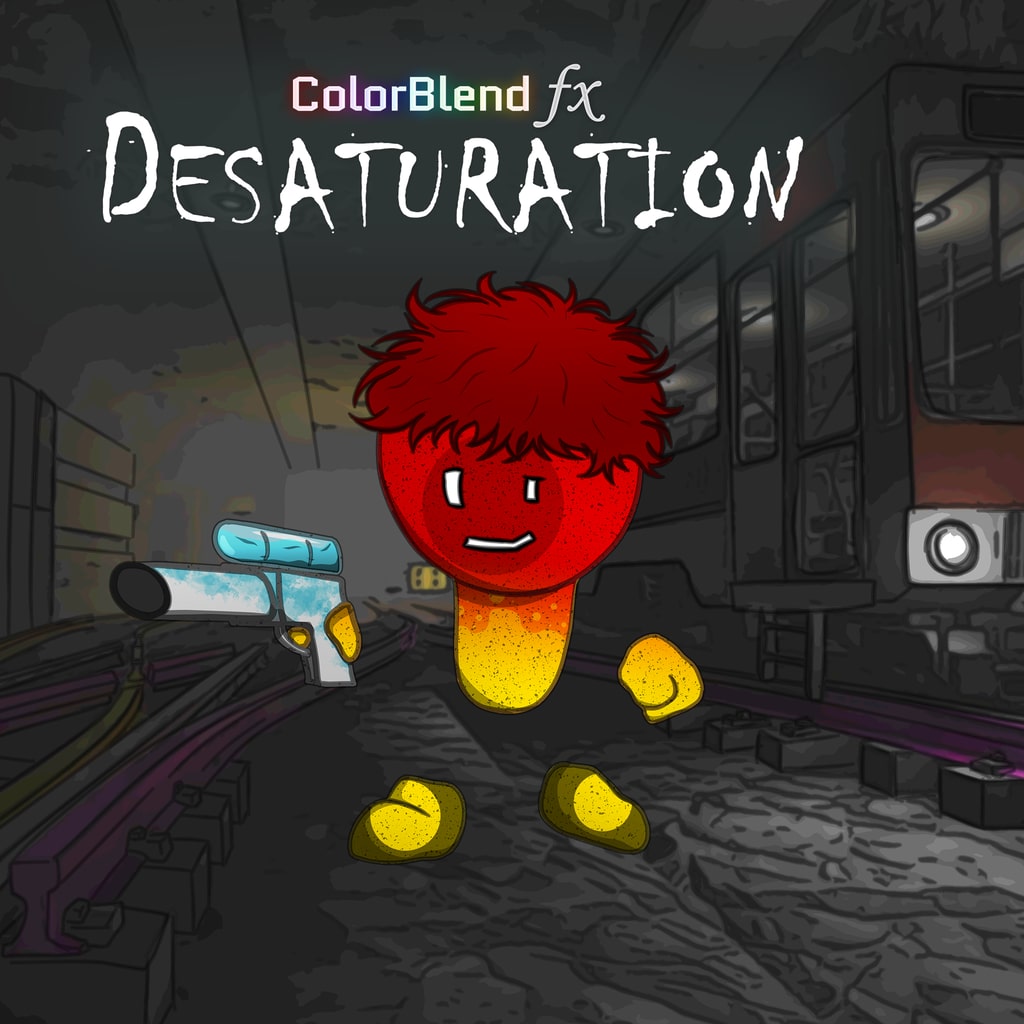
Colour is one of the most powerful storytelling tools in games. From guiding players through environments to conveying emotion and atmosphere, colour often shapes our experience of a world long before dialogue or plot begin to unfold. ColorBlend FX: Desaturation, developed by Pi-Dev Bulgaria Ltd. under the direction of Petar “PeterSvP” Petrov, is built around that idea.
At its core, this is a 2.5D puzzle-platformer with strong Metroidvania DNA, but it stands out through a unique mechanic: colour itself is the key to progress. Set in a world drained of life by a mysterious force known as Lord Ashen, players must restore vibrancy to the land using special abilities linked to paint, slime physics, and environmental interaction.
The game combines exploration, physics puzzles, and narrative themes about creativity and restoration. While it occasionally struggles with pacing and clarity, ColorBlend FX: Desaturation remains an imaginative and often charming journey through a world desperate to regain its lost colour.
A World Drained of Colour
The story begins in Splatland, a once-vibrant world now dulled to muted greys and dull tones following the rise of an entity known as Lord Ashen. Originally a government project linked to humanity’s downfall, this mysterious force has effectively drained the environment of its colour—and with it, much of its vitality.
Players assume the role of a Splatian, a small but resolute creature capable of manipulating colour through a substance called Rainbow Powder.
From the very start, the main goal becomes clear: to restore colour to the world and uncover the truth behind the catastrophe that drained it.
Narratively, the game relies more on environmental storytelling than on lengthy dialogue sequences. Abandoned structures, strange machinery, and scattered remnants of humanity hint at the darker origins of Lord Ashen’s creation.
While the plot itself isn’t overly complicated, the setting provides a strong thematic backdrop. The contrast between colourless environments and the bursts of vibrancy players gradually restore creates a palpable sense of progress that underscores the story’s central message of renewal.
A Metroidvania Built on Colour
ColorBlend FX: Desaturation follows a non-linear Metroidvania layout, encouraging exploration across interconnected regions of Splatland.
Initially, the player’s abilities are limited, restricting access to certain areas. However, as the adventure progresses, new upgrades unlock additional traversal options and puzzle-solving tools.
Some of the most important upgrades include:
- Spring Shoes – allow higher jumps and vertical exploration
- The Colorizator – enables the restoration and manipulation of colour-based objects
- Enhanced Rainbow Powder abilities – allow interaction with new environmental elements
These abilities progressively reveal the world, rewarding players who revisit earlier regions to discover hidden paths and secrets.
This structure works effectively because it reinforces the game’s theme of rediscovery. Areas that once seemed empty and lifeless gradually become colourful and interactive as new abilities are unlocked.
For players who enjoy exploration-focused gameplay, this slow transformation of the world can be deeply satisfying.
Slime Physics and Puzzle Design
Perhaps the most distinctive feature of ColorBlend FX: Desaturation is its physics-based colour puzzles.
Instead of simply switching colours or activating mechanisms, players interact with pools of paint-like slime scattered throughout the environment.
Each colour affects the Splatian in different ways.
Stepping into certain pools can change the character’s physical properties, allowing them to bounce higher, stick to surfaces, or interact with environmental elements that were previously inert.
These mechanics create a surprising variety of puzzle scenarios.
Some challenges require precise timing, while others demand experimentation with colour combinations and environmental physics. The best puzzles feel playful and inventive, encouraging players to think creatively rather than simply follow obvious solutions.
However, not every puzzle lands perfectly. Occasionally, the game’s physics systems can feel slightly unpredictable, making some sequences more frustrating than intended.
Fortunately, these moments are relatively rare and rarely derail the overall experience.
A Gradually Expanding World
Splatland is divided into several distinct regions, each exhibiting its own visual style and environmental challenges.
Early areas focus on teaching players the basic colour mechanics, while later zones introduce more complex puzzle designs and traversal challenges.
The gradual reintroduction of colour significantly influences how these environments develop. As players advance, areas that once seemed lifeless begin to glow with vibrant hues, revealing hidden platforms and interactive objects.
This visual transformation becomes one of the game’s most rewarding features.
The Metroidvania structure also encourages backtracking, although the game generally offers enough shortcuts and traversal upgrades to prevent exploration from becoming tedious.
Nevertheless, players expecting a tightly guided experience may find the open-ended exploration occasionally disorienting.
A Distinctive Visual Identity
Unsurprisingly, colour is the centre of attention.
The game begins in a muted grayscale world, emphasising the loss of vibrancy caused by Lord Ashen’s influence. As players restore colour to the environment, the visuals gradually shift towards a rich palette of glowing paints and luminous landscapes.
This transformation is quite dramatic.
Entire areas can change mood and atmosphere once colour is reintroduced, making the restoration mechanic feel meaningful rather than merely cosmetic.
The 2.5D art style also complements the game’s physics-based puzzles. Platforms, paint pools, and environmental elements are clearly recognisable, ensuring that players can easily understand how different colours interact.
Character design follows a similarly playful aesthetic. The Splatians themselves are simple yet expressive, fitting naturally into the colourful world they inhabit.
Sound and Atmosphere
Complementing the visual design is a calming, atmospheric soundtrack.
The music subtly shifts as areas regain their colour, emphasising the sense that the world is slowly coming back to life. Ambient sound design also plays an important role, with gentle splashes, bubbling paint pools, and environmental effects adding texture to the experience.
The overall tone is calm and contemplative rather than high-energy.
This makes ColorBlend FX: Desaturation feel almost meditative at times, especially during exploration-heavy segments where players simply wander through the gradually revitalised world.
Pros
- Unique colour-based puzzle mechanics
- Strong Metroidvania exploration structure
- Visually striking transformation from grey to vibrant colour
- Creative use of slime physics
Cons
- Occasional physics quirks during puzzles
- Exploration can sometimes feel directionless
- Story remains fairly minimal
Final Verdict
ColorBlend FX: Desaturation offers a novel twist on the puzzle-platformer genre. Developed by Pi-Dev Bulgaria Ltd., the game combines Metroidvania exploration with inventive colour-based mechanics to create a thoughtful and visually striking adventure.
Its main mechanic—restoring colour to a drained world—does more than just influence gameplay. It serves as a compelling visual metaphor that reflects the game’s themes of creativity, resilience, and rediscovery.
Although the physics-based puzzles can feel somewhat rough around the edges and the narrative remains quite understated, the core experience remains consistently engaging.
Players who enjoy exploration-focused platformers and unconventional puzzle mechanics are likely to find much to appreciate here.
ColorBlend FX: Desaturation may not completely reinvent the Metroidvania formula, but its imaginative use of colour ensures it stands out as a memorable indie experiment.