There are few things in Train Sim World quite as satisfying as watching the landscape blur as the speedometer climbs towards 300 km/h. Schnellfahrstrecke Nürnberg – Ingolstadt is built around that sensation, taking one of Germany’s most impressive modern railway routes and turning it into a playground for anyone who enjoys the precision and concentration demanded by high-speed rail. It is a route where seconds matter, where braking points arrive frighteningly quickly, and where the difference between feeling completely in control and suddenly wondering what went wrong can be remarkably small.
Available for PC, Xbox, and PS5, this Train Sim World 6 add-on covers roughly 90 kilometres of high-speed railway through Bavaria. The route opened in 2006 and broadly follows the A9 motorway, cutting through the countryside with an unapologetic focus on speed. That means tunnels, sweeping curves, steep gradients, and long stretches where the railway seems determined to get you from Nürnberg to Ingolstadt as quickly as physics will allow. It is a very different experience from the slower, more scenic branch lines that have traditionally provided some of Train Sim World’s most relaxed journeys.
Speed Is the Main Attraction
The first thing that strikes you about Schnellfahrstrecke Nürnberg – Ingolstadt is how quickly everything happens. At lower speeds, Train Sim World often gives you time to admire stations, signals and passing scenery, but here the world tends to disappear behind you. At 300 km/h, a landmark that appears in the distance can be passed before you have much chance to appreciate it.
That sensation is exactly what makes this route so exciting. High-speed railway operation is not simply about moving quickly. It is about understanding what the train is doing, anticipating what is coming next and making the right decisions long before the next restriction becomes visible. The line’s extensive tunnel sections reinforce that feeling, as your attention naturally shifts from sightseeing to the instruments, signalling systems and the train’s behaviour.
There is something wonderfully hypnotic about settling into a high-speed run. Once everything is configured correctly and the ICE is powering through the Bavarian countryside, you can feel the sheer momentum of the machine. It is a very different kind of excitement from driving a locomotive on a freight route, and Schnellfahrstrecke Nürnberg – Ingolstadt understands that distinction.
Learning to Think Ahead
For newcomers, the route can initially feel intimidating. High-speed services leave considerably less room for hesitation, and learning to work with the signalling and safety systems is an important part of the experience. The LZB and PZB systems are not merely decorative here. They are central to understanding how these trains operate and to maintaining the sense that you are actually driving a modern German high-speed service.
LZB in particular changes the rhythm of driving because the information you receive in the cab becomes more important than simply watching for conventional lineside signals. You are constantly processing speed information and movement authority while keeping an eye on what the train is doing. It can take some time to become comfortable with the relationship between the systems and your own inputs, but that learning process is part of what makes the route rewarding.
This is where Schnellfahrstrecke Nürnberg – Ingolstadt feels most authentic. It does not reduce high-speed rail operation to holding down the accelerator and watching scenery rush past. The faster you go, the more important precision becomes. A braking point that might feel comfortably distant at 160 km/h suddenly feels much closer when you are travelling at considerably more than 250 km/h.
The ICE 3
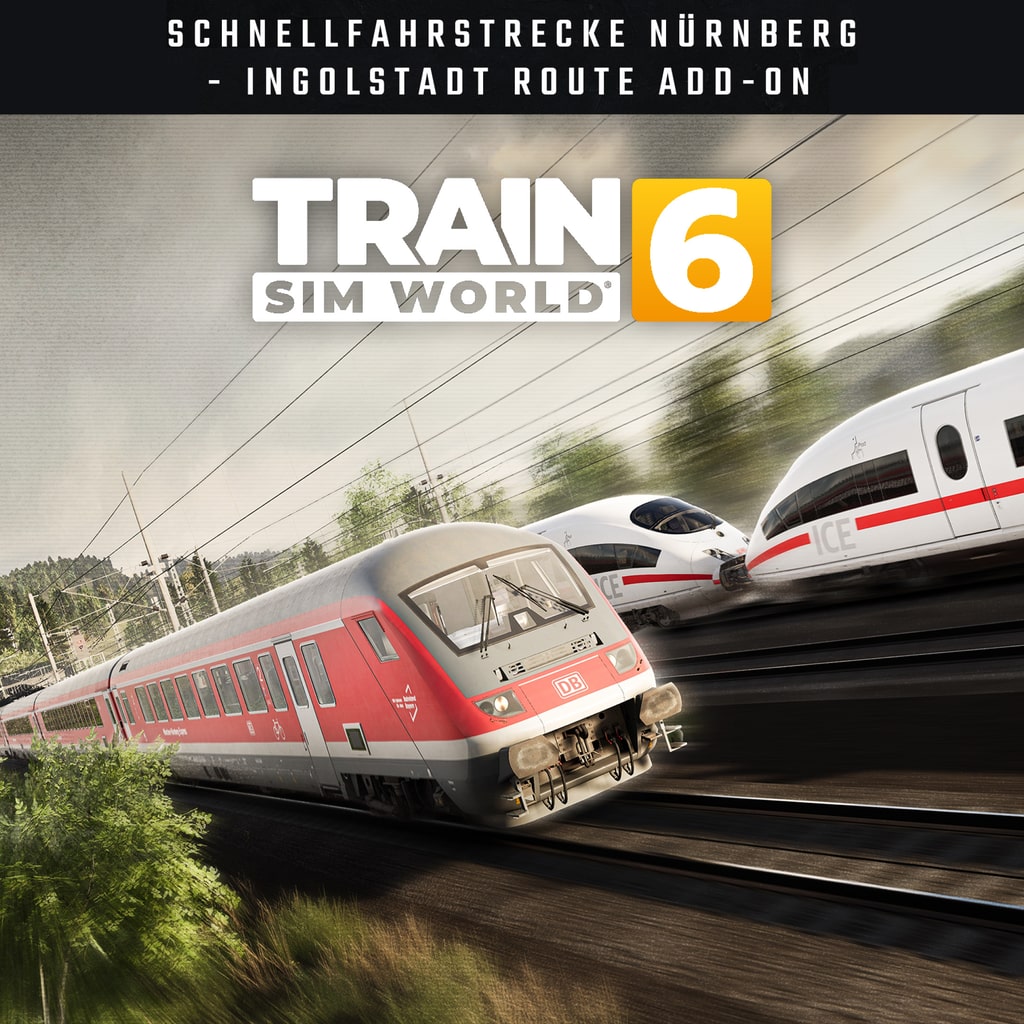
The star of the route is, naturally, the iconic red-striped ICE 3. There is something instantly recognisable about the train, and its inclusion makes perfect sense given the character of the line. Climbing into the cab and preparing for a high-speed run feels like the start of a journey rather than simply selecting another service from a menu.
The train itself feels particularly well suited to this route because the entire experience revolves around speed and stability. The acceleration, braking and high-speed running all contribute to the sensation of travelling at enormous velocity while remaining completely composed. It is the kind of train that makes you want to keep looking at the speed display simply because seeing the numbers climb never really gets old.
The contrast between the train and the landscape is also effective. The ICE feels like a piece of modern engineering cutting through a much older environment. Outside the windows are Bavarian fields, valleys and settlements, while inside the cab you are dealing with technology designed specifically to make extremely high-speed railway travel possible.
A Different Kind of Regional Service
Schnellfahrstrecke Nürnberg – Ingolstadt is not exclusively about blasting between cities at maximum speed. The route also introduces the München-Nürnberg-Express, bringing a more traditional regional railway flavour to proceedings. These services operate at up to 200 km/h, which sounds positively leisurely after spending time at the controls of the ICE, but the change of pace is welcome.
The regional services require a different mindset. Instead of simply settling into a high-speed run between major destinations, you have to consider intermediate stations and adopt a different rhythm in your driving. Braking becomes particularly important because arriving accurately at platforms is just as satisfying as maintaining a precise high-speed run.
The inclusion of the classic DB BR 101 working in push-pull configuration with the München-Nürnberg-Express coaches also adds welcome variety. It offers an older, more traditional railway experience alongside the cutting-edge ICE operation. Having both available means the route does not feel like a one-trick pony.
Tunnels, Curves and Bavarian Scenery
Visually, the route has a character all of its own. The decision to build a railway prioritising speed means it does not always offer the sweeping postcard views associated with more traditional railway routes. Instead, the landscape is frequently interrupted by tunnels, cuttings and engineered sections designed to keep trains moving quickly.
That is not necessarily a weakness. In fact, the tunnels help create some of the most memorable moments on the route. Hearing the roar of another high-speed train as it approaches inside a tunnel, before watching it flash past at enormous speed, is one of those little details that makes Train Sim World work so well when everything comes together.
There are still plenty of opportunities to appreciate the surrounding Bavarian landscape. The railway’s gentle curves and changing gradients give the journey enough visual variety, while stations provide welcome breaks from the relentless pace. Driving along the route at different times and in different conditions can also change its personality considerably.
The Cost of Going Fast
The biggest criticism I have is also something that comes naturally with the route’s design. Once you have reached cruising speed and everything is running smoothly, there can be periods with little interaction beyond monitoring the train and the signalling information. Compared with a busy commuter route with frequent stops and junctions, the high-speed railway can occasionally feel rather quiet.
That said, this is not really a flaw in the route itself. Real high-speed railway operation involves periods of sustained running, and removing those moments would arguably make the experience less authentic. The important thing is that the route provides enough demanding sections around stations, speed changes and safety systems to keep you engaged when it matters.
It is also a route that rewards repetition. Your first run might be about simply reaching Ingolstadt without making a serious mistake. By the fifth or sixth journey, you start concentrating on smoother braking, cleaner acceleration and better timing. That gradual improvement is where much of Train Sim World’s long-term appeal comes from, and this route provides plenty of opportunity for it.
Verdict
Schnellfahrstrecke Nürnberg – Ingolstadt is a superb showcase for what makes high-speed railway simulation so compelling. It combines one of Germany’s most impressive railway corridors with the unmistakable ICE 3, demanding signalling systems, and the sheer thrill of travelling at extreme speeds through Bavaria.
It is not the most interactive route at every moment, and newcomers may need patience before LZB, PZB and high-speed braking begin to feel natural. Once those systems start to make sense, however, the experience becomes immensely rewarding. There is genuine satisfaction in completing a long run while maintaining control, hitting your braking points, and arriving at the destination with everything going according to plan.
The addition of the München-Nürnberg-Express and DB BR 101 also deserves credit, as it provides a valuable change of pace. One moment you are hurtling through Germany at extreme speed aboard an ICE, and the next you are approaching a regional station and carefully managing a completely different service.
For PS5 owners seeking a Train Sim World 6 route that puts speed, precision and railway technology front and centre, Schnellfahrstrecke Nürnberg – Ingolstadt is an easy recommendation. It may not have the constant activity of a busy urban railway, but when the ICE is charging through a tunnel at 300 km/h and another train flashes past in the opposite direction, there is very little else in the simulation world quite like it.