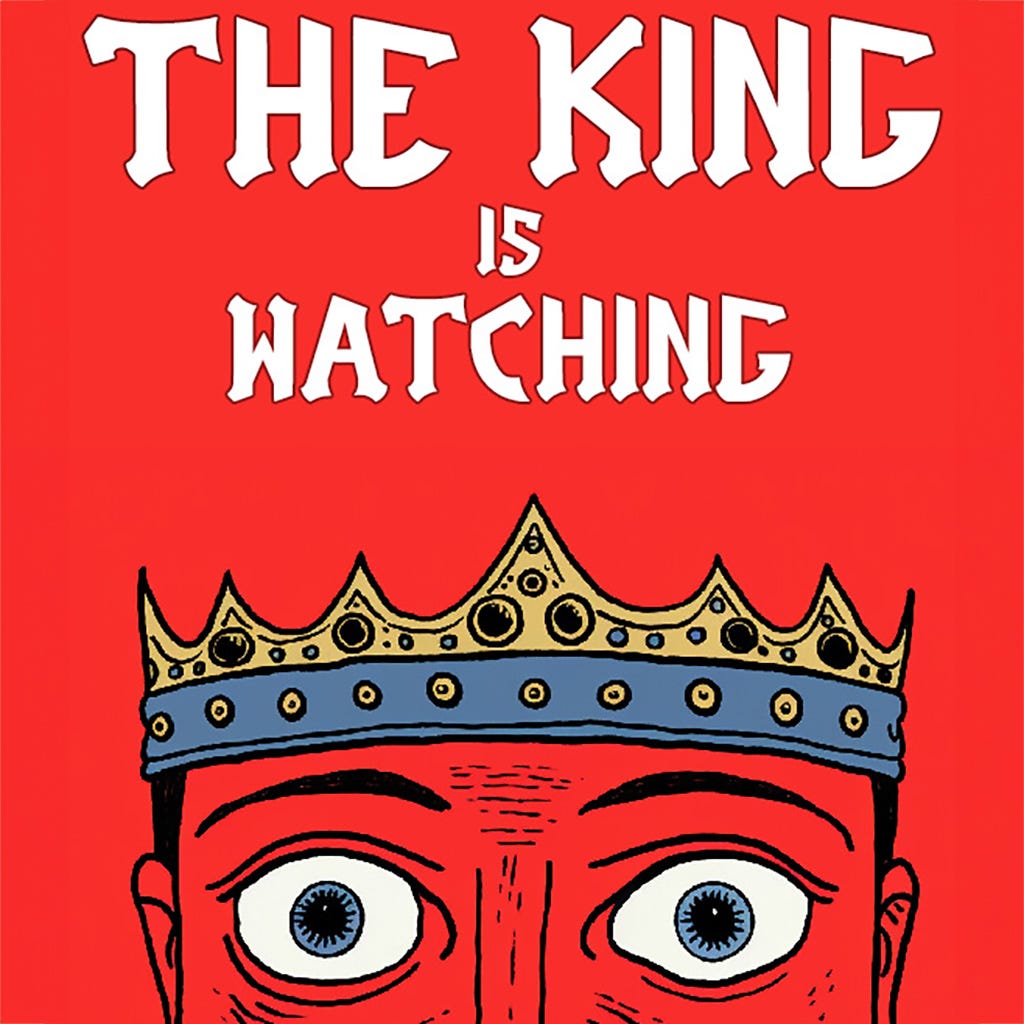
Strategy games have spent decades asking players to build bigger kingdoms, train larger armies and create increasingly efficient economies. Most eventually become exercises in optimisation, where production lines quietly tick away while your attention drifts elsewhere. The King is Watching throws that comfortable formula out of the castle window with one brilliantly simple idea. Nothing happens unless you’re looking at it.
That single mechanic transforms what initially appears to be a familiar kingdom builder into something wonderfully tense. Farmers refuse to harvest crops when ignored. Miners stop swinging their pickaxes the moment your gaze drifts away. Soldiers stand idle until the King’s attention falls on the barracks. It sounds absurd on paper, yet within minutes it becomes clear this is one of the smartest strategy hooks to come along in quite some time.
Developed by Hypnohead and published by tinyBuild, The King is Watching combines real-time strategy, roguelite progression and castle management into an experience that constantly demands your attention without ever becoming overwhelming. It is challenging, inventive and, perhaps most importantly, enormously satisfying once everything begins to click into place.
Gameplay
Every successful strategy game is built around meaningful decisions, and The King is Watching never stops asking you to make them. Your kingdom occupies a compact grid, where every building serves a distinct purpose. Farms produce food, quarries generate stone, workshops manufacture equipment, and barracks prepare soldiers for the inevitable attacks beyond your walls. Under normal circumstances, these buildings would quietly operate in the background while you concentrated elsewhere. Here, however, every one requires the King’s watchful gaze before any work begins.
This creates an almost hypnotic rhythm. You might begin by directing your attention to the wheat fields to replenish dwindling food supplies, then shift your gaze to the mines for desperately needed stone. Moments later, enemy forces appear on the horizon, forcing an immediate switch to military production as your barracks spring to life. Every shift of your attention feels meaningful because every second spent looking at one building means another has stopped working entirely.
It is remarkable how much tension emerges from such a straightforward concept. There are no complicated button combinations or intimidating management screens. Instead, success comes from constantly asking yourself one question. What deserves my attention right now? The answer rarely remains the same for very long.
A Kingdom Built on Priorities
Beneath its accessible surface lies impressive strategic depth. Resources feed directly into one another, creating production chains that demand careful planning. Farms keep citizens alive, miners gather raw materials, workshops convert resources into useful equipment, while military buildings prepare your forces for the next assault. Neglect any one part of that chain for too long, and the entire kingdom begins to struggle.
Unlike traditional strategy games, where efficient layouts eventually allow economies to run themselves, The King is Watching never lets you become complacent. Even the most carefully constructed kingdom still relies on your constant supervision. It turns every successful run into an engaging balancing act, where short-term survival and long-term planning compete for your limited attention.
The pressure steadily builds without ever feeling unfair. Every failure usually comes with immediate clarity. You know exactly which decision caused your downfall, whether you spent too long focusing on resource gathering or failed to prepare enough soldiers before the next invasion arrived. That constant feedback loop makes defeat surprisingly enjoyable, because every failed reign teaches valuable lessons for the next attempt.
Roguelite Progression
The roguelite structure fits naturally within the game’s design philosophy. Each new kingdom begins with familiar foundations, but procedural upgrades quickly send every campaign down different strategic paths. New buildings, passive abilities, military improvements and royal decrees gradually reshape how each run unfolds, encouraging experimentation rather than repetition.
Permanent progression ensures time never feels wasted. Even disastrous campaigns contribute to unlocking additional rulers, council members and upgrades that strengthen future attempts. That steady sense of advancement helps soften the inevitable frustration that accompanies difficult strategy games.
The newly included Volcano biome further expands the experience by introducing fresh environmental hazards alongside powerful new enemies and bosses. It offers experienced players another meaningful challenge rather than simply increasing enemy numbers, reinforcing the game’s emphasis on adapting strategies rather than relying on established routines. Each campaign tells its own story through the decisions you make, and that unpredictability gives the game exceptional replay value.
Presentation
The King is Watching embraces pixel art with confidence rather than nostalgia alone. Its compact kingdom layout remains wonderfully readable even during frantic moments when dozens of systems compete for your attention. Buildings possess enough personality to stand out without cluttering the screen, while animated workers bring constant life to your tiny realm whenever the King’s gaze allows them to get back to work.
Enemy assaults are equally satisfying to watch unfold. Soldiers clash, arrows fly across defensive walls, and siege forces steadily advance while your economy desperately attempts to keep pace behind the scenes. The contrast between the calm organisation inside your castle and the mounting chaos outside creates an engaging visual rhythm throughout every campaign.
Performance remains consistently smooth even in later stages, when numerous production chains and combat encounters occur simultaneously. Given how heavily the gameplay relies on rapid decision-making, that technical stability proves invaluable.
Sound Design
Audio complements the gameplay beautifully without ever demanding centre stage. The soundtrack shifts naturally from peaceful kingdom management to increasingly urgent battle themes as invasions intensify. Music quietly reinforces the rising pressure without becoming distracting, allowing players to remain focused on their constantly shifting priorities.
Sound effects provide useful feedback throughout every session. The reassuring clink of mining, the bustle of active farms and the clash of battle all communicate important information without requiring players to constantly stare at every corner of the kingdom.
It is subtle work, but highly effective. The soundscape becomes another management tool, quietly informing your decisions alongside the visual presentation.
Lasting Appeal
The King is Watching proves remarkably difficult to put down. Runs rarely feel identical, thanks to procedural upgrades, shifting enemy commanders and evolving strategies. One kingdom may thrive through overwhelming military strength, while the next depends entirely on careful resource efficiency and defensive positioning. That variety keeps experimentation rewarding long after the opening hours.
The game’s greatest achievement, however, lies in how naturally its central mechanic evolves. What initially feels unusual soon becomes second nature. Before long, your eyes instinctively dart around the kingdom, searching for the next production bottleneck before it even appears. Few strategy games forge such an immediate link between player attention and in-game success.
There are moments when the pace becomes almost overwhelming, particularly in later encounters, where multiple crises erupt simultaneously. Yet those moments rarely feel chaotic for the wrong reasons. Instead, they capture the fantasy of ruling a kingdom where every decision truly matters.
Final Verdict
The King is Watching succeeds because it dares to build an entire strategy game around a genuinely original mechanic. Rather than layering unnecessary complexity onto familiar systems, it rethinks how players interact with kingdom management. The result is a clever, engaging and deeply addictive experience that consistently rewards careful observation and thoughtful decision-making.
Its roguelite progression adds lasting replay value, the presentation remains charming throughout, and the strategic depth continues to expand long after the tutorial ends. Most importantly, it never loses sight of what makes it special. Every glance carries weight, every choice shapes your kingdom, and every successful defence feels completely earned.
In a genre often dominated by familiar ideas, The King is Watching feels refreshingly different. It proves that sometimes the smallest idea can completely transform an entire game.