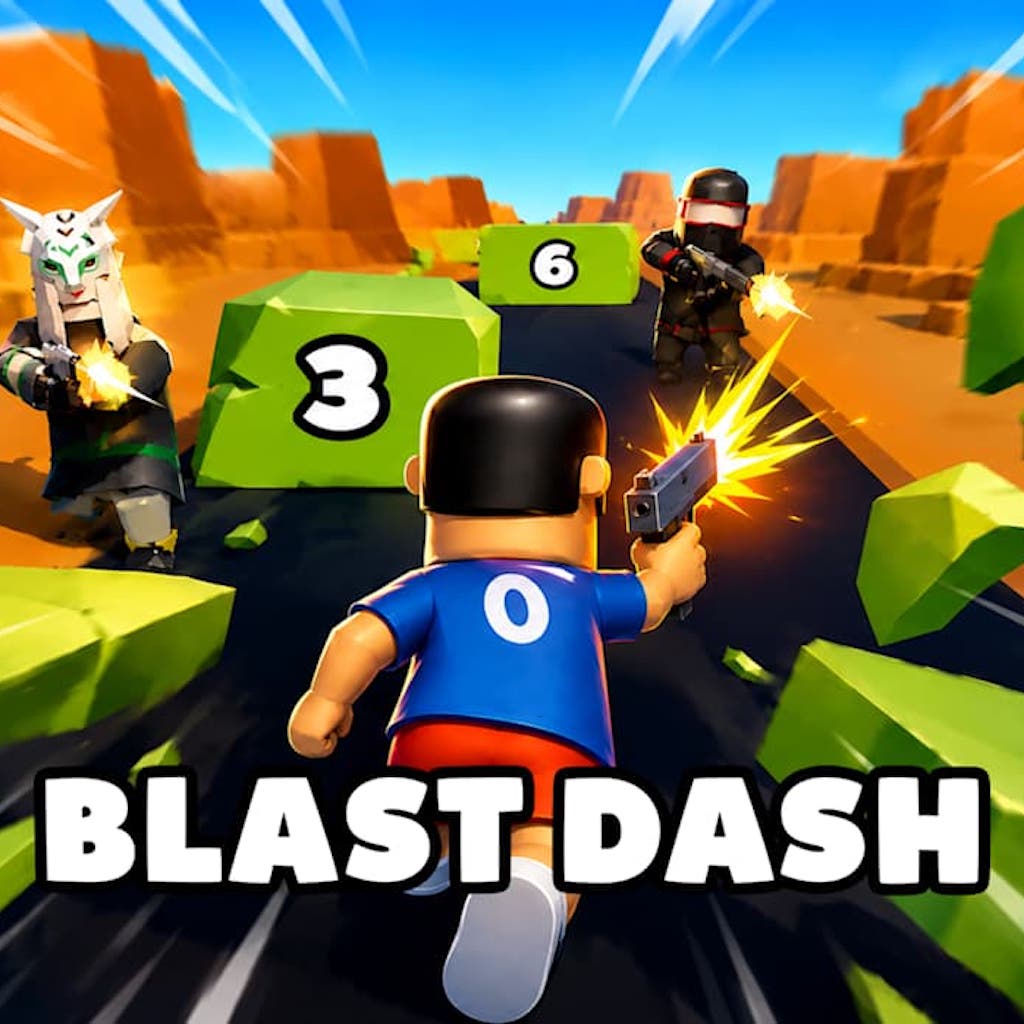
There is something refreshingly honest about games that know exactly what they are. Blast Dash never pretends to be an epic adventure or a sprawling action experience packed with cinematic storytelling. Instead, it throws you onto a brightly coloured track, hands you a pair of pistols, and asks one simple question. How long can you survive when everything in front of you wants to stop your run?
Developed and published by Entity3, Blast Dash wears its mobile gaming influences proudly. Its short bursts of action, immediate controls, and steady stream of upgrades are built for quick sessions rather than marathon playtimes. That approach will inevitably divide opinion, especially on consoles, where players often expect more substantial experiences, but there is also an undeniable charm to a game that simply wants to entertain for a few minutes at a time.
While Blast Dash never reaches beyond its modest ambitions, it succeeds more often than not by delivering an energetic gameplay loop that prioritises speed, rhythm, and constant movement over complexity.
Gameplay
From the moment a run begins, Blast Dash refuses to let you breathe. Your character automatically sprints forward, leaving you responsible for Weaving between hazards, leaping over obstacles, ducking beneath barriers, and firing continuously at everything standing in your way. It creates an enjoyable multitasking challenge, with your eyes constantly scanning the path ahead while your fingers keep enemies at bay.
The dual-gun mechanic gives the game a little more personality than a traditional endless runner. Rather than simply avoiding danger, you’re actively clearing it. Enemy soldiers appear in groups, firing back as you advance, while destructible walls require enough firepower to avoid an abrupt end to your run. The constant need to shoot while maintaining perfect movement keeps each thirty-second sprint surprisingly engaging.
Obstacle variety helps maintain the pace throughout the early hours. Rotating blades, spinning spikes, collapsing barriers, and moving hazards force you to stay alert rather than settling into a comfortable rhythm. Some sections require quick lane changes before immediately demanding a jump or slide, creating satisfying moments where successful navigation feels genuinely earned.
The controls remain wonderfully accessible throughout. Movement is responsive, and jumping rarely feels unreliable. Shooting requires little more than maintaining pressure while focusing on positioning. That simplicity makes Blast Dash easy to pick up within minutes, allowing almost anyone to grasp its mechanics without lengthy tutorials or complicated systems getting in the way.
Progression That Encourages One More Run
Like many hyper-casual games, Blast Dash relies heavily on progression outside individual runs. Every failed attempt rewards coins based on performance, and those coins can be invested in permanent upgrades that steadily improve your effectiveness.
Increasing your fire rate makes clearing enemy formations noticeably easier, while extending your shooting range gives you precious extra seconds to destroy approaching walls. Faster reload speeds also become increasingly valuable in later stages, where the action is far less forgiving. These upgrades may seem incremental individually, but together they provide a satisfying sense of long-term improvement.
This steady progression forms the backbone of the experience. Even unsuccessful attempts contribute to becoming stronger, creating that familiar “just one more run” mentality that has powered arcade games for decades. Watching previously impossible sections become manageable after a handful of upgrades provides genuine satisfaction.
Cosmetic unlocks offer additional motivation. New weapon appearances and character skins provide visual variety without affecting balance, rewarding continued play while allowing players to personalise their runs. They are hardly game-changing additions, but they add enough incentive to keep collecting coins long after the initial upgrades have been purchased.
Challenge and Pacing
Blast Dash maintains impressive momentum throughout each session. Individual runs rarely exceed forty seconds, yet those brief windows feel packed with activity. There is little downtime between hazards, so concentration never has a chance to drift.
As stages progress, the game steadily introduces faster enemy placements and more demanding obstacle combinations. Early levels gently teach movement fundamentals before gradually expecting players to combine multiple actions almost simultaneously. Jumping over spinning blades, unloading bullets into a wall, and then quickly sliding beneath a barrier create moments of controlled chaos that capture the game’s frantic identity.
Difficulty generally feels fair because failures are almost always the player’s responsibility rather than the game’s. Success depends on recognising patterns, reacting quickly, and making full use of upgraded abilities. The learning curve remains accessible without ever becoming effortless.
That said, the formula inevitably begins to repeat itself after extended play. While later stages become faster and more crowded, the overall structure changes very little. Players hoping for major gameplay twists or evolving mechanics may eventually find themselves wishing for additional ideas to keep the experience fresh.
Presentation
Blast Dash embraces colourful simplicity. Environments are bright, clean and easy to read, ensuring players can instantly identify incoming hazards without visual clutter getting in the way. Character models and enemies remain fairly basic, but clarity matters far more than graphical fidelity in a game built around split-second reactions.
Animations are smooth enough to support the rapid pace, while explosions and bullet impacts provide satisfying visual feedback whenever enemies fall or walls crumble under sustained fire. Nothing here pushes console hardware particularly hard, yet the presentation suits the game’s arcade ambitions.
Performance remains consistently stable throughout gameplay, which is perhaps the most important technical achievement. In a game where fractions of a second determine success or failure, smooth responsiveness is essential, and Blast Dash largely delivers exactly that.
Menus are equally straightforward. Upgrades, cosmetic unlocks and new runs are never more than a few button presses away, allowing players to spend most of their time actually playing rather than navigating unnecessary interfaces.
Sound Design
The soundtrack leans heavily on energetic electronic music that complements the constant forward momentum. While individual tracks may not linger in your memory after switching the console off, they sustain the game’s lively pace throughout each run.
Weapon effects deliver enough impact to make shooting feel satisfying, while obstacle collisions and environmental hazards provide clear audio cues during hectic moments. The mix remains clean, ensuring important sounds are never overwhelmed by the background music.
There is little in the way of atmosphere or dramatic audio design, but Blast Dash never needs it. Its soundscape exists purely to reinforce speed, urgency and arcade excitement, which it achieves effectively.
Lasting Appeal
Blast Dash understands its limitations. This is not a game designed to fill dozens of hours with deep mechanics or expansive content. Instead, it serves as a quick arcade distraction remarkably well.
Its short runs make it perfect for brief gaming sessions, whether you have ten minutes before work or simply want something fast between larger games. The permanent upgrade system also provides enough progression to encourage regular returns without demanding an enormous time investment.
The biggest obstacle to long-term longevity is repetition. Once you’ve unlocked most upgrades and mastered the core mechanics, there are relatively few surprises left. Dedicated score chasers will continue refining their runs, but others may gradually drift away after experiencing everything the game has to offer.
Still, there is value in games that respect your time. Blast Dash delivers immediate entertainment without asking for lengthy commitments, and sometimes that is exactly what players are looking for.
Final Verdict
Blast Dash is a straightforward arcade experience that succeeds because it never loses sight of its purpose. Every mechanic feeds into a simple yet enjoyable gameplay loop built around quick reactions, constant movement and satisfying progression. Its mobile-inspired design may lack the depth of larger console releases, but its accessibility and addictive pacing make it surprisingly easy to return to.
The limited variety prevents it from becoming a long-term obsession, yet for players who enjoy endless runners or fast arcade challenges, there is plenty of enjoyment packed into its brief sessions. Entity3 has created a polished, responsive little time-killer that understands the appeal of chasing just one more run. Sometimes that is more than enough.