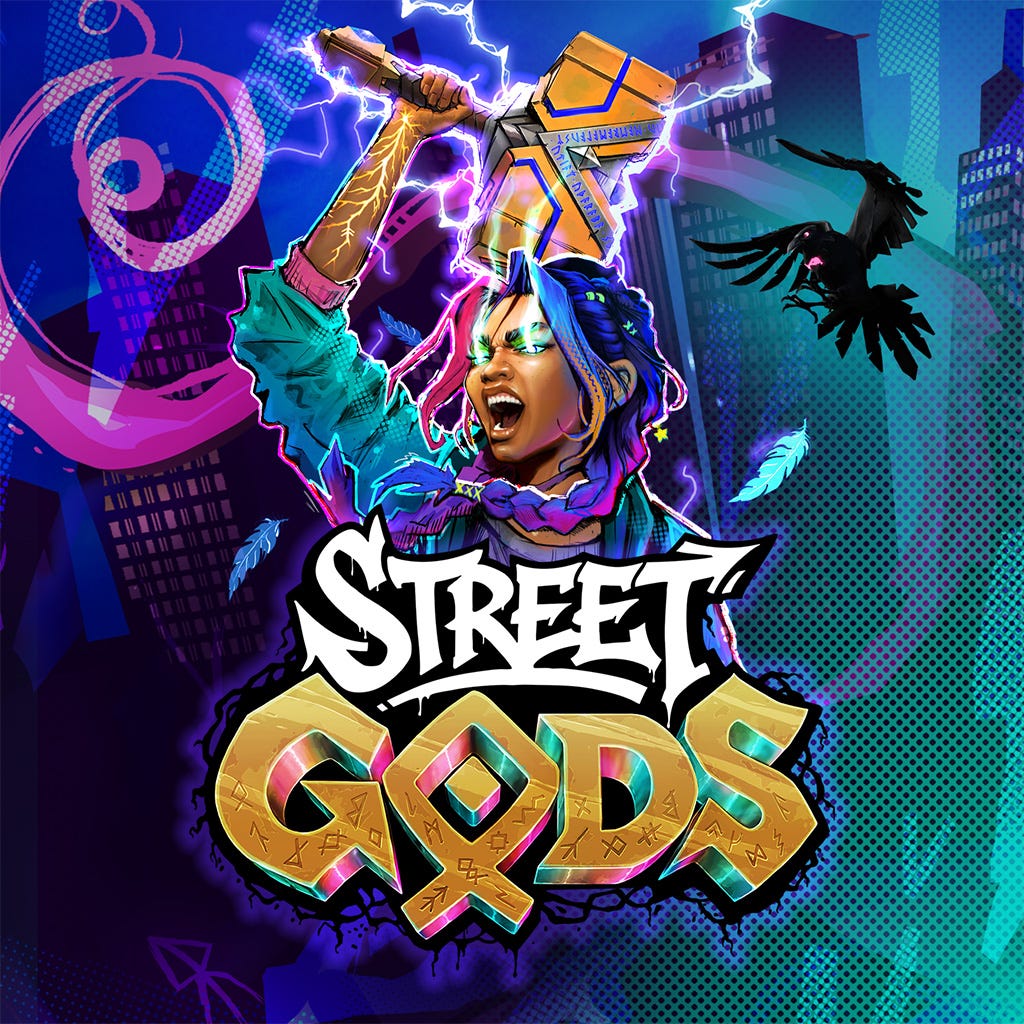
Street Gods is a VR action roguelite that fuses Norse mythology with a fractured modern New York City, offering players the fantasy of wielding Mjölnir against corrupted gods, undead hordes, and myth-infused enemies. Built specifically for Meta Quest hardware, the game leans heavily into physics-based melee combat and run-based progression, aiming to deliver a sense of raw power and replayable challenge.
It is an experience full of bold ideas: mythological spectacle, roguelite structure, and tactile VR combat all wrapped in an urban fantasy setting. At its best, Street Gods offers moments of satisfying chaos and empowerment. At its worst, it exposes the difficulty of making melee combat feel consistently impactful in virtual reality.
Narrative and Setting: Norse Gods Meet Urban Ruin
The premise behind Street Gods is immediately striking. An ordinary person stumbles upon Mjölnir in a city torn apart by divine corruption, becoming an unlikely champion in a war between gods gone mad. Norse mythology bleeds into everyday environments — city streets, rooftops, and abandoned buildings become battlegrounds for ancient power struggles.
Storytelling is intentionally light. Rather than deep lore or extended character arcs, narrative beats are delivered in short segments between runs. This approach keeps the focus on gameplay momentum but limits emotional investment. The world feels intriguing, yet underexplored, with much of the mythological intrigue serving as background flavour rather than a driving force.
For players more interested in action than story, this restraint will be welcome. Those seeking rich narrative depth, however, may find the setup promising but ultimately shallow.
Core Gameplay: Physics-Driven Combat With Inconsistent Impact
The heart of Street Gods lies in its melee combat. Using motion controls, players swing, throw, and recall Mjölnir while engaging enemies in close-quarters brawls. Combat encounters are framed as intense skirmishes where positioning, timing, and stamina management all matter.
In theory, this should be exhilarating — and occasionally it is. Landing a clean hammer throw or chaining attacks across multiple enemies can feel empowering. Unfortunately, the impact feedback often fails to fully sell these moments. Hits lack the physical weight and audiovisual punch that VR melee thrives on, which can make even powerful strikes feel oddly muted.
Enemy behaviour is serviceable but rarely surprising. While different enemy types exist, encounters often resolve in similar patterns, reducing the sense of tactical depth over time. Combat pacing fluctuates, with some runs offering exhilarating intensity and others feeling more like repetitive clean-up operations.
Roguelite Structure: Progression That Encourages Persistence
Street Gods uses a familiar roguelite framework. Each run begins with a route-selection phase, allowing players to choose paths through the city that influence encounters, rewards, and difficulty. Death sends you back to the start, but persistent upgrades carry over, gradually strengthening your character.
Runic upgrades enhance abilities such as damage output, movement speed, elemental effects, or survivability. Over time, these upgrades create a noticeable power curve, helping players overcome early difficulty spikes and enabling more aggressive playstyles.
When progression clicks, the sense of growth is satisfying. However, because the underlying combat feel remains inconsistent, upgrades sometimes feel like compensation rather than empowerment. The structure is solid, but it doesn’t always elevate moment-to-moment play as effectively as it should.
Movement and Locomotion: Functional but Demanding
Movement in Street Gods blends traditional VR locomotion with dash-based evasive mechanics. Players are encouraged to stay mobile, using short bursts of speed to avoid attacks and reposition during combat.
While these systems work as intended, they can feel physically demanding when paired with constant melee action. Precision movement becomes harder during intense combat sequences, particularly for players not accustomed to extended VR sessions. The game rewards spatial awareness, but it sometimes asks too much from players in terms of sustained physical engagement.
Verticality and environmental awareness add some strategic nuance, allowing players to use elevation and cover, but these elements are not explored deeply enough to consistently refresh combat encounters.
Visual Style and Audio: Personality With Rough Edges
Visually, Street Gods aims for a comic-book-inspired blend of mythic fantasy and urban grit. When it works, the aesthetic is striking — glowing runes, divine enemies, and supernatural effects contrast nicely with modern cityscapes.
However, visual quality is uneven. Some environments and enemy designs stand out, while others feel under-detailed or repetitive. Performance fluctuations can also affect immersion, particularly during busier combat scenarios.
Sound design reinforces atmosphere but lacks the visceral punch expected from a melee-focused VR title. Weapon impacts and enemy reactions could benefit from stronger audio cues to better sell the sensation of power.
Replayability and Longevity
Replay value is driven primarily by the roguelite loop. Different routes, upgrade combinations, and enemy groupings provide some variety between runs, encouraging experimentation and repeated attempts.
For dedicated players who enjoy optimisation and gradual mastery, this loop offers several hours of engagement. However, limited enemy variety and similar encounter structures can make long-term play feel repetitive. Without deeper mechanical layers or narrative incentives, replayability depends heavily on personal tolerance for repetition.
Strengths and Weaknesses
Strengths:
- Creative blend of Norse mythology and modern urban settings
- Roguelite progression encourages repeated play
- Occasional moments of satisfying power fantasy
- Designed specifically for Meta Quest hardware
Weaknesses:
- Inconsistent combat impact and feedback
- Limited enemy and encounter variety
- Uneven visual polish and performance
- Shallow narrative engagement
Final Verdict
Street Gods is an ambitious VR roguelite that dares to blend mythological spectacle with physics-based melee combat. Its core ideas are strong, and there are moments where wielding Mjölnir genuinely feels empowering. Unfortunately, inconsistent combat feedback, limited variety, and technical rough edges prevent the experience from reaching its full potential.
For Meta Quest players looking for a myth-inspired action roguelite and willing to overlook some shortcomings, Street Gods offers enjoyable bursts of gameplay. Those seeking consistently polished VR melee combat, however, may find the experience uneven over time.