There is something wonderfully uncomplicated about a game that knows exactly what it wants to be. Stone Run does not ask you to save the world, manage an inventory, decipher an ancient mystery, or spend twenty hours learning an elaborate skill tree. Instead, it puts a giant rolling stone behind you, points you towards the horizon, and effectively tells you to run for your life. Developed by Cool-Two Interactive and published by Desert Water Games, this fast-paced 2D arcade platformer is built around one wonderfully simple idea: keep moving, react quickly, and never, ever look back.
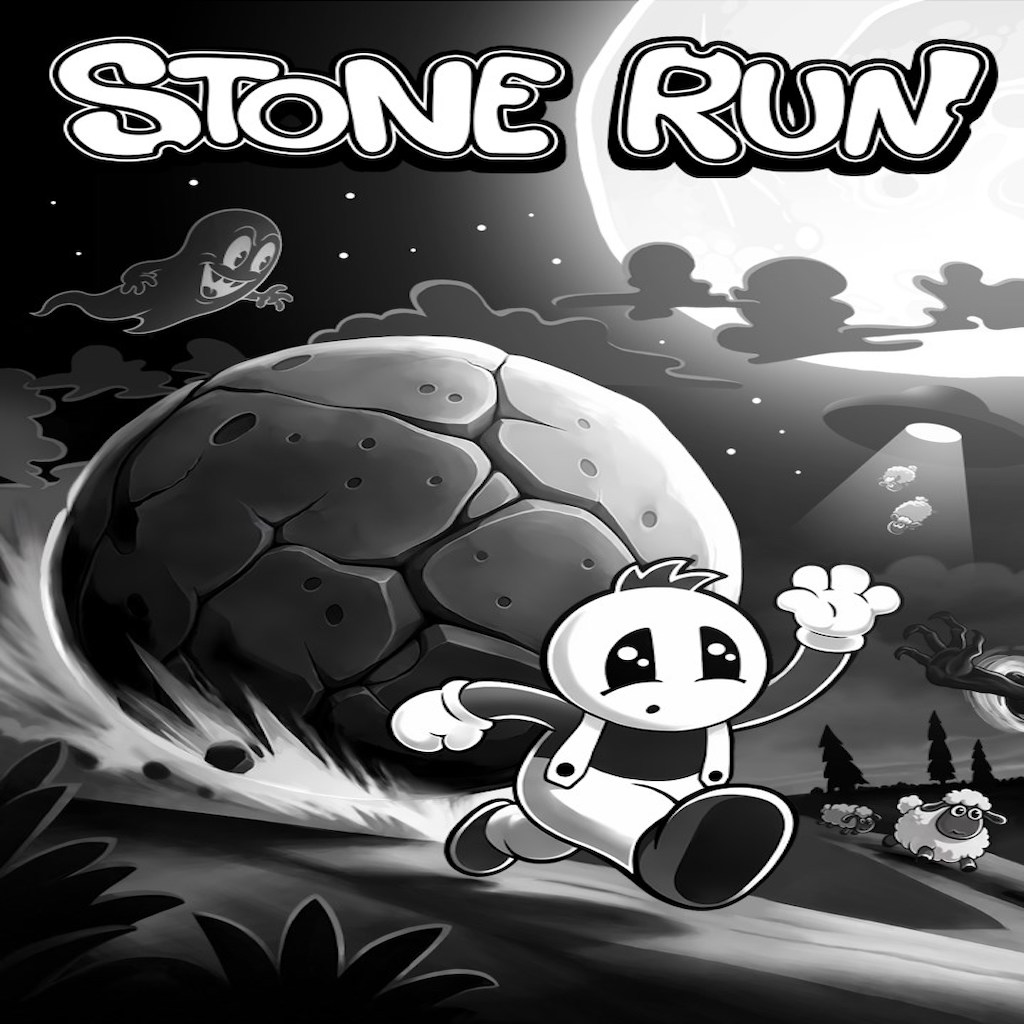
That simplicity is very much part of Stone Run’s charm. In an era when even relatively small indie games arrive packed with systems, menus, progression mechanics, and endless customisation, there is something refreshing about a game that strips everything back to the basics. You are a caveman; the prehistoric landscape is trying to kill you, and a gigantic boulder is doing its best to turn you into a rather unfortunate smear on the scenery. What follows is a frantic race through colourful environments where every jump, dodge, and split-second decision can be the difference between keeping your run alive and watching everything come crashing to an abrupt halt.
Run Like Your Life Depends On It
The central mechanic in Stone Run could hardly be easier to understand. You run forwards while the enormous stone relentlessly follows behind, leaving very little room for hesitation. Obstacles appear in your path, the terrain becomes increasingly hazardous, and hostile wildlife can add another layer of danger to an already stressful journey. There is no time to stand around admiring the scenery because the game constantly encourages you to react, adapt and keep your momentum.
It is that sense of pressure that makes Stone Run surprisingly addictive. The controls are responsive enough that when something goes wrong, it generally feels like your own mistake rather than the game simply deciding that you should lose. Miss a jump and you know why. React too slowly to an approaching obstacle and there is nobody to blame but yourself. That relationship between failure and improvement is at the heart of good arcade design, and Stone Run understands it.
The trial-and-error nature of the experience also gives repeated attempts a purpose. Your first run might end almost immediately because you simply did not know what was coming, but subsequent attempts become about remembering patterns, improving reactions and squeezing a little more distance from the previous attempt. It is an old-fashioned design philosophy, but there is still tremendous satisfaction in seeing a high score gradually climb because you are becoming better rather than because your character has simply become more powerful.
A Cartoon Prehistoric World
Visually, Stone Run is arguably at its strongest. The hand-drawn cartoon presentation gives the game a warmth and personality that could easily have been lost with a more generic retro aesthetic. The prehistoric environments have an appealing illustrated quality, and the caveman protagonist and surrounding hazards help the whole thing feel like a playable Saturday morning cartoon rather than another deliberately gritty retro revival.
That visual style is important because Stone Run is not attempting to compete with technically demanding modern platformers. Its identity comes from its presentation, movement and arcade immediacy. The hand-drawn artwork gives the game character, while the exaggerated nature of the rolling boulder and prehistoric dangers adds a playful sense of humour to the constant threat of being flattened. It is colourful, energetic and easy on the eye, which makes the frantic gameplay considerably more enjoyable.
There is also something nostalgic about the overall presentation. Stone Run feels like the sort of game that could have been designed around the simple idea of putting a player in front of an arcade machine and seeing how long they can survive. It does not bombard you with unnecessary information, and that restraint works in its favour. Everything is there to support the central challenge of running further, reacting faster and chasing a better score.
The Art of the Perfect Reaction
Where Stone Run really succeeds is in recognising that reflex-based games do not need complicated mechanics to be engaging. The satisfaction comes from timing. A well-judged leap over an obstacle, a perfectly timed dodge, or a narrow escape from the rolling stone can provide a brief rush of adrenaline that makes you want to try again immediately.
That is also where the game’s difficulty becomes part of its appeal. Stone Run is not necessarily difficult because its controls are complicated. It is difficult because it demands concentration. The longer a run continues, the more valuable every reaction becomes, and the pressure created by the stone means that mistakes are rarely forgiven. You cannot simply stop and consider your next move, because standing still is effectively an invitation for the boulder to catch up.
The wildlife and unpredictable obstacles help prevent the experience from becoming completely mechanical. You need to pay attention to what is happening directly in front of you rather than simply memorising one sequence and repeating it forever. That keeps the action lively, even if experienced arcade players will probably become familiar with the overall formula fairly quickly.
Simple, But Is It Enough?
The biggest question hanging over Stone Run is also the most obvious. Once the initial excitement of being chased by a gigantic stone settles, how much more is there to discover? The answer is that this is a deliberately straightforward arcade experience. While that works beautifully for short bursts, it also means the game lacks the depth or variety some players may be looking for.
There is no denying that the core gameplay loop can become repetitive. Run, jump, dodge, collect bonuses, survive, and try to improve your score. It is an effective formula, but it is also a familiar one, and Stone Run does not radically reinvent the endless runner or retro arcade platformer. The relatively brief structure means that players looking for a substantial adventure may reach the limits of the experience sooner than they would like.
That said, judging Stone Run solely on what it does not offer would miss the point. This is not trying to be a huge adventure. It is a game designed around quick bursts of action, and within those boundaries it works rather well. Sometimes you do not want a sprawling experience that consumes an entire weekend. Sometimes you want to sit down, play for twenty minutes, chase a score, swear loudly when you mistime a jump, and then immediately have another go.
Built For One More Attempt
Replayability is therefore closely tied to how much you enjoy arcade score chasing. If beating your previous performance is enough motivation, Stone Run has plenty to offer. There is particular satisfaction in turning an earlier failure into a better run, especially when you know exactly where you went wrong and manage to survive that section the next time.
Players who need constant new content may find the appeal wears thin more quickly. The mechanics are straightforward, and once the novelty of the presentation has settled, the emphasis falls almost entirely on improving your own performance. For some, that will be the entire point. For others, the lack of significant mechanical evolution may leave them wishing there were more surprises beyond the next stretch of prehistoric landscape.
Personally, I think there is something quite likeable about that honesty. Stone Run does not pretend to be something it isn’t. It is a compact arcade challenge with a strong visual identity, responsive controls and a simple idea that works because it is easy to understand and difficult to master. There is an almost comforting purity to that approach, particularly for anyone who grew up with games where the objective was simply to survive, score points and have another go.
Final Verdict
Stone Run may not revolutionise the retro arcade platformer, but it does not need to. Its greatest strength is the sheer immediacy of its central idea. Put a giant stone behind the player, throw obstacles into their path, and make them run until their reflexes give out. It is simple, silly, and surprisingly effective, and the charming hand-drawn artwork gives the whole experience considerably more personality than its basic mechanics might initially suggest.
There are limitations, particularly in variety and long-term depth. Players looking for an expansive platforming adventure will probably find the experience too brief and familiar, while those expecting a constant stream of new mechanics may eventually feel that the formula has run its course. But for anyone who enjoys arcade games built around quick reactions, high scores, and the irresistible temptation to have just one more attempt, Stone Run delivers exactly what it promises.
It is the sort of game that does not need to shout about itself. It simply drops a massive boulder behind you and waits for you to run. And sometimes, that is all the motivation you need.