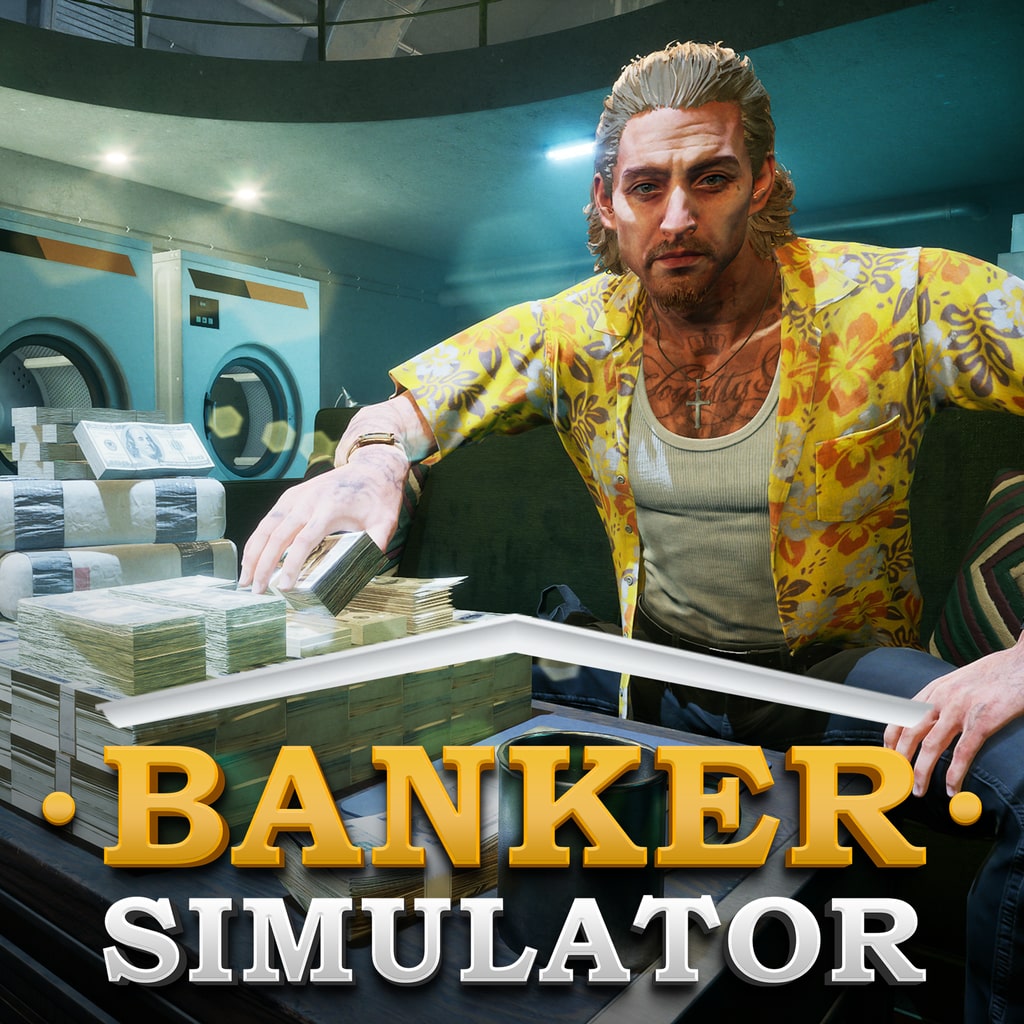
There is something strangely appealing about the idea of running a bank. Perhaps it is the thought of starting with a tired old building, a handful of customers and a bank balance that looks like it has seen better days, then slowly turning the whole operation into a financial powerhouse. Banker Simulator takes that fantasy and gives it a decidedly unconventional twist. Developed by Soi Games and published by Red Axe Games, this first-person simulation puts you behind the counter of a struggling bank and asks you to do whatever it takes to bring it back from the brink.
At first glance, Banker Simulator appears to be another job simulator built around the everyday tasks of working in a financial institution. There is plenty of that here, with cash counting, currency exchange, identity verification and loan management all forming part of the daily routine. But beneath the respectable banking façade lies something considerably less wholesome, because this is a bank where legitimate financial services can sit rather comfortably alongside counterfeit money, money laundering and other illicit operations. It is an unusual combination, and for a while at least, that unpredictability gives the game a personality of its own.
Welcome to the Bank
The opening hours are arguably where Banker Simulator makes its strongest impression. Taking control of a rundown, bankrupt bank gives the experience an immediate sense of purpose. You are not simply stepping into a fully functioning financial empire and watching numbers go up. You are starting from a place that needs genuine attention, and every improvement feels like a small step towards turning the place around.
The first-person perspective also makes the experience feel more hands-on than some management simulations. Rather than simply clicking menus and watching spreadsheets change, you are physically involved in many of the bank’s everyday activities. Counting money, checking identification documents, dealing with customers and processing financial transactions provide a sense of routine that makes the bank feel like a workplace rather than just a collection of statistics.
There is something oddly satisfying about getting into that rhythm. A customer arrives, you work out what they need, complete the appropriate task and move on to the next person. It is mundane in precisely the way a good job simulator should be. The appeal comes from gradually becoming more efficient and understanding how all those small jobs fit into the larger operation.
From Teller to Tycoon
The management side of Banker Simulator is where the game begins to broaden its ambitions. Keeping the bank running is only the beginning, as you are expected to expand the business and find new ways to generate income. Office management, vault rentals and financial services all become part of the bigger picture, giving you plenty of decisions to make beyond simply serving whoever happens to be standing at the counter.
That progression is important because it gives meaning to the routine. If you were simply counting notes and checking passports indefinitely, the novelty would wear off fairly quickly. Instead, those tasks feed into a larger objective, with the money you generate allowing you to improve the bank and push towards greater profitability.
The problem is that the progression does not always maintain that momentum. Once the initial excitement of rebuilding the bank starts to fade, some of the tasks can begin to feel repetitive. There is a point at which the satisfying management loop starts to feel more like a grind, particularly when you realise that many of the improvements require you to repeatedly perform the same basic duties.
The Bank Has A Dark Side
Then there is the game’s biggest wildcard. Banker Simulator is not content with letting you become a respectable banker. Beneath the legitimate business lies an underground operation involving counterfeit money and laundering, creating an entirely different side to the experience. It is a bizarre concept, but it is also one of the things that prevents the game from feeling like a completely conventional banking simulator.
The contrast between the two sides of the business is where some of the game’s darker humour and personality comes from. One moment you can be carefully checking a customer’s identity and processing a perfectly legitimate transaction, while elsewhere you are dealing with activities that would make any regulator reach for the telephone. It is ridiculous, but deliberately so, and that sense of absurdity helps give Banker Simulator its own identity.
The illicit mechanics also introduce another layer of decision-making. The underground side of the bank can provide additional opportunities to make money, but it comes with the feeling that you are operating outside the rules. This creates a more entertaining fantasy than simply watching a profit percentage slowly rise on a management screen.
When The Numbers Start To Blur
Unfortunately, the game does not always handle its various systems as elegantly as it could. The user interface can feel awkward in places, particularly when moving between different aspects of the business. A simulation with this many individual jobs and management responsibilities needs a clear, intuitive interface, because the player already has enough to think about without wrestling with the controls.
Performance is another area where Banker Simulator struggles. Reports surrounding the full 1.0 release and console arrival have highlighted optimisation problems, and these issues can take some of the shine off an otherwise entertaining concept. Technical problems are particularly frustrating in a game built around routine, because interruptions and sluggishness can turn a relaxing task into an irritating one.
That is a shame, because there is a genuinely good simulation underneath the rough edges. The combination of first-person interaction and broader management works surprisingly well when everything is behaving as it should. You can see the foundations of a much stronger game here, which makes the roughness feel more frustrating rather than simply easy to dismiss.
The Grind Sets In
The biggest question surrounding Banker Simulator is its longevity. There is enough variety in the systems to make the opening stages interesting, but the experience can become increasingly repetitive as you progress. The satisfaction of learning the ropes is replaced by the need to repeat familiar tasks to earn enough money for the next stage of development.
This is a common problem with management games. Repetition can be satisfying when each repetition contributes to a bigger strategic decision, but it becomes less engaging when you are simply performing the same task because the game requires another injection of cash. Banker Simulator occasionally falls into that trap, particularly during the middle portion of the experience.
It is also a shame, because the game’s concept could support considerably more depth. The idea of balancing legitimate banking against an underground operation is ripe for more meaningful consequences, choices and risks. Greater customer personalities, more dynamic financial events or deeper economic systems could have given the bank a much stronger sense of life.
A Rough Diamond
Despite its flaws, there is still something likeable about Banker Simulator. It is clearly unafraid to be a little silly, and the decision to combine traditional banking activities with criminal financial operations gives it a memorable hook. Many simulation games blur together after a while, but you are unlikely to confuse this one with a standard office management title.
There is also a certain satisfaction in watching the rundown bank gradually improve. Starting from a struggling institution and working towards something more successful provides the kind of progression that management fans understand instinctively. Even when the individual tasks become repetitive, there remains an underlying desire to see how far you can take the business.
The game would benefit enormously from further refinement, though. Better optimisation, a more polished interface and a more varied mid-game could transform the experience. There is nothing fundamentally wrong with the core concept, but it feels as though Banker Simulator is still some distance from realising everything that idea could become.
Final Verdict
Banker Simulator is an oddball management game with a surprisingly entertaining premise. Its hands-on teller activities provide a satisfying sense of involvement, while the wider management systems give you a reason to care about every transaction and every improvement. Throwing counterfeit money and laundering into the mix adds an unexpected layer of dark humour and gives the game considerably more character than its basic banking premise might suggest.
Unfortunately, the experience is undermined by technical problems, an awkward interface, and a mid-game that can become unnecessarily repetitive. The transition from satisfying simulation to grinding for the next upgrade is noticeable, and once that happens, the limitations of the underlying systems become harder to ignore.
There is still fun to be found here, particularly for players who enjoy job simulators and management games with a strange twist. Banker Simulator may not quite have the polish or depth required to become a standout in the genre, but there is enough personality beneath the problems to make it worth investigating for those who enjoy unconventional simulations.