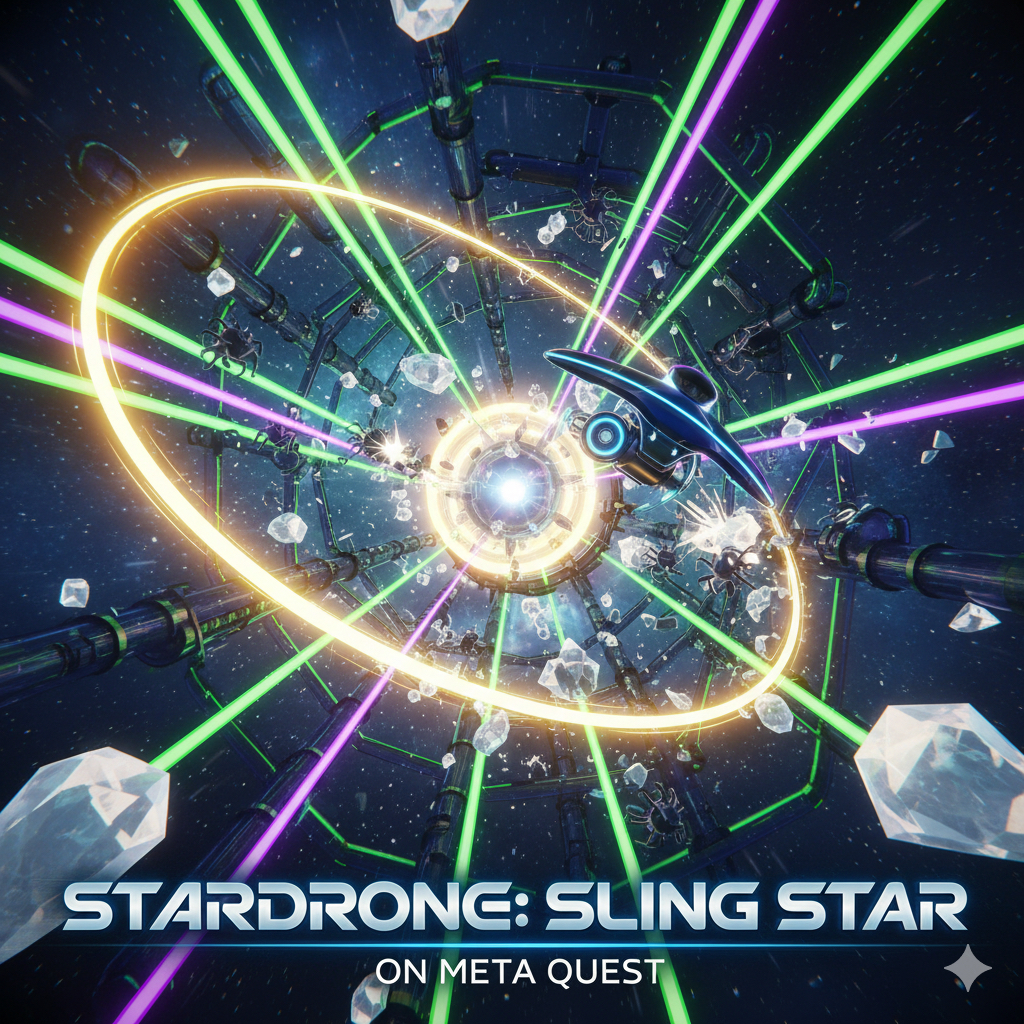
In the sprawling universe of VR shooters and action titles on Meta Quest, StarDrone: Sling Star stakes its claim as an arcade-style thrill ride with a twist: rather than simply pointing and shooting, the game places emphasis on kinetic traversal, momentum-driven movement, and the satisfying physics of “slingshotting” yourself across vibrant arenas to outmaneuver enemies. It’s an ambitious blend of twin-stick combat sensibilities, physics-oriented navigation, and quick-reaction chaos, wrapped in a colourful sci-fi aesthetic that works incredibly well within the Quest’s standalone capabilities.
After extensive play sessions across solo and co-op duels, StarDrone: Sling Star reveals itself as one of the more compulsively playable VR shooters on the platform — an action game with real presence that pushes beyond rote enemy waves and delivers moments of surprising strategic depth. While it isn’t without flaws — including a reliance on repetitious enemy patterns and a progression system that could use more breadth — the core loop is polished, dynamic, and consistently engaging.
Core Concept and Identity
At its heart, StarDrone: Sling Star is a VR action shooter rooted in two foundational pillars: combat and locomotion. Unlike many VR shooters that rely on static positioning or teleportation, this title emphasises dynamic motion through physics-based “slingshot” mechanics. You’re not just firing at enemies — you’re launching yourself across arenas, using momentum to reposition, dodge, and create offensive opportunities.
This focus on movement imbues the game with a kinetic identity that feels immediate and rewarding. Combat doesn’t unfold just through trigger pulls; it’s about where you are, how fast you’re moving, and how deftly you weave between shots and threats. The result is a tactile experience that feels distinctly different from button-mash shooters and more like a hybrid between twin-stick arcade action and physical VR traversal.
Travel and Physics: A Movement Highlight
Movement in StarDrone: Sling Star is where the game most proudly stands apart from its peers. Using the Sling mechanic — essentially grabbing, pulling, and releasing yourself toward a target — you find yourself darting, arcing, and navigating complex 3D space with surprising agility. Unlike teleportation, this feels like genuine motion: you feel the momentum, the pulls and pushes, and the satisfying release of launching into space.
It’s a mechanic with real physicality. Mastery isn’t instantaneous; it demands a sense of timing, spatial orientation, and anticipation. But once you’ve grasped the fundamentals, movement becomes a pleasure in itself — a rhythmic flow of launch, pivot, strafe, and fire that feels like surfing through combat. In many respects, this mechanic elevates exploration and combat alike, because your traversal is not an afterthought but a central strategy tool.
The Quest’s tracking and input systems handle this adeptly. Both Oculus Touch and hand movements translate into intentional action, giving the player a strong sense of embodied control over locomotion. While occasional tracking quirks occur (as they often do with freerange movement), they are rare and rarely expensive in terms of gameplay impact.
Combat Mechanics and Enemy Design
Combat in StarDrone: Sling Star is fast, colourful, and increasingly demanding. The game introduces enemy types in measured stages — basic drones early on, then agile stalkers, shielded units, and explosive bombers as you progress. Each enemy type forces adaptive tactics: some rush directly, others fire ranged attacks or require sustained focus to bring down.
The good news is that your arsenal keeps pace. Weapons range from rapid-fire lasers and homing shots to area-effect blasters and charged projectiles. Each holds its niche, and swapping between them mid-battle feels fluid thanks to intuitive weapon cycling and clearly differentiated feedback. Visually distinctive enemy designs and weapon effects help readability even when the screen becomes chaotic, which is crucial in a game where speed and clarity matter.
However, while enemy variety improves with progression, patterns can feel repetitive over extended runs. Later arenas introduce more aggressive spawn rates and faster pacing, but the core behaviours — dodge, shoot, repeat — remain consistent. For many players, this replicative structure is familiar arcade fun; for others seeking evolving enemy tactics or narrative stakes, it may feel a bit shallow over time.
Arenas, Level Design, and Progression
Arenas in StarDrone: Sling Star are compact but cleverly arranged. Verticality, obstacles, and launch points are integrated in ways that reward mastery of the Sling mechanic. Some stages feel like intricate puzzles where positioning and speed matter as much as accuracy. Walls, platforms, and environmental features are used intelligently to shape engagement flow rather than simply act as backdrop.
The sense of progression primarily stems from unlocking new arenas, tougher enemy combinations, and incremental weapon upgrades. Between rounds, you can invest earned currency into weapon performance, capacity, and special abilities. These upgrades incentivise repeat play and experimentation, though the overall progression arc could benefit from deeper customization or divergent skill trees that encourage distinct playstyles.
Multi-stage campaigns and escalating challenge modes help maintain momentum, but the absence of more robust narrative framing or emergent mission types (stealth, timed escapes, defensive holds) means the core loop always returns to combat arenas and waves. For players who relish pure action, this isn’t a detriment; for those craving narrative or mechanical variety, it’s a noticeable omission.
Multiplayer and Social Engagement
One of StarDrone: Sling Star’s strengths is its multiplayer mode. Co-op play introduces tactical synergy: players can coordinate movement paths, flank enemies, and share weapon types to maximise coverage. Versus modes, where supported, lean into competitive agility — a thrilling proposition when players sling through space trying to outmaneuver and outshoot one another.
Matchmaking is straightforward, though a more layered ranked system or seasonal event structure could enhance long-term engagement. The social element — gestures, callouts, cooperative launches — boosts replay value and turns familiar arenas into fresh theatre when played with others.
Presentation, Visuals, and Audio Design
Visually, StarDrone: Sling Star embraces a vibrant sci-fi aesthetic that remains readable during hectic play. Neon accents, bold enemy silhouettes, and clear environmental cues ensure that players never lose track of threats, goals, or spatial orientation. While not aiming for photorealism, the title’s artistic design complements kinetic gameplay and elevates immersion.
Audio plays a significant supporting role. Weapon fire, enemy cues, and ambient sound are spatially realised, giving valuable feedback during movement and combat. The soundtrack — pulsing, energetic, and textured — helps to sustain momentum without overwhelming player focus. Audio balance is well handled: sound cues guide attention without creating chaos in crowded scenes.
Accessibility and Comfort
StarDrone: Sling Star scores high on accessibility. Comfort options include adjustable movement sensitivity, snap or smooth turning, and adaptive locomotion, allowing players to tailor the experience to their tolerance for motion. These features matter because the Sling mechanic, while exhilarating, can induce discomfort in players new to free movement in VR. Providing adjustable comfort mitigations ensures the game is approachable to a broader audience.
Controls are intuitive for both VR veterans and newcomers. Tutorials are present without being obtrusive, and early levels serve as gentle onboarding to mechanics that grow naturally complex.
Final Verdict
StarDrone: Sling Star is a kinetic VR action title that embraces movement and momentum as central pillars of engagement. Its physics-driven traversal, responsive combat mechanics, and multiplayer support make it a standout experience on Meta Quest for players who relish fast, skill-based action. While its progression systems could benefit from more depth and its enemy variety from greater complexity, the core gameplay — slinging, shooting, and soaring through combat arenas — delivers consistent thrills.