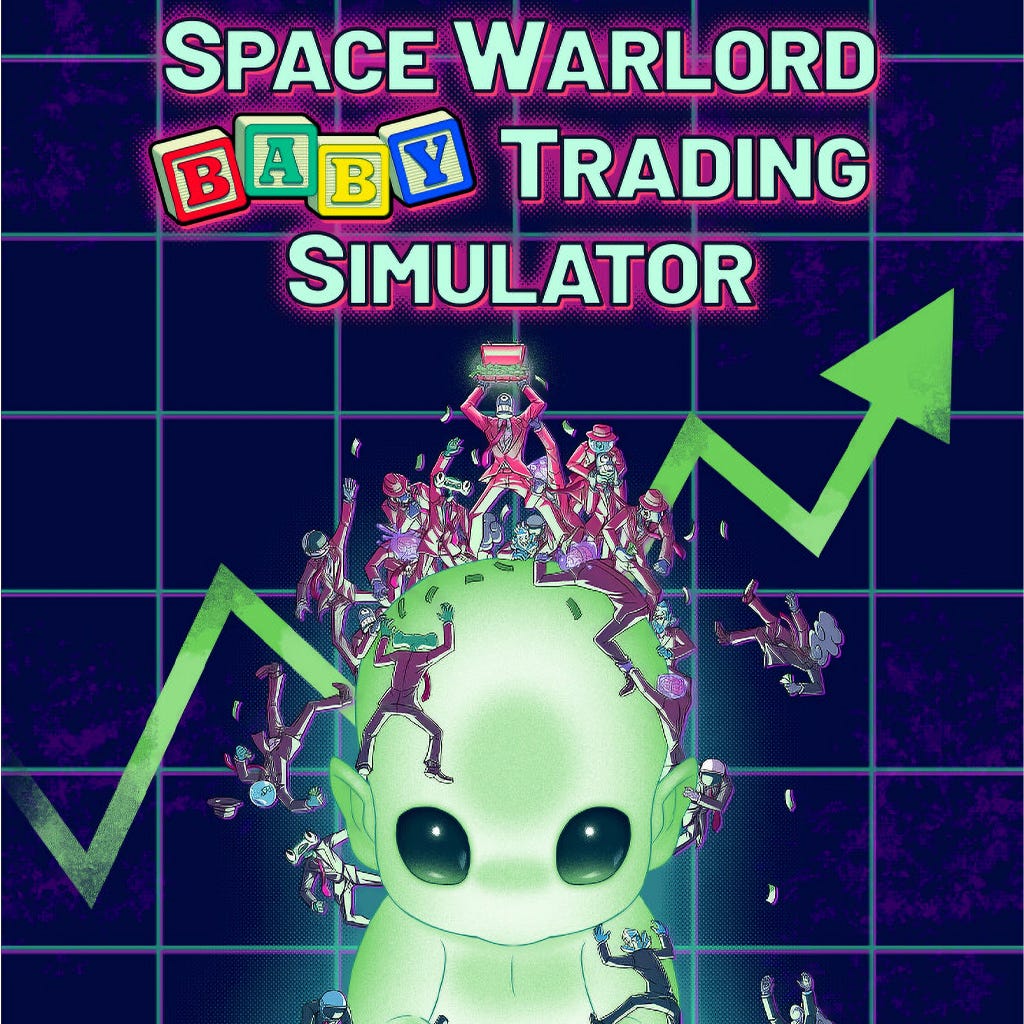
Some game titles clearly indicate the experience they offer. Then there is Space Warlord Baby Trading Simulator, which does that, but also challenges you to question why you expected anything normal. Created by Strange Scaffold and published by Frosty Pop, this satirical arcade stock market simulator takes place in the same absurd universe as Space Warlord Organ Trading Simulator. On the surface, it is a game about trading financial instruments linked to the lives of alien infants. However, beneath its deliberately provocative premise lies a deeper commentary on commodification, market volatility, and the grotesque rationale of markets.
The Xbox Series X|S “Complete Edition” combines the full PC release with post-launch updates, including Daily Challenge mode and several mini-campaign expansions. This results in a sharper, more polished version of an already chaotic concept—one that revels in speed, discomfort, and absurdity.
A Market Built on Moral Absurdity
At its core, Space Warlord Baby Trading Simulator isn’t really about babies, stocks, or even simulation. It is about systems—specifically, systems that convert living outcomes into numbers on a screen.
The premise is simple: you are a trader observing the simulated lives of alien children across the galaxy. Their futures fluctuate based on randomised events—success, tragedy, absurd cosmic interventions—and you place financial bets on those outcomes. Buy low, sell high. Or “short” their success if you believe misfortune is imminent.
The game emphasises, repeatedly and somewhat defensively, that you are not actually trading babies. You are trading data tied to their outcomes. This distinction is both a joke and a critique. The game recognises that it is asking you to participate in something ethically uncomfortable, and it uses that discomfort as fuel.
But once you accept the premise, the real game begins: speed, pattern recognition, and panic-driven decision-making.
Trading as Arcade Chaos
Unlike traditional financial simulators that emphasise realism or long-term strategy, this game operates like an arcade shooter disguised as a spreadsheet. Markets fluctuate rapidly. Information arrives in bursts. Decisions must be made instantly.
Each “Trading Rush” is a condensed cycle of speculation and reaction. You are not carefully analysing trends—you are gambling on incomplete data under time pressure. The outcome is more like an action game than a simulation, where reflexes are as important as logic.
This design choice works brilliantly. It turns abstract financial mechanics into something visceral. You’re constantly reacting, recalibrating, and second-guessing. Even success feels a bit accidental, which is probably the point.
It isn’t about mastering the market. It’s about surviving it.
Consultants, Chaos, and Controlled Exploitation
One of the more intriguing mechanical layers stems from the “consultant” system. Throughout runs, players can buy the services of peculiar advisors who offer partial insights into baby life trajectories. These range from probability adjustments to explicit narrative hints about upcoming events.
However, none of this information can be fully trusted. Consultants lessen uncertainty but never eliminate it. This ensures that even well-informed decisions carry a layer of risk.
This system emphasises the game’s core theme: knowledge does not equate to control. You are always operating with incomplete information, regardless of how much you invest.
It also introduces a subtle deck-building element to progression. Over time, your trading style becomes shaped by the consultants you prefer, creating emergent strategies that differ between runs.
Structure and Campaign Design
The Xbox “Complete Edition” features multiple mini-campaigns, each with slightly different rule sets, market conditions, and narrative framing. These campaigns help prevent the experience from becoming too repetitive, at least in the short term.
Some campaigns focus on high-volatility markets where fortunes can change rapidly within seconds. Others highlight slower, more deliberate decision-making with longer-term results. The Daily Challenge mode adds extra replayability, encouraging players to engage with constrained scenarios that test adaptability rather than mastery.
However, despite this variety, the fundamental loop remains the same. You are still monitoring graphs, reacting to events, and making quick buy/sell decisions. The framing shifts more than the mechanics.
Presentation: Minimalism with Intentional Unease
Visually, the game adopts stark minimalism. Interfaces dominate the screen, with alien life data depicted through clean yet unsettling UI elements. There is little attempt to humanise the subjects of your speculation, which itself acts as a design statement.
The absence of emotional framing creates distance. You are not meant to empathise with the babies—or their alien counterparts—you are meant to observe them as statistical fluctuations. This detachment is uncomfortable and deliberately so.
Sound design reinforces this atmosphere with glitchy interface effects, sudden notification cues, and occasional surreal audio stingers that break the otherwise sterile presentation. It cultivates a sense of controlled instability, as if the game itself is subtly malfunctioning under the weight of its own premise.
Comedy, Critique, and Discomfort
Discussing Space Warlord Baby Trading Simulator without considering its tone is impossible. The game exists in a space between satire and absurdist comedy, constantly balancing critique and provocation.
On one hand, it clearly mocks the detachment of financial systems that reduce human outcomes to abstractions. On the other, it simply revels in the chaos of its own concept. The humour is dark, quick, and often intentionally unsettling.
This duality won’t appeal to everyone. Some players may find the premise tiring or too self-aware. Others will value its willingness to dwell in discomfort without offering resolution.
What it definitely avoids is moral preaching. The game does not instruct you on what to think. It merely presents the system and invites you to engage with it.
Performance and Console Adaptation
On Xbox Series X|S, the game runs smoothly, with quick transitions between trading phases and minimal load times. The UI has been effectively adapted for controller input, although the overall design still feels inherently mouse-and-keyboard in its approach.
Menus are dense but easy to read, and once familiar, navigation becomes instinctive. The gameplay pace benefits from the responsiveness of console hardware, especially during high-intensity Trading Rush segments.
Final Verdict
Space Warlord Baby Trading Simulator is not a traditional simulation game, nor is it a straightforward satire. It is an arcade experiment wrapped in financial mechanics and ethical discomfort, designed to make players engage with systems of abstraction at a rapid pace.
Its strength lies in its pacing and its willingness to turn cold systems into chaotic play. Its weakness lies in repetition and the limits of its mechanical variation. But even when its novelty begins to fade, its central idea remains compelling.
It is a game about making decisions within a system that reduces everything—life included—to numbers. And it never lets you forget how strange that really is.