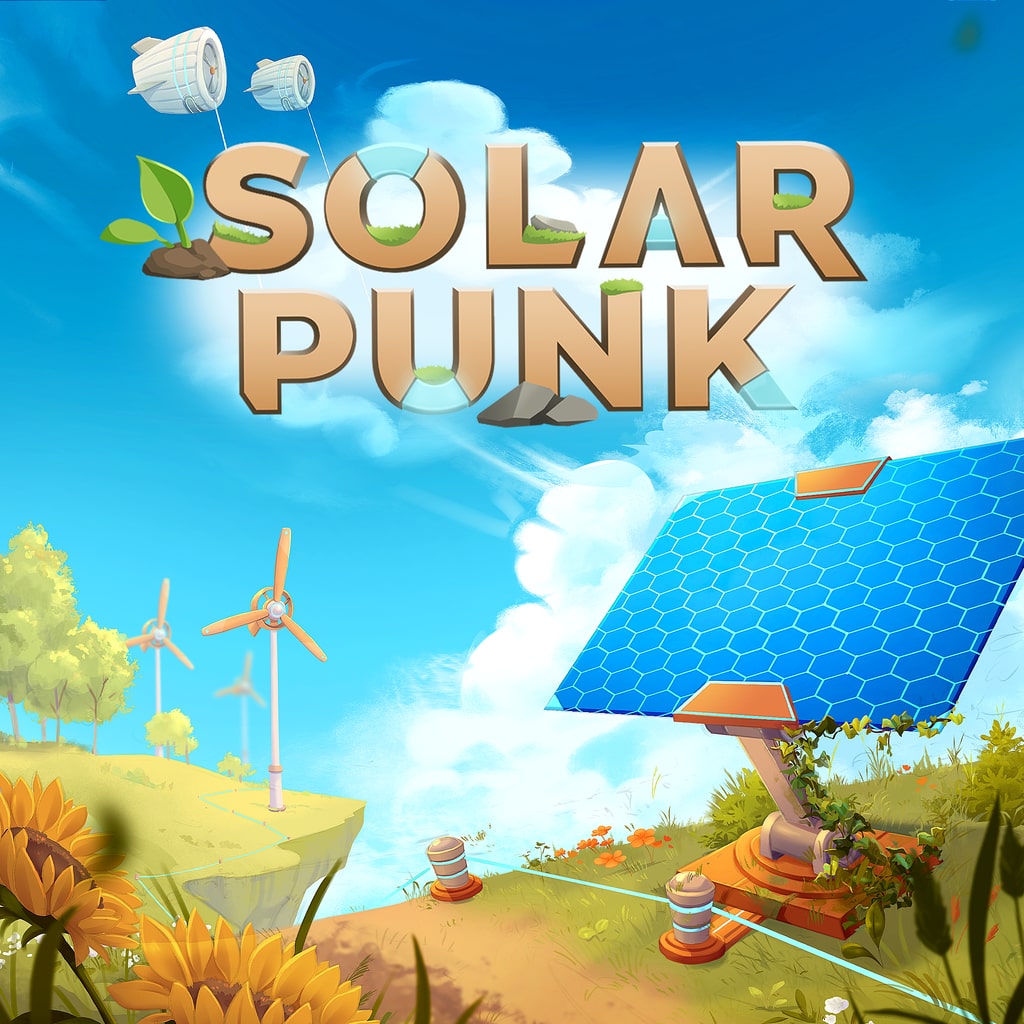
For years, survival games have followed a familiar formula. You wake in a hostile world, punch trees, battle hunger, fend off increasingly dangerous enemies, and slowly transform a ramshackle shelter into a sprawling fortress. It is a formula that works, but after countless variations, it can feel predictable. Solarpunk arrives with a very different philosophy.
Developed by a tiny two-person team, this skybound crafting adventure asks a simple question: what if survival wasn’t about overcoming nature but about living alongside it? Rather than placing players in a constant struggle against their environment, Solarpunk presents a future where technology and ecology work hand in hand. The result is one of the most relaxing survival sandboxes in recent memory.
Set among a breathtaking collection of floating islands suspended high above the clouds, Solarpunk invites players to build, farm, automate, and explore at their own pace. There are no monsters waiting to tear down your base in the middle of the night. No looming apocalypse demanding your attention. No punishing survival meters threatening disaster every few minutes. Instead, there is simply a beautiful world and the freedom to make something of it.
Building a Home in the Sky
The heart of Solarpunk lies in creation. From the moment you gather your first resources, the game encourages experimentation and self-expression. Building tools are intuitive and flexible, allowing players to create everything from modest cottages to sprawling multi-level compounds suspended above the clouds.
What makes the building system particularly appealing is the sheer freedom to decorate. Furniture, ornaments, lighting, plants, pathways, and structural pieces offer plenty of opportunities to personalise your floating sanctuary. It quickly becomes clear that Solarpunk is less concerned with efficiency than many sandbox games and more focused on helping players create spaces that feel genuinely lived in.
Hours can disappear while tweaking a rooftop garden, adjusting a workshop layout, or adding small decorative touches to a balcony overlooking the endless sky. Few games understand the appeal of cosy construction quite as well as this one.
The visual design certainly helps. Floating islands drift peacefully through rolling cloudscapes, while warm sunlight illuminates wooden structures and vibrant greenery. There is a softness to the presentation that perfectly complements the game’s relaxed tone.
Powering the Future
While construction forms the backbone of the experience, Solarpunk’s most distinctive feature is its renewable energy system. Rather than relying on traditional crafting-game logic, where machines simply function forever once placed, every automated process requires energy. Wind turbines spin gently in the breeze. Solar panels collect sunlight throughout the day. Batteries store excess power for later use.
What sounds simple on paper gradually becomes an engaging layer of resource management. Weather conditions directly influence energy production. A bright, sunny day may flood your network with excess power, while overcast conditions can considerably reduce efficiency. Wind patterns also affect output, forcing players to think carefully about how their infrastructure is arranged.
The system strikes a satisfying balance between accessibility and depth. It never becomes overwhelming, yet there is genuine satisfaction in watching a carefully planned energy network power an increasingly sophisticated home base. More importantly, it reinforces the game’s central themes. Progress is achieved through sustainability rather than exploitation, making every successful automation project feel aligned with the world’s optimistic vision.
Farming Without Exploitation
Another area where Solarpunk distinguishes itself from its peers is its approach to animals and agriculture. Most farming games inevitably treat animals as resources. Whether through harvesting products or processing livestock, creatures often exist to serve production chains. Solarpunk rejects that mindset entirely.
Animals are companions within the ecosystem rather than commodities. Pigs help uncover valuable truffles when treated well. Wildlife roams freely throughout the environment. The emphasis is always on cooperation rather than ownership.
Meanwhile, crop farming becomes the primary source of food and progression. Planting, tending, and harvesting crops follow familiar mechanics, but the emphasis on coexistence creates a surprisingly refreshing atmosphere. It is a subtle difference, yet one that contributes significantly to the game’s unique identity. In a gaming landscape often focused on extraction and conquest, Solarpunk’s gentler worldview feels genuinely distinctive.
Automation That Respects Your Time
One of the smartest design decisions is how the game handles automation. Many crafting sandboxes eventually bog down in repetitive busywork. Gathering resources manually, transporting materials, and maintaining large farms can gradually turn enjoyable systems into chores.
Solarpunk addresses this issue with transport drones and automated infrastructure. Once established, these systems can gather resources, manage crop maintenance, and handle routine tasks with minimal player involvement. Rather than removing gameplay, automation creates opportunities for players to focus on more creative pursuits.
The progression feels natural and rewarding. Early on, the focus is on learning the basics and gathering materials manually. Later, as your systems expand, your role gradually shifts from labourer to designer and planner.
Watching a network of drones quietly perform tasks while your renewable energy grid hums in the background is oddly satisfying. It creates the feeling that your floating community is truly alive.
Taking to the Skies
Of course, no game built around floating islands would be complete without exploration. Thankfully, Solarpunk’s airships are every bit as enjoyable as they sound.
Each player can build their own flying vessel and use it to travel between islands, searching for resources, discovering new locations, and expanding their horizons. There is a genuine sense of adventure on every journey, particularly in the early hours, when the world still feels full of mystery.
Flying through cloud banks towards a distant island never loses its charm. The combination of peaceful exploration and gorgeous scenery creates some of the game’s most memorable moments. The sense of scale may not rival that of massive open-world adventures, but the handcrafted nature of the islands helps every destination feel purposeful.
The Missing Sense of Direction
For all its strengths, Solarpunk will not appeal to everyone. The biggest obstacle for some players will be the complete absence of a traditional narrative. There are no major storylines, dramatic quests, or memorable characters to guide the experience. Beyond a handful of basic objectives and progression systems, the game leaves players largely to their own devices.
For creative sandbox enthusiasts, this freedom is a major advantage. For players who prefer clear goals and structured progression, however, the experience may eventually feel aimless.
The multiplayer inventory system can also create occasional friction. Because players maintain separate inventories, collaborative building projects sometimes require more item management than expected. It is hardly a major issue, but it can slightly disrupt the otherwise smooth cooperative flow.
There are also moments when the game’s small-team origins become visible. While generally polished, some systems lack the depth and refinement found in larger sandbox productions. None of these shortcomings are severe, but they are noticeable.
Final Verdict
Solarpunk is a rare game that feels genuinely optimistic. In a medium crowded with post-apocalyptic wastelands, endless conflict, and survival through domination, it presents a future built on cooperation, sustainability, and creativity. That vision alone makes it stand out.
Its beautiful floating islands, satisfying automation systems, and wonderfully relaxed atmosphere create a sandbox that is easy to lose yourself in for hours. The lack of narrative direction may leave some players wanting more structure, but those willing to embrace its open-ended nature will find a deeply rewarding and refreshingly peaceful experience.
Sometimes a game does not need to challenge your reflexes or test your endurance. Sometimes it simply needs to provide a place you enjoy spending time in. Solarpunk succeeds brilliantly at doing exactly that.