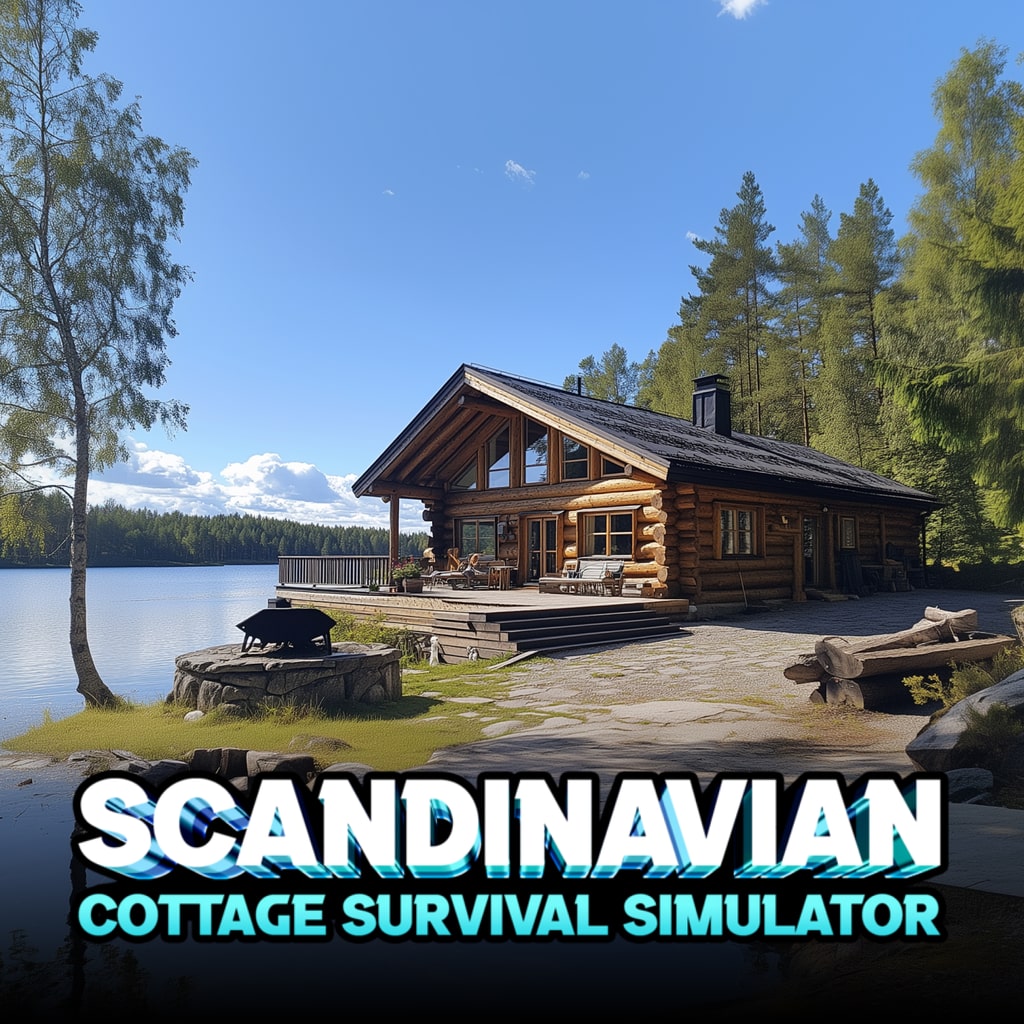
Scandinavian Cottage Survival Simulator is a game defined by stillness. Where many survival titles rely on constant threats, escalating danger, and aggressive pacing, this experience instead focuses on isolation, routine, and the slow, methodical challenge of enduring nature on its own terms. Set in a remote Nordic landscape, the game casts players as a lone inhabitant of a modest wooden cottage, tasked with surviving harsh weather, managing limited resources, and maintaining a fragile balance between comfort and necessity.
It is a deliberately restrained survival simulator, and while that restraint gives the game a distinctive identity, it also exposes the limits of its systems when examined over longer play sessions.
Survival as Lifestyle, Not Crisis
From the outset, Scandinavian Cottage Survival Simulator establishes a tone that is markedly different from mainstream survival games. There are no monsters, no hostile factions, and no dramatic narrative arc pushing the player forward. Instead, the threat is environmental and gradual. Cold, hunger, fatigue, and neglect are the true adversaries, and they manifest slowly rather than explosively.
This framing transforms survival into a lifestyle simulation. Daily tasks — chopping wood, cooking meals, repairing tools, maintaining warmth — form the backbone of play. Success is not measured by conquest or progression milestones, but by continuity: another day endured, another storm weathered.
This approach will resonate strongly with players who enjoy realism-driven simulation and meditative gameplay. However, it also means that tension is subtle and cumulative, rather than immediate. Scandinavian Cottage Survival Simulator asks players to appreciate small victories rather than dramatic triumphs.
Core Gameplay Systems and Resource Management
At its mechanical core, Scandinavian Cottage Survival Simulator revolves around resource management and environmental awareness. Players must gather firewood, manage food supplies, monitor body temperature, and maintain the structural integrity of their cottage. These systems are interconnected in logical ways. Neglect one, and others begin to suffer.
The game excels at communicating cause and effect. Forget to restock firewood, and the cottage grows cold. Ignore nutrition, and stamina suffers. These consequences unfold predictably, reinforcing immersion and encouraging thoughtful planning.
However, the systems themselves are relatively shallow. Once players understand optimal routines — when to gather resources, how to prepare for weather changes, how to prioritise tasks — the challenge becomes one of maintenance rather than adaptation. There are few surprises, and little systemic escalation to disrupt established habits.
This design supports the game’s realism but limits long-term engagement. Survival becomes less about problem-solving and more about repetition.
Environmental Design and Atmosphere
Atmosphere is Scandinavian Cottage Survival Simulator’s greatest strength. The Nordic environment is quiet, expansive, and often beautiful in its austerity. Snow-covered forests, frozen lakes, and muted skies create a powerful sense of isolation. The world feels indifferent rather than hostile, reinforcing the theme that survival is not about fighting nature, but respecting it.
Weather plays a central role. Snowstorms reduce visibility, cold snaps force players indoors, and changing seasons subtly alter routines. These elements are not dramatic set pieces, but persistent conditions that shape daily decisions. The result is an environment that feels alive without being reactive in overt ways.
Visually, the game is functional rather than detailed. Textures are serviceable, lighting is subdued, and environmental variety is limited. While this supports performance and clarity, it also prevents the world from feeling richly detailed. Over time, the environment risks blending into a single aesthetic note.
Cottage Management and Player Agency
The cottage itself serves as both sanctuary and responsibility. Players must maintain heating, repair damage, and occasionally upgrade facilities to improve efficiency. These upgrades are modest, focusing on quality-of-life improvements rather than transformative changes.
This restraint reinforces the game’s grounded tone. The cottage never becomes a fortress or a hub of automation. It remains a small, fragile space that demands attention. However, the lack of meaningful expansion options also limits player expression. Customisation exists, but it is largely cosmetic or incremental.
Player agency is defined by routine rather than choice. There are few divergent paths or playstyles. All players will eventually converge on similar strategies for survival, reducing replayability and experimentation.
Pacing and Longevity
Scandinavian Cottage Survival Simulator is paced deliberately slowly. Time passes at a steady rate, and progress is measured in subtle improvements rather than dramatic milestones. This pacing supports immersion but requires patience.
In short sessions, the game is absorbing and atmospheric. In longer sessions, repetition becomes increasingly apparent. Without new mechanics, narrative developments, or systemic surprises, the experience can feel static. The game’s commitment to realism ultimately limits its ability to evolve meaningfully.
There is no clear end state or victory condition, which suits the simulation ethos but leaves some players without a sense of closure or achievement.
Audio Design and Immersion
Audio design plays a significant role in shaping the experience. Ambient sounds — wind through trees, creaking wood, distant wildlife — reinforce isolation and environmental presence. The absence of constant music allows silence to dominate, making the world feel vast and empty.
When music does appear, it is subtle and melancholic, reinforcing the game’s reflective tone. Sound effects are understated but effective, providing tactile feedback for actions without drawing attention to themselves.
This restrained audio approach enhances immersion, though it may feel sparse to players accustomed to more dynamic soundscapes.
Accessibility and Audience Fit
Scandinavian Cottage Survival Simulator is mechanically accessible. Controls are straightforward, systems are logical, and failure states are gradual rather than punitive. This makes the game approachable even for players new to survival simulations.
However, its true barrier is experiential. The game demands patience, tolerance for repetition, and an appreciation for quiet routine. Players seeking excitement, narrative payoff, or mechanical variety will likely struggle to remain engaged.
This is a niche experience, designed for players who value atmosphere and realism over challenge or spectacle.
Final Verdict
Scandinavian Cottage Survival Simulator is a contemplative survival experience that finds its strength in mood, restraint, and environmental immersion. It offers a rare take on the genre, framing survival as a slow, solitary process rather than a constant battle. In doing so, it delivers moments of genuine tranquility and satisfaction, particularly for players drawn to realism-driven simulation.
However, its limited mechanical depth, lack of escalation, and repetitive routines prevent it from sustaining engagement over extended play. Once optimal strategies are established, the experience risks becoming maintenance rather than survival.
For the right audience, Scandinavian Cottage Survival Simulator offers a uniquely calming and immersive escape. For others, it may feel sparse and underdeveloped.
A quiet, atmospheric survival simulator that excels in immersion and tone, but whose shallow systems and limited variety restrict its long-term appeal.